
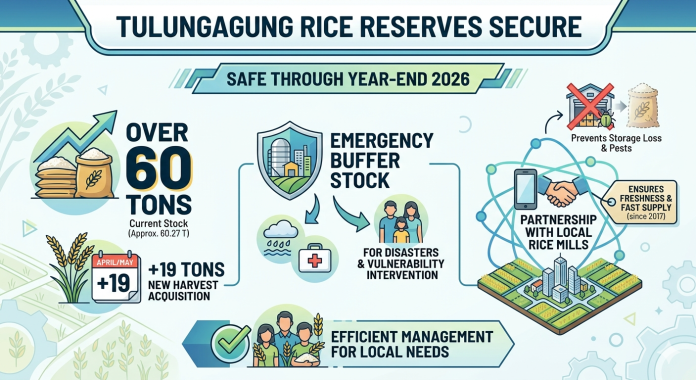

TULUNGAGUNG – Tulungagung authorities say regional rice reserves remain secure through the end of 2026, with current food stocks already exceeding most annual emergency needs.
The local government has prepared regional food reserves to anticipate price instability, natural disasters, and urgent social assistance needs. Officials said the reserve currently holds 60.27 tons of rice.
Dinas Ketahanan Pangan Tulungagung distribution and food reserve official Hari Pujianto said the stock will increase again during the main harvest season.
“Our current stock stands at 60.27 tons. We plan another procurement of around 19 tons in April or May during the main harvest,” he said.
That addition would raise total rice reserves to about 79 tons. Officials believe the figure will fully cover emergency needs across the district next year.
Hari said the amount already exceeds the annual target set by the regional government, which stands at 70 tons. The reserve functions as buffer stock and is not intended for regular daily distribution.
He explained that authorities only use the rice during emergencies. These include floods, landslides, food insecurity, and support for people living in extreme poverty.
“This reserve is specifically prepared for emergency situations such as floods, landslides, or extreme poverty response,” he said.
The district no longer stores rice directly in government warehouses. Officials changed the system to avoid quality loss, shrinkage, and pest damage.
Since 2017, the government has worked with local rice mills to manage reserve supplies. Under this system, partners maintain stock and deliver fresh rice when authorities request it.
“In the past, direct storage often caused losses because of pests or reduced quality. Now we cooperate with local rice mills,” Hari said.
The agreement requires rice mills to provide fresh rice quickly whenever the district needs emergency supply. Officials say this method also makes food reserve management more flexible.
With sufficient stock and faster distribution, Tulungagung expects to meet emergency food demand without relying on supply from outside the region.