
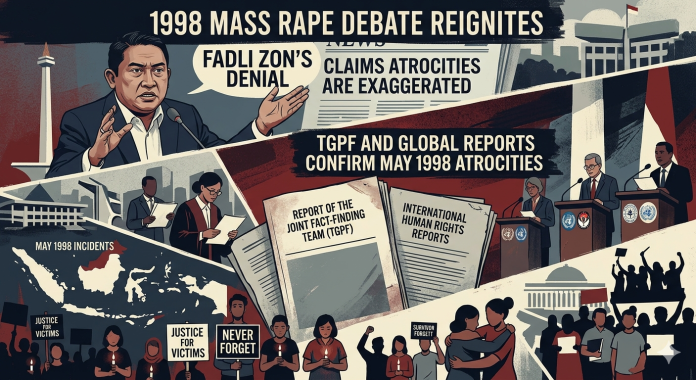

RADAR TULUNGAGUNG – The controversy surrounding the 1998 mass rape resurfaced after Indonesia’s Minister of Culture, Fadli Zon, publicly questioned whether such atrocities ever occurred during the May 1998 riots. His statement quickly sparked nationwide debate, drawing sharp criticism from human rights groups and reigniting painful memories of one of Indonesia’s darkest chapters.
In an interview on June 11, 2025, Fadli Zon claimed there was no solid evidence of sexual violence, including mass rape, during the May 1998 unrest. He described the allegations as unproven narratives that were never formally documented in history books. The statement immediately triggered backlash, particularly from Komnas Perempuan, which called the remarks deeply hurtful to survivors.
TGPF Findings Contradict the Denial
Five days after the controversy, Fadli Zon issued a clarification, emphasizing that different perspectives exist regarding the 1998 tragedy. However, his claims stand in contrast to the findings of the Joint Fact-Finding Team (TGPF), established by President B.J. Habibie in July 1998.
After conducting investigations for approximately three months, the TGPF released its final report on October 23, 1998. The report documented evidence of sexual violence in several cities, including Jakarta, Medan, and Surabaya. In total, the team recorded 85 cases of sexual crimes during the riots.
These cases were categorized into four types: rape, rape accompanied by physical assault, sexual assault, and sexual harassment. The report detailed 52 rape victims, 14 victims of rape with violence, 10 cases of sexual assault, and 9 instances of harassment.
The findings were based on testimonies from victims, families, eyewitnesses, as well as professionals such as doctors, psychologists, and counselors. This comprehensive documentation directly contradicts claims that the 1998 mass rape is merely a rumor.
Evidence of Systematic Violence
One of the most alarming conclusions from the TGPF report was the pattern of gang assaults. Many victims were attacked by multiple perpetrators, often in public or semi-public spaces. This indicates that the violence was not random but carried out in an organized and systematic manner.
The report also highlighted that ethnic Chinese women were specifically targeted during the riots. At the time, the community faced widespread discrimination and was often blamed amid the economic crisis. Survivors’ testimonies revealed that attackers frequently identified victims based on physical appearance, suggesting intentional targeting.
International organizations further strengthened these findings. Reports from Human Rights Watch, Amnesty International, and the U.S. Department of State documented similar patterns of violence, confirming that the 1998 mass rape was part of broader human rights violations.
Official Recognition Strengthens the Facts
The Indonesian government has also acknowledged these events. President B.J. Habibie formally recognized the findings of the TGPF and condemned the violence in his address to parliament on August 15, 1998. He described the acts as disgraceful and damaging to the nation’s dignity.
More recently, in 2023, President Joko Widodo officially recognized the May 1998 riots as one of 12 gross human rights violations in Indonesia’s history. This acknowledgment further reinforces the credibility of reports confirming the occurrence of the 1998 mass rape.
The Case That Shook the Nation
The case of Ita Martadinata Haryono remains one of the most tragic symbols of the May 1998 events. A young Chinese-Indonesian student, Ita was preparing to testify before the United Nations about the violence she experienced.
However, just days before her scheduled departure, she was found dead in her home on October 9, 1998. Reports indicated that activists and witnesses had previously received threats, raising suspicions about the circumstances of her death.
Although authorities classified the case as a common crime, many observers questioned the conclusion. Ita’s death became a stark reminder of the risks faced by survivors and activists who attempted to reveal the truth behind the 1998 mass rape.
Why Acknowledging History Matters
The renewed controversy highlights the importance of recognizing historical facts. Evidence from the TGPF, supported by international investigations and official government acknowledgment, indicates that the May 1998 violence was not a baseless claim but a documented reality.
Understanding these events is essential not only for justice but also to prevent similar tragedies in the future. As Indonesia continues to revisit its historical narrative, acknowledging the truth remains a crucial step toward accountability and reconciliation.