
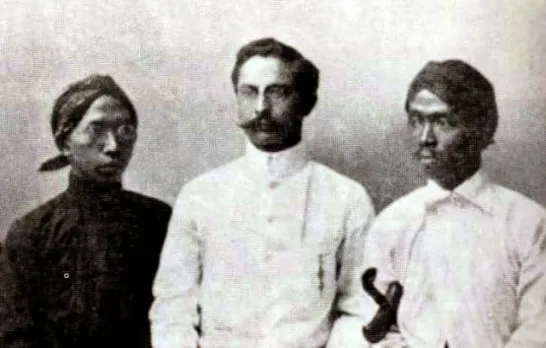

RADAR TULUNGAGUNG – The story of the Tiga Serangkai Indonesian nationalist trio remains one of the most powerful narratives in Indonesia’s journey toward independence. Comprised of Ernest Douwes Dekker, Cipto Mangunkusumo, and Ki Hajar Dewantara, this trio played a crucial role in shaping early nationalist thought and resistance against Dutch colonialism.
Emerging from diverse backgrounds, the three figures united under a shared vision: a free and sovereign Indonesia. Their ideas, activism, and bold criticism of colonial policies ignited national awareness during a time when oppression and discrimination were deeply entrenched in society.
Early Roots of Resistance
Ernest Douwes Dekker, also known as Danudirja Setiabudi, began his journey not as a politician but as a witness to injustice. While working on plantations in East Java, he saw firsthand the exploitation of indigenous workers. These experiences shaped his worldview and later influenced his sharp critiques of colonial policies through journalism.
Meanwhile, Cipto Mangunkusumo, a physician educated at STOVIA, developed a reputation as a fierce critic of social inequality. He openly challenged racial discrimination, unequal wages, and the rigid social hierarchy imposed by the Dutch. His writings and actions often placed him at odds with authorities, yet he refused to compromise his principles.
Ki Hajar Dewantara, born into Javanese nobility, took a different path. Initially active in journalism and politics, he used his writing skills to communicate anti-colonial ideas in a way that resonated with the broader public. His famous article, Als Ik Een Nederlander Was (“If I Were a Dutchman”), sharply criticized the hypocrisy of colonial celebrations funded by the colonized.
Formation of Indische Partij
The collaboration between the three figures reached its peak with the establishment of the Indische Partij in 1912. This political organization stood out as the first to promote inclusive nationalism, advocating unity across ethnic and racial lines, Indo-Europeans, natives, and other groups.
The party quickly gained traction, attracting thousands of members across the Dutch East Indies. It promoted the idea that the Indies belonged to all its inhabitants, not just the Dutch elite. However, its progressive stance also made it a threat to colonial власти.
The Dutch government responded swiftly. Applications for legal recognition were repeatedly rejected, and the party was eventually banned. Despite its short lifespan, the Indische Partij laid the foundation for future nationalist movements.
Exile and Continued Struggle
Following their activism and provocative writings, the Tiga Serangkai faced severe consequences. In 1913, all three were exiled to the Netherlands. Rather than silencing them, exile expanded their influence.
In Europe, they continued their political work through publications and organizations, influencing Indonesian students abroad. Their ideas contributed to the transformation of student groups into politically conscious movements advocating independence.
Diverging Paths After Exile
Upon returning to the Indies, each member of the trio pursued different approaches to continue the struggle.
Cipto Mangunkusumo remained active in politics and became increasingly radical. His relentless criticism of colonial власти led to repeated arrests and eventual exile to remote regions, where his health deteriorated. He died in 1943, before witnessing independence.
Ki Hajar Dewantara shifted his focus to education. In 1922, he founded Taman Siswa, a school system aimed at empowering indigenous Indonesians through education. His philosophy emphasized independence, character building, and cultural identity, earning him recognition as the Father of Indonesian Education.
Ernest Douwes Dekker returned to journalism and later entered politics. Despite facing imprisonment and exile again, he remained committed to the nationalist cause. After independence, he briefly served in the Indonesian government before passing away in 1950.
Lasting Legacy
The Tiga Serangkai Indonesian nationalist trio left a profound legacy that extended beyond their lifetimes. Their ideas of unity, equality, and independence inspired later movements and leaders, including the rise of modern Indonesian nationalism.
Their courage in confronting colonial власти, despite imprisonment and exile, marked them as pioneers of Indonesia’s independence movement. Today, their contributions continue to be remembered as a cornerstone of the nation’s history.