
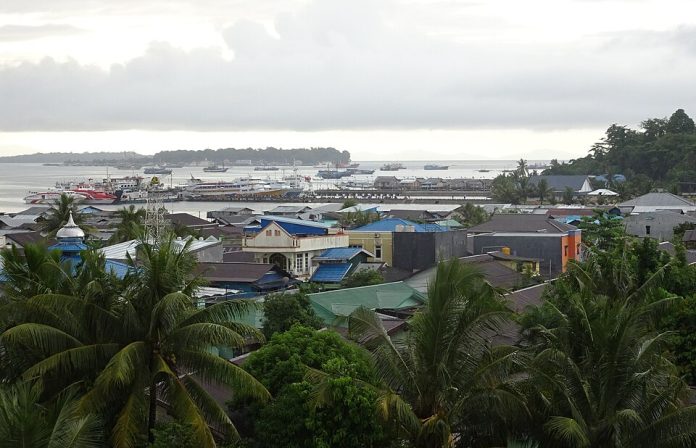

RADAR TULUNGAGUNG – The story behind the Sorong City origins remains one of the most intriguing historical discussions in eastern Indonesia. As the capital of Southwest Papua Province and the main gateway to Raja Ampat, Sorong has developed into a strategic economic and tourism hub, yet questions about the origin of its name continue to spark debate among historians and local communities.
Several theories attempt to explain how the city acquired the name “Sorong.” One popular account links the name to the Dutch colonial-era oil industry that helped transform the region into a major petroleum center during the early twentieth century. Another explanation traces the name to indigenous linguistic traditions that predate colonial influence by centuries.
Historical evidence suggests the strongest explanation comes from the Biak language, where the word “Soren” refers to a deep and wavy sea. Over time, interactions among local communities, traders, missionaries, and migrants are believed to have altered the pronunciation, eventually producing the modern name Sorong that is now recognized as the administrative and commercial center of Southwest Papua.
The Origins of the Name Sorong
The most widely documented account traces the name Sorong to the Biak word “Soren,” which refers to a deep and wavy sea. Historical sources state that Biak seafarers who migrated and traded across the islands of the Bird’s Head region and Raja Ampat used the term to describe the coastal waters around what is now Sorong. Over time, interactions with traders, missionaries, and migrants from Maluku, Sangihe, and other regions gradually transformed the pronunciation from “Soren” into “Sorong.”
A second theory, frequently repeated in popular accounts, claims that the name originated from a Dutch oil company or an abbreviation linked to petroleum exploration activities. However, available historical references do not support this explanation as strongly as the Biak-language origin. Historians generally recognize the “Soren” etymology as the most credible account of the city’s name.
Long before modern administrative boundaries emerged, the area formed part of the broader sphere of influence of the Sultanate of Tidore. Tidore established political relationships across parts of present-day Papua and recognized local rulers in the Raja Ampat region, helping shape the area’s early governance structures.
From Oil Town to Provincial Capital
Sorong’s modern development accelerated during the Dutch colonial period when petroleum exploration expanded in the region. The city earned the nickname “oil city” because of its strategic role in supporting oil production and logistics activities.
Administrative reforms later transformed Sorong from a district center into a major urban municipality. The Indonesian government established Sorong Administrative City through Government Regulation No. 31 of 1996. Three years later, Law No. 45 of 1999 elevated the area into an autonomous city, formally separating it from Sorong Regency and creating the administrative structure that exists today.
The city’s importance increased further after the establishment of Southwest Papua Province in 2022, with Sorong designated as the provincial capital. Today, it functions as a transportation hub, commercial center, and the primary entry point for visitors traveling to Raja Ampat, one of the world’s most renowned marine tourism destinations.
Tourism Growth and Regional Significance
Beyond its historical role, Sorong has become a growing tourism center. Its coastal location provides access to beaches, mangrove ecosystems, nearby islands, and marine biodiversity that attract domestic and international travelers.
The city also benefits from its proximity to Raja Ampat, whose coral reef ecosystems rank among the richest on Earth. As a result, Sorong has developed into a key transit hub for diving, ecotourism, and nature-based travel across eastern Indonesia.
Local authorities continue to promote tourism infrastructure while balancing conservation efforts. The city’s expanding transportation network and strategic geographic position have strengthened its role as one of Papua’s most important economic gateways.
The history of Sorong City origins reflects both indigenous cultural heritage and centuries of regional interaction. While alternative explanations remain popular, historical evidence points most strongly to the Biak word “Soren” as the source of the city’s name. From a coastal settlement linked to Raja Ampat to the capital of Southwest Papua, Sorong continues to play a central role in the development of eastern Indonesia.