
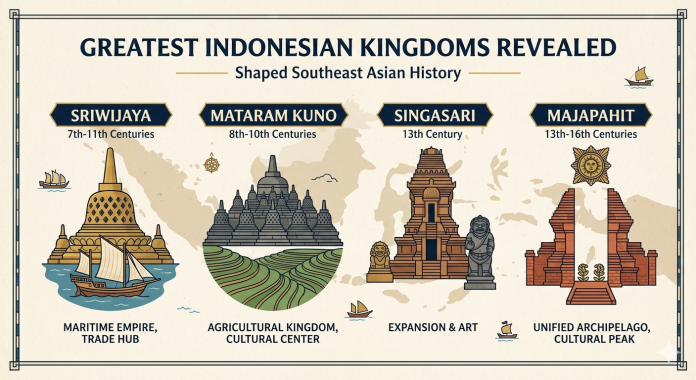

RADAR TULUNGAGUNG – The greatest Indonesian kingdoms once transformed the archipelago into one of Asia’s most influential centers of trade, culture, and political power. Long before the emergence of modern Indonesia, powerful states controlled strategic maritime routes, built monumental architecture, and established diplomatic ties that extended far beyond Southeast Asia.
Among the many kingdoms that flourished across the archipelago, four stand out for their extraordinary influence: Sriwijaya, Mataram Kuno, Singasari, and Majapahit. These kingdoms not only dominated vast territories but also shaped regional commerce, religion, governance, and cultural development for centuries.
Historical records, inscriptions, and foreign accounts reveal how each of these kingdoms rose to prominence through different strengths. Sriwijaya mastered maritime trade, Mataram Kuno left behind monumental temples, Singasari pursued ambitious expansion across Nusantara, and Majapahit built one of the largest spheres of influence in Southeast Asian history. Together, they represent some of the most significant chapters in Indonesia’s pre-colonial past.
Sriwijaya and Its Control of Asia’s Strategic Maritime Routes
The Kingdom of Sriwijaya emerged around the seventh century and developed into one of the most influential maritime powers in Southeast Asia. Centered in present-day Palembang, South Sumatra, Sriwijaya controlled critical shipping lanes through the Malacca Strait and Sunda Strait, making it a key intermediary in trade between China, India, and the Middle East.
Historical records from the Chinese Buddhist monk I-Tsing (Yijing), who visited Sriwijaya between 671 and 695 CE, describe the kingdom as a major center of Mahayana Buddhist learning. He recommended that monks traveling to India study in Sriwijaya before continuing their journey.
At its height, Sriwijaya exercised authority over large portions of eastern Sumatra, the Malay Peninsula, and several strategic coastal regions. Its wealth stemmed from maritime trade, port administration, and taxes levied on passing merchant vessels.
However, Sriwijaya’s dominance began to weaken after attacks by the Chola Empire of southern India under Rajendra Chola I in 1025 CE. Although the kingdom survived, its influence gradually declined. By the late 13th century, the Pamalayu Expedition launched by Singasari further shifted power dynamics in Sumatra, and Sriwijaya eventually disappeared from the historical record.
Mataram Kuno Built Two of Indonesia’s Greatest Monuments
The Mataram Kuno Kingdom, also known as the Medang Kingdom, flourished between the eighth and early eleventh centuries in Central and later East Java. The kingdom is remembered for producing some of Indonesia’s most remarkable cultural achievements, including Borobudur and Prambanan.
According to the Canggal Inscription dated 732 CE, the kingdom was associated with King Sanjaya, whose dynasty promoted Hindu Shaivism. Later rulers from the Sailendra Dynasty embraced Mahayana Buddhism, leading to the construction of Borobudur, one of the world’s largest Buddhist monuments.
Around 929 CE, ruler Mpu Sindok moved the kingdom’s political center from Central Java to East Java, establishing the Isyana Dynasty. Historians continue to debate whether volcanic activity, political instability, or external threats prompted the relocation.
During the reign of Rakai Watukura Dyah Balitung between 898 and 910 CE, Mataram Kuno expanded its influence across much of Java and maintained regional trade connections. Evidence of these links appears in the Laguna Copperplate Inscription discovered in the Philippines and dated to 900 CE, which references political entities associated with Java.
Singasari’s Ambition to Unite the Archipelago
The Kingdom of Singasari emerged in East Java in 1222 after Ken Arok defeated Kediri and established a new royal dynasty. Despite lasting only about 70 years, Singasari became one of the most ambitious kingdoms in Indonesian history.
Its greatest ruler, King Kertanegara, reigned from 1268 to 1292 and pursued an expansive foreign policy aimed at extending influence throughout the archipelago. His vision, often referred to as Cakrawala Mandala Dwipantara, sought to build a network of allied territories across Nusantara.
Historical sources indicate that Singasari expanded its influence into Bali, Madura, parts of Sumatra, and regions along important maritime trade routes. Kertanegara’s growing confidence led him to reject demands from the Mongol-led Yuan Dynasty under Kublai Khan, a decision that eventually triggered a punitive expedition toward Java.
Before Mongol forces arrived, however, Kertanegara was overthrown and killed by Jayakatwang in 1292, bringing Singasari to an end.
Majapahit Became the Most Influential Kingdom in Indonesian History
Majapahit emerged in 1293 under Raden Wijaya, who established the kingdom after defeating Jayakatwang and outmaneuvering the Mongol expedition sent by Kublai Khan.
The kingdom reached its peak during the reign of King Hayam Wuruk from 1350 to 1389, supported by his renowned prime minister, Gajah Mada. Contemporary sources, particularly the Nagarakretagama, describe an extensive sphere of influence stretching across much of the Indonesian archipelago and neighboring regions.
Historians note that many territories associated with Majapahit were not directly governed but instead maintained tributary relationships, recognized Majapahit’s prestige, or participated in its trade network.
The kingdom became a major commercial hub connecting merchants from China, India, Arabia, and Southeast Asia. This exchange fostered significant cultural development and helped establish Majapahit as a center of political and economic power.
Following Hayam Wuruk’s death in 1389, internal succession disputes weakened the kingdom. Over the following century, regional powers expanded while Majapahit gradually declined. By the early sixteenth century, its political authority had largely disappeared, marking the end of one of Southeast Asia’s most influential kingdoms.
The stories of Sriwijaya, Mataram Kuno, Singasari, and Majapahit continue to shape Indonesia’s historical identity, illustrating how powerful kingdoms once transformed the archipelago into one of Asia’s most important centers of trade, culture, and political influence.