
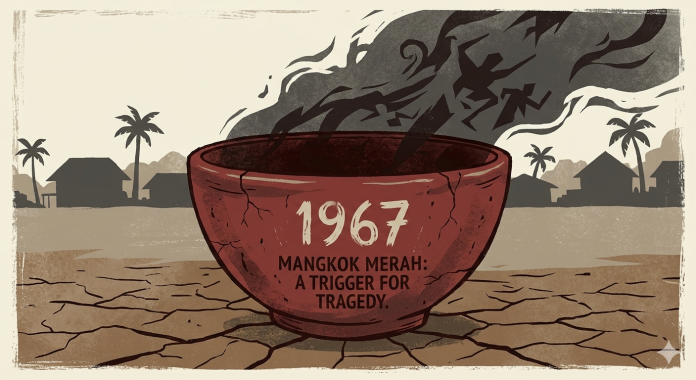

RADAR TULUNGAGUNG – Mangkok Merah 1967 remains one of the darkest chapters in Indonesian history after ethnic violence in West Kalimantan killed thousands of ethnic Chinese civilians during a period of anti-communist operations, political instability, and regional conflict linked to the Indonesia-Malaysia Confrontation.
The tragedy emerged after tensions escalated between Dayak communities and groups linked to PGRS and Paraku, armed movements formed during President Soekarno’s “Ganyang Malaysia” campaign in the early 1960s. For decades, Dayak and ethnic Chinese communities had lived peacefully across Kalimantan before political propaganda and misinformation shattered those relations.
Historical studies estimate that direct violence killed between 2,000 and 3,000 people between October and December 1967. Disease, starvation, and poor sanitation later killed thousands more inside refugee camps across West Kalimantan.
Political Conflict Fueled the Crisis
Mangkok Merah grew out of the Indonesia-Malaysia Confrontation, or Konfrontasi, which President Soekarno launched after the Federation of Malaysia formed in 1963. Soekarno believed Britain wanted to strengthen Western influence in Southeast Asia through the new federation.
Indonesia later supported volunteer forces such as PGRS (Pasukan Gerilya Rakyat Sarawak) and Paraku (Pasukan Rakyat Kalimantan Utara) near the Kalimantan border. Many members came from ethnic Chinese communities living close to Sarawak and West Kalimantan.
The political situation changed dramatically after the 1965 G30S crisis weakened Soekarno’s government and strengthened President Soeharto’s anti-communist campaign. Authorities increasingly viewed PGRS and Paraku as organizations linked to PKI because both groups had received support during the Soekarno era.
Violence intensified in July 1967 after PGRS-Paraku fighters reportedly attacked military air facilities in Singkawang and Sanggau Ledo. The attack killed several Indonesian military personnel and allowed the group to seize weapons and ammunition. Indonesian state records later included the incident in broader anti-insurgency operations in West Kalimantan.
Mangkok Merah Mobilized Communities
Military operations and political tensions quickly spread fear across the Kalimantan interior. At the same time, mysterious killings targeting Dayak victims increased tensions between Dayak communities and ethnic Chinese residents.
Historians still debate who carried out those killings because investigators never identified the perpetrators conclusively. Rumors nevertheless spread rapidly across villages, especially claims that communist-linked groups threatened Dayak traditions and local authority structures.
The situation worsened after rumors claimed PGRS-Paraku fighters had killed a district head in Ledo. Officials later confirmed that the district head survived, but the misinformation had already sparked anger among local communities.
Dayak leaders then activated the traditional Mangkok Merah ritual, which communities historically used during emergencies and wartime. Leaders circulated a symbolic bowl filled with ritual objects from village to village to mobilize support and solidarity.
Violence spread rapidly across Bengkayang, Mandor, Anjungan, and surrounding regions in October 1967. Armed groups attacked ethnic Chinese settlements and forced tens of thousands of civilians to flee toward Pontianak and Singkawang.
Refugees Faced Disease, Hunger, and Trauma
Researchers estimate that the violence displaced between 50,000 and 80,000 ethnic Chinese residents. Refugee camps soon struggled with overcrowding, food shortages, poor sanitation, and limited medical supplies.
Dysentery, tuberculosis, starvation, and infectious diseases later killed many refugees. Some historical estimates suggest the overall death toll, including refugee casualties, reached approximately 5,000 people.
Survivor testimonies and historical reports also described widespread destruction of homes, businesses, and property during the attacks. Several accounts documented brutal killings and severe human rights abuses, although historians continue to dispute some extreme allegations because verified evidence remains limited.
More than five decades later, Mangkok Merah 1967 still leaves deep scars in Indonesia’s collective memory. Historians argue that political propaganda, ethnic polarization, and misinformation rapidly destroyed long-standing social harmony in multicultural communities across West Kalimantan.
Although many questions remain unanswered, researchers broadly agree that Cold War politics, anti-communist campaigns, border conflict, and ethnic tensions combined to create one of Indonesia’s deadliest communal tragedies.