
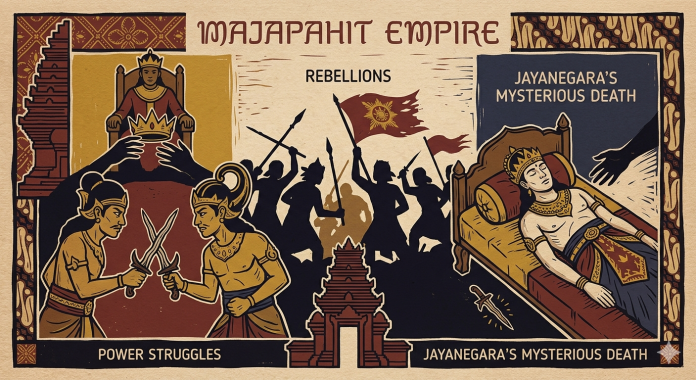

RADAR TULUNGAGUNG – Majapahit Empire history remains one of the most fascinating chapters in Southeast Asian civilization, marked by power, intrigue, and internal conflict. Founded in 1293 by Raden Wijaya, whose original name was Nararia Sangrama Wijaya, the empire quickly rose to prominence, controlling vast territories across the Nusantara.
In the early phase of the Majapahit Empire history, Raden Wijaya established a strong administrative system by appointing loyal followers who had supported him during his struggle. Key figures such as Arya Wiraraja and Rangga Lawe were entrusted with strategic positions, while Nambi was appointed as the chief minister. Meanwhile, Lembu Sora took charge as the Patih of Daha.
The growth of the kingdom was also supported by strategic policies. In 1294, Raden Wijaya granted rewards to the leader of Kudadu village, as recorded in the Kudadu inscription. He also formed an elite unit known as Dharmaputra, consisting of seven trusted members tasked with safeguarding the kingdom.
Transition of Power and Political Structure
As part of succession planning in the Majapahit Empire history, Raden Wijaya appointed his son, Jayanegara, as the crown prince in 1295. Jayanegara governed Kediri (Daha) under the supervision of Lembu Sora. After Raden Wijaya passed away in 1309, he was succeeded by Jayanegara, also known as Kalagemet.
Jayanegara’s lineage reflected the political alliances of the time. His mother, Darapetaka, came from the Dharmasraya Kingdom in Sumatra, further strengthening Majapahit’s regional influence. During his reign, Jayanegara established the Mahamantri Katrini council, which included key officials such as Sri Rangganata, Kameswara, and Wiswanata.
Rebellions that Shook the Empire
However, the stability of the kingdom was soon tested. The Majapahit Empire history under Jayanegara was marked by a series of rebellions, largely driven by dissatisfaction among former allies of Raden Wijaya.
The first major uprising occurred in 1309, led by Rangga Lawe, a regional ruler from Tuban. His dissatisfaction stemmed from the appointment of Nambi as chief minister, allegedly influenced by a cunning court figure named Mahapati. This rebellion escalated into the first civil war in Majapahit history.
Following Rangga Lawe’s death in battle, tensions continued to rise. In 1311, Lembu Sora was killed after being falsely accused of rebellion. The pattern of intrigue deepened as Mahapati manipulated political dynamics to eliminate rivals and gain power.
The conflict reached a tragic peak in 1316, when Nambi himself was killed along with his family in Lumajang. Once again, accusations of rebellion, fueled by Mahapati, led to devastating consequences. These internal conflicts weakened the political stability of the empire.
The Rise of Gajah Mada and Palace Crisis
Another significant turning point in the Majapahit Empire history came in 1319, when a rebellion led by Rakuti from the Dharmaputra elite unit successfully seized the royal palace. King Jayanegara was forced to flee and was secretly protected by the Bhayangkara troops.
At this critical moment, a young figure named Gajah Mada emerged as a key savior. As a member of the royal guard, he played a crucial role in rescuing the king and organizing a counterattack. Under his initiative, Majapahit forces managed to reclaim the palace, restoring Jayanegara to power.
This event marked the early rise of Gajah Mada, who would later become one of the most influential figures in Majapahit history.
The Mysterious Death of Jayanegara
Despite surviving multiple rebellions, Jayanegara’s reign ended in mystery. In 1328, he was assassinated by Ratanca, a court entertainer who also served as a physician. During a medical procedure, Ratanca suddenly stabbed the king, leading to his death.
The motives behind this assassination remain unclear and continue to be debated among historians. Some sources suggest political conspiracy, while others view it as a personal act. Shortly after the incident, Gajah Mada killed Ratanca, preventing further investigation.
Jayanegara died without leaving an heir, creating a succession crisis within the Majapahit Empire history.
The Rise of Tribhuwana Tunggadewi
Following Jayanegara’s death, the throne passed to Tribhuwana Tunggadewi, the daughter of Raden Wijaya and Gayatri. Gayatri herself chose a spiritual life as a Buddhist nun, delegating royal authority to her daughter.
Tribhuwana ruled until 1350 and played a significant role in stabilizing the empire after years of turmoil. Her reign also paved the way for the golden age of Majapahit under the leadership of Hayam Wuruk and Gajah Mada.
The Majapahit Empire history thus reflects not only the grandeur of a powerful kingdom but also the complex political struggles that shaped its legacy.