
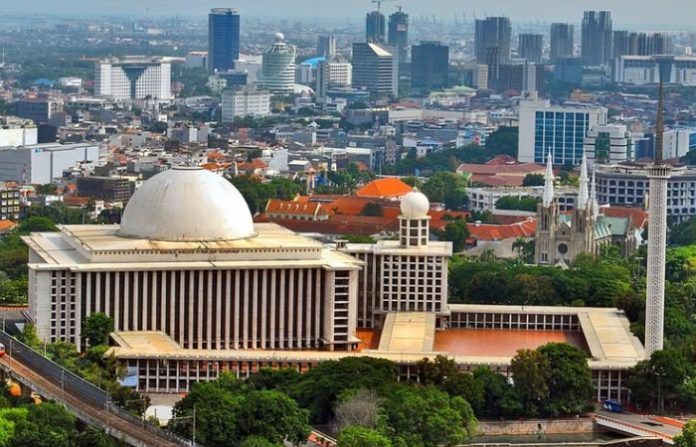

RADAR TULUNGAGUNG – Istiqlal Mosque, Indonesia’s national mosque and the largest mosque in Southeast Asia, stands as more than a place of worship. Indonesia built the landmark to celebrate independence, strengthen national identity, and showcase religious tolerance. Nearly eight decades after independence, the mosque continues to symbolize the country’s commitment to unity in diversity.
Islamic leaders first proposed a grand national mosque in 1950, less than five years after Indonesia proclaimed independence. Then Religious Affairs Minister KH Wahid Hasyim and Islamic leader Anwar Tjokroaminoto championed the idea and envisioned a mosque that would reflect both the aspirations of Indonesia’s Muslim majority and the nation’s pluralistic character.
President Sukarno quickly embraced the proposal and later took an active role in determining the mosque’s design and location. He supported the name “Istiqlal,” an Arabic word meaning “independence,” to commemorate Indonesia’s liberation from colonial rule.
A National Mosque Built at the Heart of the Capital
One of the most significant debates surrounding the project involved its location. Vice President Mohammad Hatta favored building the mosque closer to established Muslim communities, while Sukarno advocated constructing it in the former Wilhelmina Park area, the site of the Dutch colonial Citadel Fortress.
Sukarno’s vision ultimately prevailed. He believed the national mosque should stand at the center of the capital, near the seat of government, as a symbol of Indonesia’s sovereignty. The chosen site carried additional historical meaning because it occupied land once associated with Dutch colonial power.
Equally symbolic was the decision to place the mosque adjacent to the Jakarta Cathedral. The proximity of the two religious landmarks has long been viewed as a representation of interfaith coexistence and Indonesia’s commitment to religious harmony under the principles of Pancasila.
Supporting Data and Historical Background
The mosque’s design was selected through a national architectural competition launched in 1955. The winning proposal came from Friedrich Silaban, a Protestant Christian architect from North Sumatra, whose submission carried the codename “Ketuhanan” (“Divinity”). His victory reflected the inclusive spirit promoted by the project’s organizers and by Sukarno himself.
Silaban adopted a modernist architectural approach rather than a traditional regional style. Historians argue that this decision helped avoid privileging any single ethnic or cultural tradition within Indonesia’s diverse society. The result was a monumental structure intended to represent all Indonesians rather than one particular region.
Construction officially began when Sukarno laid the first foundation pillar on August 24, 1961. However, economic difficulties, inflation, and political upheaval, including the turmoil surrounding the 1965 political crisis, slowed progress considerably. The project ultimately took 17 years to complete.
Several architectural elements carry symbolic meaning. The mosque’s main dome has a diameter of 45 meters, representing the year 1945 when Indonesia declared independence. Twelve large columns support the central structure, a reference often associated with the 12th day of Rabiul Awal, traditionally observed as the birth date of the Prophet Muhammad.
Reactions, Challenges and Lasting Impact
Construction progressed slowly because Indonesia faced severe economic difficulties and political instability throughout the 1960s. Rising inflation, budget constraints, and the political turmoil surrounding the events of 1965 repeatedly delayed the project.
Despite those challenges, Friedrich Silaban remained involved in the development for many years. After political power shifted from Sukarno to President Suharto, a new committee continued the project while preserving Silaban’s original design.
President Suharto later mobilized public support and encouraged donations from Muslim communities to help finance construction. Government agencies and private contributors subsequently provided resources that enabled the project to continue.
After approximately 17 years of work, Indonesia finally completed the mosque. President Suharto inaugurated Istiqlal Mosque on February 22, 1978, marking the culmination of one of the country’s most ambitious post-independence construction efforts.
Today, Istiqlal Mosque remains a defining symbol of Indonesia’s national identity. The mosque reflects the vision of leaders who sought to unite a diverse nation through shared values rather than ethnic or religious exclusivity. Its location beside Jakarta Cathedral and the fact that a Christian architect designed the structure continue to highlight Indonesia’s tradition of tolerance and coexistence.
More than a monumental building, Istiqlal Mosque tells the story of a young nation that transformed its independence into a lasting symbol of unity, faith, and mutual respect.