
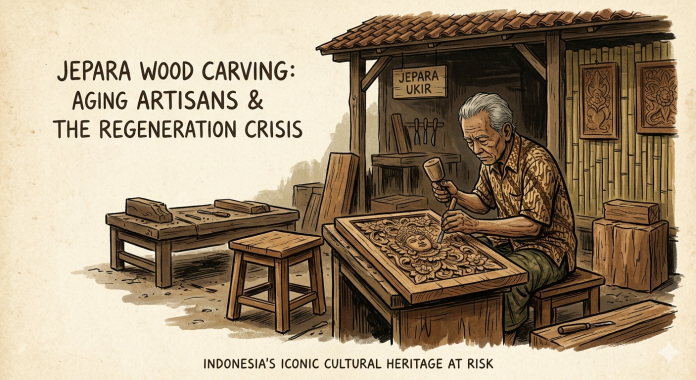

RADAR TULUNGAGUNG – Jepara wood carving, one of Indonesia’s most celebrated cultural traditions, faces a growing regeneration crisis as fewer young people choose careers as artisans. The challenge threatens a craft that flourished under Queen Kalinyamat in the 16th century and later gained wider recognition through the efforts of RA Kartini.
For centuries, Jepara has served as the center of Indonesia’s wood-carving tradition. Local craftsmen have created distinctive carvings that decorate homes, mosques, and furniture exported worldwide, helping Jepara earn a reputation as a global hub for wood craftsmanship.
Today, cultural observers, artisans, and local officials warn that declining youth participation could weaken the future of the industry and put a key element of Indonesia’s cultural heritage at risk.
Jepara’s Wood-Carving Legacy Traces Back to the 16th Century
Historians link the development of Jepara wood carving to the reign of Queen Kalinyamat, who governed Jepara from around 1549 to 1579.
The Mantingan Mosque, built in 1559, remains one of the most important historical sites connected to the tradition. Its carved stone reliefs and decorative panels showcase a blend of Islamic, Chinese, and Hindu artistic influences.
Researchers consider the Mantingan carvings among the earliest surviving examples of Jepara’s artistic heritage. Craftsmen incorporated lotus motifs, geometric Islamic patterns, and Chinese-inspired decorative elements into the structure, reflecting the cultural exchanges that accompanied Jepara’s maritime trade networks.
Jepara’s position on regional trade routes helped local communities connect with merchants from Malacca, China, India, and the Middle East. Those interactions introduced new artistic influences that enriched local carving traditions.
Kartini Helped Turn Cultural Heritage Into Economic Opportunity
The industry expanded significantly during the late 19th and early 20th centuries through the work of RA Kartini.
Kartini took a strong interest in the welfare of local craftsmen. Through her writings and social networks, she encouraged artisans to develop marketable products that could improve their livelihoods while preserving traditional skills.
She worked directly with craftsmen, promoted new design ideas, and introduced Jepara handicrafts to broader audiences. Her efforts helped increase awareness of Jepara carving beyond Central Java and supported its emergence as a commercially viable industry.
The sector continued to grow during the Dutch colonial era and remained economically important after Indonesia gained independence. In September 1952, President Sukarno visited Jepara and attended a carving exhibition, demonstrating national recognition of the craft.
Young Workers Leave the Industry as Regeneration Slows
Jepara’s carving industry achieved major export success during the late 20th century. Strong international demand and favorable export conditions helped many businesses expand, particularly during the 1998 Asian financial crisis when Indonesian products became more competitive overseas.
Today, however, artisans face a different challenge.
Many young people now prefer manufacturing, services, or other sectors that offer more predictable income and career opportunities. By contrast, carving often requires years of training while providing uncertain earnings.
Senior craftsmen report a sharp decline in the number of apprentices. Local cultural activists say only a small percentage of school-age youth now show interest in learning carving skills compared with previous generations.
The closure of specialized woodworking and carving programs has further reduced opportunities for skill development and professional training.
Despite these obstacles, students in vocational schools across Jepara continue to study carving and woodworking. Teachers and industry leaders hope those students can help preserve the region’s cultural identity while adapting traditional techniques to modern markets.
Local officials and cultural advocates have called for stronger policies to support artisans. They argue that policymakers should treat wood carving as both an economic asset and a cultural art form. Proposed measures include talent-development programs, regular exhibitions, artisan incentives, and closer cooperation between government institutions, industry groups, and community organizations.
Jepara’s wood-carving tradition has survived for centuries through cultural exchange, craftsmanship, and entrepreneurship. Many observers believe its future now depends on whether policymakers, educators, and artisans can inspire a new generation to continue the legacy.