
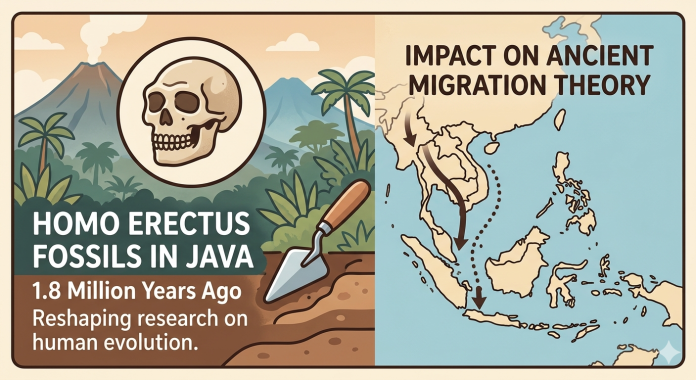

RADAR TULUNGAGUNG – The discovery of Homo erectus fossils estimated to be 1.8 million years old in Bumiayu, Central Java, has strengthened Indonesia’s position as one of the world’s most important locations for studying human evolution. Researchers say the findings could prompt scientists to re-examine aspects of long-standing theories about the early migration and development of ancient humans.
The fossils, identified from thigh bone fragments, jaw remains, and tooth roots, were recovered from geological layers in Bumiayu, Brebes Regency. Archaeologists determined that the remains belong to Homo erectus and date back approximately 1.8 million years, making them among the oldest known human fossils discovered in Indonesia.
The discovery has renewed international interest in Java’s prehistoric record, which has produced some of the most significant fossil finds since the late 19th century and continues to provide critical evidence about the evolution of early humans.
The Bumiayu Discovery and Its Scientific Significance
Researchers from the Yogyakarta Archaeology Center confirmed that the fossils originated from the lower section of the Kaliglagah Formation, a geological layer dated to around 1.8 million years ago. The age assessment was based on the sedimentary matrix that remained attached to the fossilized bones.
According to archaeologist Hari Widianto, the fossils represent one of the oldest Homo erectus populations identified in Southeast Asia. Their age is particularly significant because it closely matches some of the earliest Homo erectus remains discovered in Africa.
For decades, the widely accepted Out of Africa model has argued that Homo erectus emerged in Africa roughly 1.8 million years ago before spreading into Asia and Europe. However, the Bumiayu findings suggest that early human populations were already present in Java at approximately the same time.
Scientists emphasize that the discovery does not overturn the Out of Africa theory. Instead, it highlights the possibility that ancient human migration and evolution were more complex than previously understood and may have involved multiple migration waves and regional evolutionary developments.
Java’s Long History of Ancient Human Fossil Discoveries
Java has played a central role in paleoanthropological research for more than a century. Dutch anatomist and paleontologist Eugène Dubois arrived in the Dutch East Indies in the late 19th century searching for fossil evidence related to human evolution.
In 1891, Dubois discovered fossil remains near Trinil along the Bengawan Solo River in East Java. He named the find Pithecanthropus erectus, or “upright ape-man,” believing it represented a transitional form between apes and humans.
Modern science has since revised that interpretation. Researchers now classify Dubois’ discovery as Homo erectus, an extinct human species rather than a “missing link” between humans and apes. Scientists stress that humans and modern apes share ancient common ancestors but evolved along separate evolutionary branches.
Subsequent discoveries across Java and elsewhere in Indonesia revealed a rich record of Homo erectus populations. Fossils recovered from Sangiran, Mojokerto, Ngawi, Blora, and other locations have helped researchers trace evolutionary changes over hundreds of thousands of years.
Sangiran Remains a Global Center for Human Evolution Research
Among Indonesia’s archaeological treasures, the Sangiran site in Central Java remains the most important. The area contains uninterrupted geological layers spanning approximately 2.4 million years, providing scientists with an exceptionally complete record of environmental and biological change.
The site preserves tens of thousands of fossils, including ancient humans, mammals, marine animals, freshwater species, stone materials, and prehistoric tools. This extensive collection allows researchers to reconstruct ancient ecosystems and examine how early humans adapted to changing environments.
In recognition of its scientific value, UNESCO designated Sangiran Early Man Site a World Heritage Site in 1996. UNESCO considers the location one of the most important places in the world for understanding the evolution of humans, culture, and the environment over nearly two million years.
The continuing discovery of Homo erectus fossils in Java reinforces Indonesia’s vital role in the study of human origins. As researchers uncover new evidence, sites such as Bumiayu and Sangiran continue to shape scientific understanding of how ancient humans evolved, migrated, and adapted across the prehistoric world.