
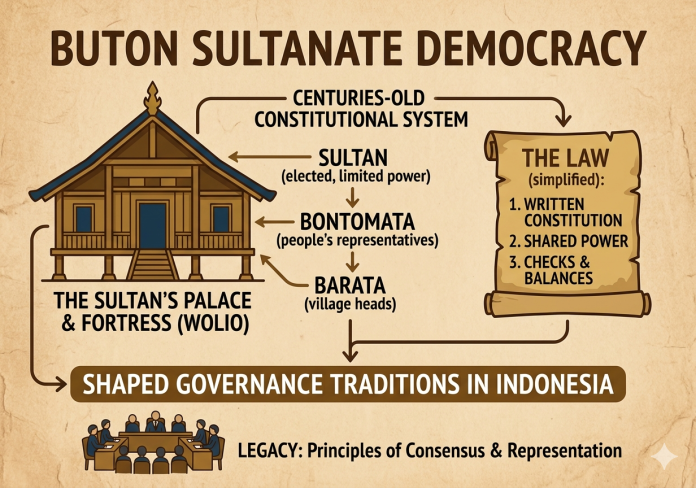

RADAR TULUNGAGUNG – The story of Buton Sultanate Democracy reveals one of Southeast Asia’s most remarkable political traditions. For centuries, the Sultanate of Buton governed its territory through a constitutional system that limited royal authority, empowered representative institutions, and enforced laws that applied even to the ruling sultan.
Located on Buton Island in present-day Southeast Sulawesi, the maritime kingdom rose along strategic trade routes connecting western Indonesia with the Maluku spice islands. Merchants, sailors, and regional powers regularly stopped in Baubau, turning the island into an important commercial hub.
Historical records show that Buton already existed during the Majapahit era. The 14th-century Nagarakretagama manuscript mentioned Buton among the regions connected to Majapahit, confirming the kingdom’s significance in the archipelago long before European colonial expansion.
From Maritime Kingdom to Islamic Sultanate
Buton’s political transformation accelerated in the 16th century when King La Kilaponto embraced Islam and became Sultan Murhum Kaimuddin, the first Sultan of Buton. Under his leadership, the kingdom adopted Islam as the foundation of governance and state administration.
The sultanate later developed a written constitution known as Murtabat Tujuh. Sultan La Elangi formalized the constitutional framework between 1597 and 1631, creating a legal system that regulated government institutions, public administration, and social life.
Unlike many hereditary monarchies, Buton did not grant unlimited power to its ruler. The constitution established checks and balances that constrained the sultan and required him to govern according to agreed legal principles.
A Constitutional System Ahead of Its Time
The Sultanate of Buton operated through institutions that resembled executive, legislative, and judicial branches. The sultan served as the executive authority, while a council known as Siolimbona represented the legislative element of government. Judicial institutions enforced the law and resolved disputes.
The selection of a new sultan also reflected this structured political system. Noble councils and religious authorities chose candidates through a deliberative process rather than automatic hereditary succession. Although royal lineage remained important, no ruler could simply appoint his own successor.
Historical studies indicate that Siolimbona monitored the conduct of the sultan and could remove him if he violated constitutional obligations. The system therefore placed accountability above personal authority.
Legal equality formed another important principle. The law applied not only to ordinary citizens but also to government officials and members of the royal family. Historical records even describe cases in which high-ranking leaders received punishment after violating constitutional rules.
Legacy, Fortifications, and Integration into Indonesia
The Sultanate of Buton survived for centuries and maintained substantial autonomy through diplomacy, trade, and military preparedness. One of its most enduring symbols remains the Buton Palace Fortress in Baubau, a massive defensive complex with a circumference of approximately 2.74 kilometers that ranks among the world’s largest fortifications.
The sultanate also relied on a community-based defense system known as Matana Sorumba, which mobilized local populations to help protect territorial sovereignty. This approach strengthened ties between the government and society while reinforcing regional security.
Buton formally became part of Indonesia in 1960, ending more than six centuries of indigenous statehood. Nevertheless, its political legacy continues to attract attention from historians who view the sultanate as one of the archipelago’s most sophisticated constitutional systems.
Today, historical manuscripts, cultural festivals, traditional institutions, and heritage sites preserve the memory of Buton’s unique political civilization. The Sultanate of Buton demonstrates that constitutional governance, institutional oversight, and legal accountability developed in parts of Indonesia long before the emergence of the modern republic.