
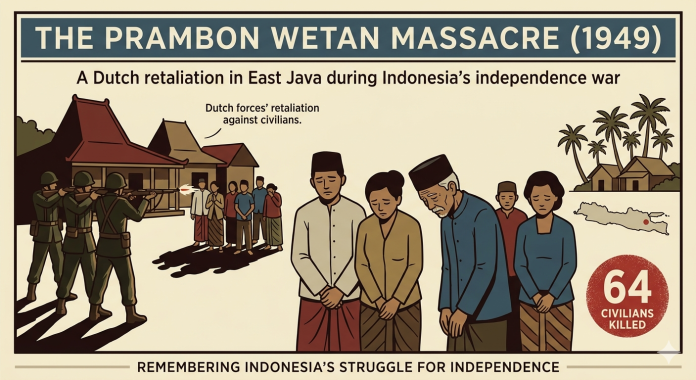

RADAR TULUNGAGUNG – The Prambon Wetan Massacre remains one of the deadliest civilian tragedies of Indonesia’s struggle for independence. On July 24, 1949, Dutch forces stormed Prambon Wetan village in Tuban, East Java, killing at least 64 civilians and destroying dozens of homes just one day after Indonesian fighters ambushed a Dutch marine patrol nearby.
The attack unfolded during the final months of the Indonesian National Revolution, a conflict that pitted Indonesian independence fighters against Dutch efforts to restore colonial rule. Historians and survivor testimonies have long linked the assault to Dutch anger over heavy losses suffered during the ambush.
More than 75 years later, researchers in Indonesia and the Netherlands continue to examine the Prambon Wetan Massacre through military archives, eyewitness accounts, and village records. Their findings have helped uncover details of a tragedy that remained largely absent from public discussion for decades.
Ambush Sets the Stage for Deadly Retaliation
The chain of events began on July 23, 1949, when Indonesian guerrilla fighters and local residents prepared an ambush near Prambon Wetan. The village served as an important base for Republican forces operating in the area.
A Dutch marine patrol led by Lieutenant Leen Teeken entered the region believing it faced little resistance. However, Indonesian fighters had recently strengthened their positions around the village.
As the patrol moved through muddy rice fields near the village border, Indonesian fighters opened fire from concealed positions. The attack killed four Dutch marines, including Teeken, and a civilian intelligence informant. Indonesian forces also captured seven Dutch marines after the clash.
Local residents viewed the ambush as part of a broader resistance campaign that intensified after Dutch troops killed several villagers and village chief Suratni during earlier operations.
Evidence and Historical Records Preserve the Story
Dutch military records documented the July 23 ambush in considerable detail. Historians later identified the incident as one of the most significant clashes involving Dutch marines during the final phase of the war.
Research by Dutch historian Marjolein van Pagee revealed that Dutch commanders did not include the patrol in official operational plans. According to her findings, Lieutenant Teeken launched the mission partly to demonstrate Dutch authority in an area that Dutch troops considered hostile.
Researchers also found evidence that Indonesian forces had increased their strength around Prambon Wetan shortly before the patrol arrived. That development likely contributed to the Dutch patrol’s miscalculation and the success of the ambush.
The incident later inspired the Dutch novel De Patrouille van Teeken by Wim Hornman, although historians caution that parts of the book contain fictionalized elements.
Survivors Recall the Human Cost of the Attack
Dutch forces returned to Prambon Wetan on July 24, 1949, with overwhelming military strength. Survivors described intense mortar fire, widespread gunfire, and soldiers moving through the village while targeting residents and torching homes.
Village records compiled after the attack listed 64 civilian deaths, including women and children. Local officials also recorded the destruction of 56 houses and significant losses of livestock.
The violence forced hundreds of residents to flee toward the Bengawan Solo River and seek safety in neighboring villages in Bojonegoro. Many survivors crossed the river on foot, by raft, or by small boats before spending one to two months in temporary refuge.
Researchers later discovered that Dutch archives focused heavily on the ambush but contained little information about the civilian deaths in Prambon Wetan. Public awareness in the Netherlands increased only after historians published investigations based on survivor testimony and village documentation.
The Prambon Wetan Massacre stands as a stark reminder of the human cost of the Indonesian National Revolution. While historians continue to debate specific details surrounding the operation, survivor accounts, village records, and archival research consistently show that Dutch forces killed at least 64 civilians and devastated much of the village on July 24, 1949. For the people of Prambon Wetan, the tragedy remains an enduring symbol of the sacrifices communities made during Indonesia’s fight for independence.