
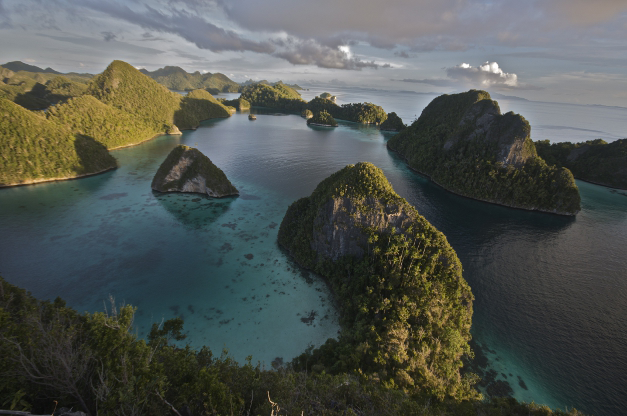

RADAR TULUNGAGUNG – Raja Ampat, one of the world’s most biodiverse marine regions, is facing growing environmental concerns as nickel mining activities expand across parts of the archipelago. While the islands remain globally renowned for their natural beauty, their long history, indigenous traditions, and ecological significance have placed Raja Ampat at the center of a debate over conservation and development.
Located in Indonesia’s province of Southwest Papua, Raja Ampat consists of more than 600 islands and is administered from the town of Waisai. The region takes its name from four historic island kingdoms, Waigeo, Salawati, Misool, and Batanta, whose legacy continues to shape local identity today.
In recent years, Raja Ampat has gained international recognition not only as a premier diving destination but also as a symbol of Indonesia’s efforts to balance economic growth with environmental protection.
The Historical and Cultural Roots of Raja Ampat
The origins of the name Raja Ampat, meaning “Four Kings,” are deeply rooted in local oral traditions. Indigenous communities, particularly the Maya people, preserve legends describing seven mysterious eggs discovered in a cave. According to the folklore, four eggs hatched into kings who ruled the region’s major islands, while the others transformed into a woman, a sacred stone, and a spiritual being. These stories remain an important part of local cultural identity.
Historically, Raja Ampat became integrated into regional maritime networks long before modern Indonesia emerged. From the 15th century onward, the islands maintained close ties with the Sultanate of Tidore, which extended its influence across eastern Indonesia through trade and political alliances.
Dutch colonial expansion later brought the islands under indirect administration through Tidore. Local rulers retained limited authority while colonial powers controlled trade and taxation. During the Japanese occupation in World War II, residents experienced forced labor and severe restrictions before Indonesia proclaimed independence in 1945.
Following a complex political process involving Papua’s integration into Indonesia, Raja Ampat eventually became part of the Republic of Indonesia. In 2003, it was officially established as a separate regency, accelerating administrative development and tourism growth.
Biodiversity and Cultural Heritage Draw Global Attention
Scientists recognize Raja Ampat as one of the richest marine ecosystems on Earth. Research has documented more than 550 coral species and over 1,400 reef fish species in its waters. Marine experts estimate that the archipelago contains approximately 75 percent of the world’s known coral species, making it a critical center for global marine conservation.
The region’s cultural diversity remains equally remarkable. Indigenous groups such as the Maya, Ambel, Matbat, and others continue to preserve traditions that reflect centuries of interaction between people and nature.
Among the most important cultural traditions is Wala, a ceremonial form of song and dance practiced by the Matbat people of Misool. Through storytelling, music, and movement, community elders pass down ancestral histories, social values, and cultural knowledge to younger generations. Indonesia’s Ministry of Education and Culture recognized Wala as part of the nation’s Intangible Cultural Heritage in 2019.
Traditional performances such as the Bintaki dance also remain central to cultural celebrations, community gatherings, and ceremonial events across the region.
Nickel Mining Raises Environmental Concerns
Despite its conservation status and tourism appeal, Raja Ampat is increasingly confronting pressures from the nickel industry.
Several islands in and around the region have become sites of mining permits and exploration projects linked to Indonesia’s growing nickel sector, which supports the global electric vehicle supply chain. Environmental organizations, including Greenpeace Indonesia, and indigenous communities have expressed concerns that mining activities could threaten fragile ecosystems and traditional livelihoods.
Critics argue that forest clearing, sediment runoff, and marine pollution could undermine the ecological foundations that support both biodiversity and sustainable tourism. They also point to the contradiction between promoting green energy technologies and extracting nickel through processes that can generate significant environmental impacts.
Supporters of mining projects, meanwhile, emphasize potential economic benefits, including employment opportunities and regional development. The debate highlights a broader challenge facing Indonesia as it seeks to expand strategic mineral production while protecting environmentally sensitive areas.
As the discussion continues, Raja Ampat stands at a pivotal moment. The archipelago’s future may depend on whether policymakers, businesses, and local communities can find a path that safeguards one of the world’s most extraordinary marine environments while addressing economic aspirations.
The story of Raja Ampat is no longer only about its legendary four kings or its spectacular coral reefs. It has become a test case for how development, indigenous heritage, and environmental stewardship can coexist in one of Indonesia’s most treasured regions.