
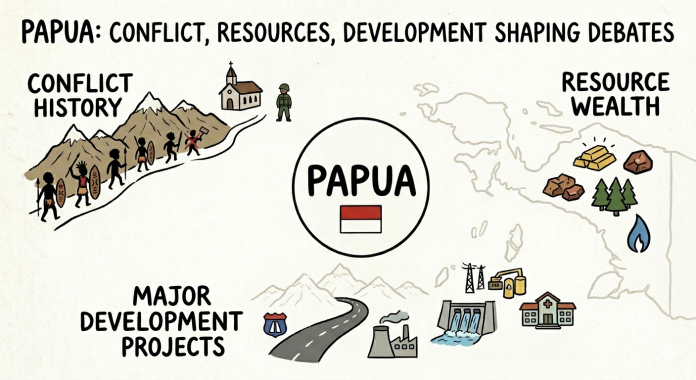

RADAR TULUNGAGUNG – The Papua conflict remains one of the most complex and enduring political issues in modern Indonesian history, despite Papua’s vast natural wealth and strategic importance. Rich in minerals, forests, and marine resources, the region continues to face tensions rooted in historical disputes, political grievances, security operations, and competing visions of development.
Home to vast tropical forests, rich fishing grounds, and some of the world’s largest gold and copper deposits, Papua plays a crucial role in Indonesia’s economic ambitions. Policymakers have increasingly promoted the region as a center for resource development and future food production, particularly through major projects planned in southern Papua.
Yet the Papua conflict extends far beyond economics and development. Historians, human rights advocates, and many indigenous Papuans continue to debate the historical events that shaped the region’s political status, while concerns over security operations, environmental change, and social inequality remain at the center of one of Indonesia’s most enduring and complex challenges.
Historical Roots of the Papua Conflict
Before Indonesia’s independence, Papua was home to hundreds of ethnic groups with distinct languages, cultures, and social systems. Scholars have frequently described the island as one of the most culturally diverse regions in the world.
The modern dispute emerged after World War II. While Indonesia claimed all former Dutch East Indies territories, including West New Guinea, as part of the new republic, the Netherlands initially retained control of the territory. During the late 1950s and early 1960s, Dutch authorities expanded educational opportunities and local political institutions, contributing to the emergence of a distinct Papuan political identity.
In 1961, the Netherlands established the New Guinea Council, a representative body that included Papuan members. During the same year, the Morning Star flag and other symbols associated with Papuan identity were publicly introduced. For some Papuan leaders, these developments represented a step toward eventual independence.
Indonesia strongly opposed the move. President Soekarno viewed Dutch policies as an attempt to preserve colonial influence and launched the Trikora campaign in December 1961, calling for the integration of West New Guinea into Indonesia. The dispute intensified during the Cold War, attracting international attention from both the United States and the Soviet Union.
The Act of Free Choice and Lasting Controversy
Diplomatic negotiations eventually produced the 1962 New York Agreement, which transferred the territory through a temporary United Nations administration before Indonesian control formally began in 1963.
A key provision required a future vote on Papua’s political status. That process culminated in the 1969 Act of Free Choice, known in Indonesia as Penentuan Pendapat Rakyat (Pepera).
Rather than a one-person-one-vote referendum, Indonesia selected 1,025 representatives who unanimously voted to remain within Indonesia. The United Nations accepted the outcome, and the territory formally became part of Indonesia.
However, the process remains controversial. Numerous historians, researchers, and human rights advocates have argued that the consultation took place under significant political pressure. The legitimacy of the Act of Free Choice continues to be disputed by many Papuan activists and pro-independence groups, making it one of the central issues behind the Papua conflict.
Following integration, armed resistance movements gradually emerged, eventually contributing to the formation of the Free Papua Movement (OPM), which advocates Papuan independence.
Natural Resources, Development, and New Challenges
The Papua conflict has become increasingly linked to natural resource management and economic development. A major turning point came in 1967 when Indonesia signed a contract with Freeport, leading to the development of one of the world’s largest copper and gold mines in Mimika and transforming Papua into a key economic region.
While the mining industry generated significant state revenue, critics argue that many indigenous communities did not benefit equally. Researchers and civil society groups have raised concerns over land rights, environmental degradation, and social inequality, while transmigration programs during the New Order era also reshaped Papua’s demographic landscape.
More recently, governments under Joko Widodo and Prabowo Subianto have promoted large-scale food security projects in Merauke and other parts of southern Papua. Supporters view the initiatives as vital for national food resilience, but environmental organizations and indigenous groups warn that extensive land conversion could threaten forests, customary lands, and local communities.
The debate reflects a broader challenge in Papua: balancing economic development with indigenous rights, environmental protection, and long-term stability. As new projects expand across the region, many observers argue that greater local participation will be essential to reducing tensions that have persisted for decades.