
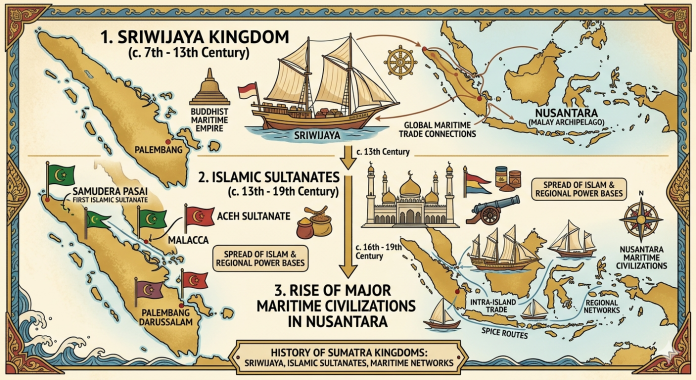

RADAR TULUNGAGUNG – The history of Sumatra kingdoms reflects one of the longest and most influential civilizational journeys in Southeast Asia. From early river settlements to powerful maritime empires, the island became a strategic center of trade, religion, and political influence that connected the Nusantara region with India, China, Arabia, and beyond.
For centuries, major rivers such as the Musi and Batanghari shaped the rise of organized communities across Sumatra. These waterways supported trade, cultural exchange, and the emergence of local rulers who gradually transformed small settlements into influential political centers. The process eventually paved the way for the rise of Sriwijaya, the dominant maritime power that controlled key international trade routes in Asia.
The history of Sumatra kingdoms continued to evolve after the decline of Sriwijaya, as Islamic sultanates including Samudera Pasai and Aceh emerged as new regional powers. Their influence reshaped commerce, religion, education, and Malay culture across the island, leaving a historical legacy that still defines Sumatra and Indonesia today.
Early River Civilizations Became the Foundation of Sumatra Kingdoms
Long before major kingdoms emerged, communities across Sumatra developed along large rivers such as the Musi, Batanghari, and Kampar. These waterways served as economic lifelines, connecting inland settlements with international maritime routes.
Archaeological discoveries, including stone inscriptions, pottery fragments, and remnants of wooden settlements, suggest that organized communities had already formed around strategic trading points. Historians believe these early settlements gradually developed political structures led by local rulers who controlled trade, taxation, and regional security.
One of the earliest political entities often associated with Sumatra’s ancient history is Kandis in present-day Riau. Although evidence remains limited and largely based on oral traditions and local archaeological findings, researchers view Kandis as an early alliance of local leaders who controlled regional trade routes.
Meanwhile, in the Batanghari River region of present-day Jambi, scholars identified the emergence of Old Malay civilization. The area gained importance because of its strategic access to both inland resources and maritime trade networks. Indian cultural influence entered Sumatra through commerce, introducing Sanskrit, religious symbols, and artistic traditions while blending with local customs rather than replacing them.
During this period, political authority followed the mandala model, a flexible regional system based on alliances and influence rather than rigid territorial borders. Control over ports and trade routes became the main source of power for local rulers.
Sriwijaya Dominated Maritime Trade Across Southeast Asia
By the seventh century, the area around Palembang emerged as the center of a powerful maritime empire known as Sriwijaya. Historians consider Sriwijaya one of the greatest naval and commercial powers in Southeast Asian history.
Several inscriptions, including the Kedukan Bukit and Talang Tuo inscriptions, provide evidence of Sriwijaya’s political influence and religious activities. Chinese Buddhist monk Yijing, also known as I-Tsing, documented his stay in Sriwijaya around the seventh century while studying Sanskrit before traveling to India. His writings described Sriwijaya as an important center of Buddhist learning.
Sriwijaya expanded rapidly because it controlled the Malacca Strait, one of the busiest maritime trade routes connecting India and China. Merchant ships passing through the strait often stopped at Sriwijaya-controlled ports for protection, supplies, and trading permits.
At its height between the eighth and tenth centuries, Sriwijaya influenced large parts of Sumatra, the Malay Peninsula, western Java, and parts of southern Thailand. The empire relied on naval strength, port taxation, and regional alliances to maintain its dominance.
Trade networks connected Sriwijaya with merchants from Arabia, India, China, and Champa. The kingdom also became a center for Mahayana Buddhist scholarship, attracting students and religious scholars from across Asia.
However, Sriwijaya’s power weakened in the 11th century after military attacks launched by the Chola Empire from southern India. The invasion disrupted maritime trade and weakened Sriwijaya’s economic and military control. As its influence declined, political power gradually shifted toward Jambi and other regional centers.
Islamic Sultanates Reshaped Sumatra’s Political and Cultural Identity
Following the decline of Sriwijaya, Islamic influence spread across Sumatra through peaceful trade networks involving merchants from Gujarat, Persia, Arabia, and China.
Coastal cities such as Perlak, Barus, Pasai, Palembang, and Jambi became important centers of Islamic learning and commerce. Muslim traders married local communities and established religious institutions, accelerating the spread of Islam throughout the island.
Historians widely recognize Samudera Pasai as the first Islamic kingdom in the Nusantara region. Gold dirham coins and foreign records indicate that Pasai maintained strong international trade relations with the Middle East, India, and other Asian regions.
Scholar Azyumardi Azra described Samudera Pasai as an important gateway for Islamic intellectual networks in Southeast Asia.
Later, the Aceh Sultanate rose as a dominant regional power under Sultan Iskandar Muda during the 17th century. Aceh controlled the lucrative pepper trade and developed diplomatic relations with the Ottoman Empire. The kingdom also became known for Islamic scholarship, literature, and religious education.
Other Malay Islamic kingdoms, including Siak, Deli, Palembang, Jambi, and Indragiri, contributed to the growth of Islamic culture and regional trade across Sumatra.
European colonial expansion began in the 16th century with the arrival of the Portuguese, followed by Dutch influence in later centuries. Many Sumatra kingdoms resisted foreign control, including Aceh, Palembang, and Minangkabau territories. Colonial plantation systems eventually transformed the island’s economy and social structure.
Today, Sumatra continues to preserve the cultural legacy of its ancient kingdoms through traditional architecture, literature, dance, and Islamic traditions. The long history of Sumatra kingdoms remains one of the strongest foundations of Indonesian civilization and maritime heritage.