
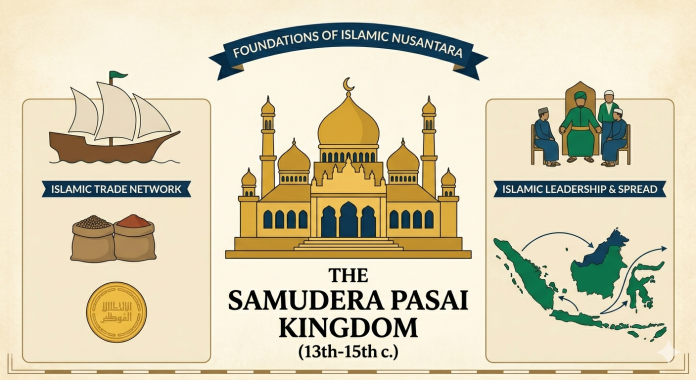

RADAR TULUNGAGUNG – The rise of the Samudera Pasai Kingdom in northern Sumatra marks a turning point in the early spread of Islam across the Nusantara region. Positioned along the strategic coast of Aceh, the kingdom grew into a major maritime hub that connected Southeast Asia with the Middle East, India, and China through active trade networks.
Historical narratives trace the Samudera Pasai Kingdom to a gradual process of unification among coastal Islamic communities. Arab and Persian merchants traveled through the Strait of Malacca, introduced new religious ideas, and reshaped local social structures through continuous interaction.
Over time, leaders such as Malik al-Saleh unified these coastal settlements into a centralized Islamic authority. The Samudera Pasai Kingdom then emerged as one of Southeast Asia’s earliest Islamic powers, and it left a lasting imprint on regional history.
Formation of the Samudera Pasai Kingdom and Early Islamic Influence
Early historical traditions trace Islamic influence in Aceh back to the Sultanate of Perlak, believed in some sources to have existed as early as the 9th century (around 840 CE). Initially influenced by Hindu-Buddhist traditions, Perlak gradually transitioned toward Islam through sustained interaction with Muslim merchants operating along maritime trade routes.
Malay chronicles such as Hikayat Raja-Raja Pasai describe how Islamic scholars and traders played a central role in shaping political leadership in the region. These early developments laid the foundation for later political integration that eventually contributed to the rise of the Samudera Pasai Kingdom.
Merah Silu, later known as Sultan Malik al-Saleh after converting to Islam, is widely regarded as the key figure in this transformation. His leadership marked the beginning of a more structured Islamic governance system, uniting Samudera and surrounding coastal regions into a single political entity.
Economic Power, Trade Dominance, and Global Recognition
Under Sultan Malik al-Saleh and his successor Sultan Muhammad Malik al-Zahir I, the Samudera Pasai Kingdom developed into a powerful maritime trade center after around 1297 CE. Its strategic position near the Strait of Malacca allowed it to dominate regional shipping lanes.
The kingdom introduced gold-based currency, reportedly containing up to 70% pure gold, and implemented maritime taxes on ships passing through key trade routes. These policies strengthened its economy and expanded its influence across Southeast Asia.
At its peak, Samudera Pasai exported massive quantities of pepper, estimated between 8,000 and 10,000 bahar annually, along with commodities such as camphor, silk, and gold. This economic strength placed the Samudera Pasai Kingdom firmly within global trade networks linking China, India, and the Middle East.
The kingdom’s international reputation was further confirmed when the Moroccan explorer Ibn Battuta visited in 1345 CE. In his travel records Rihlah ila al-Mashriq, he described the hospitality of Sultan Malik al-Zahir I and the strong Islamic governance structure he observed during his stay.
Decline, Foreign Pressure, and Lasting Legacy
The decline of the Samudera Pasai Kingdom began as regional trade routes shifted toward emerging powers such as the Sultanate of Malacca. The Portuguese conquest of Malacca in 1511 further destabilized regional trade networks, indirectly weakening Samudera Pasai’s economic position.
By 1524, the rising Sultanate of Aceh Darussalam under Sultan Ali Mughayat Syah absorbed the remaining territories of Samudera Pasai. This marked the end of its political independence, although its cultural and religious influence continued to shape the region.
Despite its collapse, the Samudera Pasai Kingdom left a profound legacy as one of Southeast Asia’s earliest Islamic centers. It helped establish maritime trade-based Islamic expansion and produced figures such as Fatahillah, who later carried its scholarly influence to Java, extending its impact across the Indonesian archipelago.