
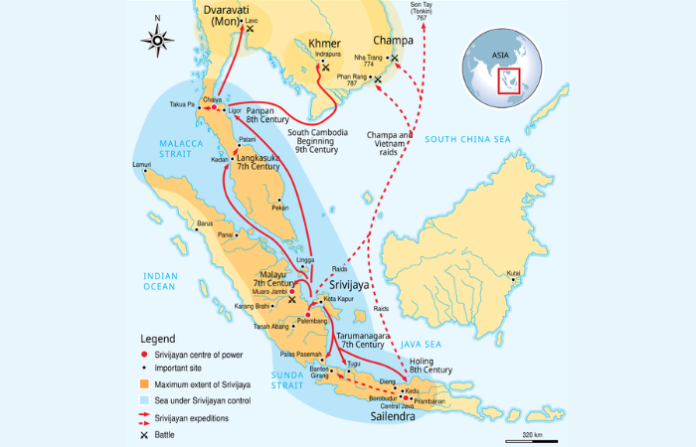

RADAR TULUNGAGUNG – The Srivijaya Empire, a powerful maritime kingdom centered in present-day Palembang, South Sumatra, remains one of Southeast Asia’s most influential yet mysterious civilizations. Historians believe Srivijaya controlled major trade routes across the Malacca Strait for centuries, shaping regional politics, Buddhism, and commerce despite leaving behind surprisingly limited physical evidence.
The story of Srivijaya continues to fascinate historians and the public alike because of its long dominance and elusive historical footprint. While many Indonesians celebrate the grandeur of Majapahit, Srivijaya arguably held power for a far longer period, with some scholars estimating its existence stretched from the 7th century to the 13th century, and possibly even earlier.
Debate surrounding the kingdom’s origins and existence resurfaced in recent years after the late Betawi cultural figure Ridwan Saidi controversially questioned whether Srivijaya ever truly existed. However, historical records, inscriptions, and foreign accounts continue to support the consensus that Srivijaya was a major regional power in ancient Nusantara.
Srivijaya Became a Maritime Superpower in the Malacca Strait
The rise of the Srivijaya Empire closely connected to the strategic importance of the Malacca Strait, which had served as a vital shipping and trade lane since ancient times. Merchants and sailors from China, India, the Middle East, and Southeast Asia passed through the route, creating prosperous port cities across Sumatra and the Malay Peninsula.
Historians generally agree that Srivijaya emerged around the 7th century, based on inscriptions dated between 683 and 775 AD. These inscriptions, written in Old Malay using Pallava script, were discovered across Sumatra, Java, and the Malay Peninsula.
Chinese Buddhist monk I Ching, who traveled through Southeast Asia in 671 AD on his journey to India, provided one of the earliest foreign records about the kingdom. In his writings, he described a place known as “Shili Foshi,” which scholars later identified as Srivijaya. His accounts also revealed that Srivijaya had become a major center for Buddhist learning, attracting monks from across Asia.
The kingdom’s name itself came from Sanskrit. “Sri” meant radiant or glorious, while “Wijaya” referred to victory, creating the meaning “glorious victory.”
Some researchers believe references to a kingdom called “Choye” in Chinese records from 392 AD may also refer to Srivijaya, suggesting the empire could have existed centuries earlier than commonly believed.
Trade, Diplomacy, and Natural Wealth Fueled Srivijaya’s Golden Age
Under rulers such as Dapunta Hyang Sri Jayanasa, Srivijaya expanded rapidly through diplomacy, naval influence, and economic control rather than large-scale territorial conquest.
Historical inscriptions, including the Kedukan Bukit and Talang Tuo inscriptions, recorded Sri Jayanasa’s military expeditions and development projects. During his reign, Srivijaya consolidated alliances with surrounding kingdoms, including Melayu in Jambi, while maintaining authority over critical maritime routes.
At its peak between the 7th and 10th centuries, Srivijaya’s influence reportedly extended across much of Sumatra, western Java, the Malay Peninsula, parts of Thailand, Cambodia, western Kalimantan, Brunei, and Sabah.
The empire’s prosperity relied heavily on controlling trade through the Malacca and Sunda Straits. Strong diplomatic ties with China’s Tang Dynasty further strengthened Srivijaya’s position in regional commerce.
Persian geographer Ibn Rustah wrote in 903 AD that he had never encountered a ruler wealthier than the Maharaja of Srivijaya. Arab historian Al-Masudi also described the kingdom as immensely prosperous in records written in 955 AD.
Natural resources from Sumatra contributed significantly to that wealth. Jambi, for example, became famous for gold production, while Sumatra itself earned the Sanskrit nickname “Suvarnadvipa,” meaning “Island of Gold.”
Invasions and Internal Divisions Triggered Srivijaya’s Collapse
Despite centuries of dominance, the Srivijaya Empire entered decline in the early 11th century. Several subordinate regions began breaking away, weakening central authority.
A major turning point came in 1025 when Rajendra Chola I of southern India launched naval attacks against Srivijaya. Chola forces captured several important territories and reportedly took the Srivijaya ruler Sri Maharaja Sangrama Vijayatunggavarman prisoner.
The invasion severely weakened Srivijaya’s influence across Southeast Asia and disrupted its trade supremacy.
Chinese diplomatic records later suggested a split in political authority between Palembang and Jambi after both regions separately sent envoys to China during the late 11th century. Historians interpreted this as evidence of internal fragmentation within the kingdom.
Further pressure came from expanding regional powers. The Singasari Kingdom launched the Pamalayu expedition in 1288, while Majapahit attacked in 1293. At the same time, Thai kingdoms such as Sukhothai reduced Srivijaya’s remaining influence in the Malay Peninsula.
By the 13th century, Srivijaya had fragmented into smaller successor states, including Malayu, Palembang, and Minangkabau polities, marking the end of one of Southeast Asia’s greatest maritime empires.
Although much about Srivijaya remains debated, historians widely agree that the kingdom played a crucial role in shaping trade, religion, and political networks across ancient Southeast Asia for hundreds of years.