

RADAR TULUNGAGUNG – The keyword Majapahit Empire life often evokes images of grandeur, power, and a golden age of Indonesian history. The Majapahit Empire is widely remembered as one of Southeast Asia’s greatest civilizations, reaching its peak in the 14th century under rulers like Hayam Wuruk and Gajah Mada.
However, beneath the splendor of temples, trade networks, and royal courts, the reality of Majapahit Empire life for ordinary people was far harsher than commonly portrayed. The romantic narrative of prosperity often hides the daily struggles faced by the majority of the population.
A Rigid Social Hierarchy That Defined Everything
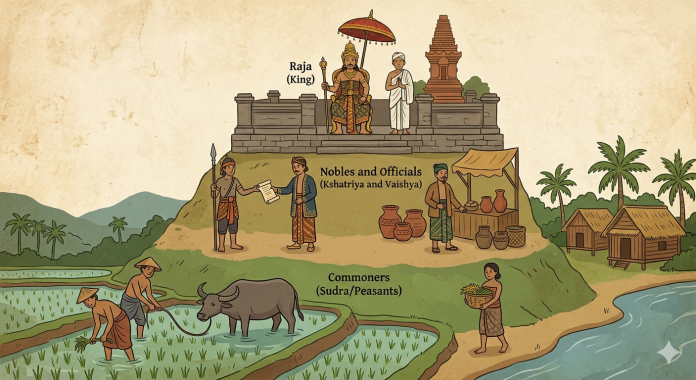
In the Majapahit era, society was structured in a strict hierarchy that left little room for mobility. At the top were the king and religious elites, followed by nobles and warriors. Meanwhile, the vast majority of people, farmers, laborers, and small traders, formed the base of the system.
This structure meant that one’s destiny was determined at birth. Unlike modern concepts of equality, individuals could not easily change their social status. The king was considered a divine ruler, and his authority was absolute, reinforcing a system where power and privilege were concentrated among a few.
Daily Life Marked by Hard Labor
For commoners, Majapahit Empire life revolved around survival. Most people worked as farmers, cultivating rice fields under harsh tropical conditions. Their tools were simple, and their workdays were long, often stretching from sunrise to sunset.
In addition to tending their own land, they were also required to perform forced labor for the state. Massive construction projects such as temples and infrastructure relied heavily on unpaid labor from villagers. Many workers never returned from these exhausting tasks, their contributions unrecorded in history.
Food scarcity was another constant challenge. While rice was the staple, many survived on cassava, tubers, or simple vegetables. Meat was rare and usually reserved for special occasions. A failed harvest due to drought or flooding could quickly lead to famine.
Health Risks and Limited Medical Knowledge
Health conditions during the Majapahit period were precarious. There were no hospitals or modern medicine. Illnesses were often treated with herbal remedies or spiritual rituals conducted by shamans.
Sanitation was minimal, and rivers were commonly used for bathing, washing, and waste disposal. This created an environment where diseases such as dysentery and cholera could spread rapidly. For many, even minor injuries could become fatal due to infection.
Women, Children, and the Elderly
The burden of Majapahit Empire life was especially heavy for vulnerable groups. Women were expected to manage household duties, work in the fields, and bear children, often without recognition or autonomy. Marriage was typically arranged, serving social or economic purposes rather than personal choice.
Children were introduced to labor at an early age, assisting their families in farming or household tasks. Formal education was limited to elites, leaving most of the population illiterate.
For the elderly, life often became increasingly difficult. Once they could no longer work, they depended entirely on their families for survival, especially during times of scarcity.
A Harsh Legal System and Constant Surveillance
Justice in the Majapahit era was severe and often brutal. Punishments for crimes could include mutilation or execution, serving as public deterrents. Laws were applied unevenly, with harsher consequences for commoners compared to elites.
Additionally, society functioned under close supervision. Local leaders monitored villagers, ensuring taxes were paid and order was maintained. This created an atmosphere where people were cautious about expressing dissatisfaction or dissent.
Between Glory and Reality
Historically, the Majapahit Empire is celebrated as a powerful maritime state with extensive trade relations across Asia. Its cultural achievements, literature, and architecture continue to inspire admiration today.
Yet, the reality of Majapahit Empire life reveals a different perspective. The grandeur of the empire was built upon the labor and sacrifices of millions of ordinary people whose stories were rarely recorded.
Understanding this duality offers a more balanced view of history, not just as a tale of glory, but also as a reflection of human struggle. The legacy of Majapahit remains significant, but its history is far more complex than the golden image often portrayed.