
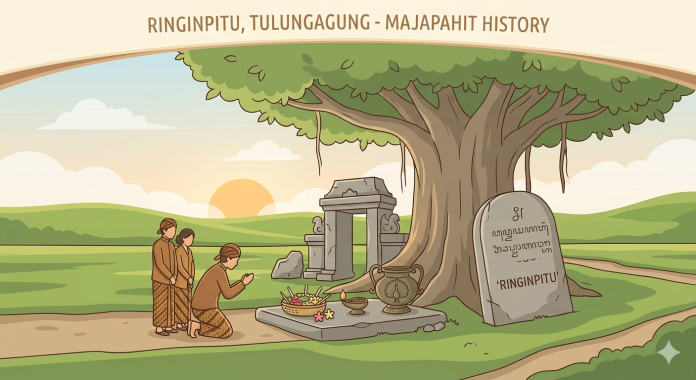

RADAR TULUNGAGUNG – Few people know that a quiet village in Tulungagung holds an important connection to the Majapahit Kingdom. The village, Ringinpitu, now attracts attention after historians uncovered strong evidence linked to ancient Majapahit history.
The keyword Ringinpitu recently gained popularity after researchers connected the village to the famous Waringin Pitu inscription from the Majapahit era. The finding sparked public interest in historical tourism, ancient Javanese culture, and religious heritage sites in East Java.
Today, Ringinpitu looks like an ordinary rural area. Centuries ago, however, the village held a special position in the Majapahit Kingdom. Historical records described the area as Perdikan Waringin Pitu, a tax-free territory dedicated to religious and spiritual activities.
The Waringin Pitu Inscription and Majapahit Connection
According to local historians, the Waringin Pitu inscription consisted of 14 copper plates issued in 1447. One damaged plate can no longer be read, but several surviving parts clearly mention Waringin Pitu as a special religious territory under Majapahit authority.
Researchers believe the inscription strongly proves that present-day Ringinpitu is the same location mentioned in ancient records. The conclusion was drawn after historians studied territorial boundaries written inside the inscription and compared them with the current geographical area.
The inscription is currently stored at the National Museum of Indonesia and has reportedly undergone four major readings by experts. Despite slight interpretation differences, researchers reached the same conclusion regarding the village’s historical identity.
Because of this evidence, November 22, 1447, was officially established as the founding date of Ringinpitu Village. In 2025, the village celebrated its 578th anniversary.
Archaeological Sites Strengthen Historical Claims
Historical recognition of Ringinpitu became stronger after archaeologists discovered several ancient artifacts in the village. One of the most important findings was a Shiva statue locally known as Situs Mbah Krapyak.
Experts identified the statue as a Majapahit-era relic based on its ornaments and artistic characteristics. Villagers also found patirtan structures believed to have been used for ritual purification ceremonies centuries ago.
Additional relics discovered in the area include stone mortars, ritual containers, keris, spears, and other ceremonial objects associated with ancient Javanese spiritual traditions.
Residents said many of the artifacts had existed for generations before formal archaeological research began. Local authorities later restored and preserved the sites after researchers confirmed their historical significance.
Ringinpitu Moves Toward Cultural Village Status
Encouraged by the historical findings, Ringinpitu is now actively promoting itself as a cultural village destination in Tulungagung. Village officials believe the area fulfills important requirements to become an officially recognized cultural heritage village.
One of the major attractions is the annual cultural parade featuring Tombak Kiai Korowelang, a sacred spear considered the village’s spiritual symbol. The ritual procession has been held since 2023 and attracts large participation from residents.
The spear is closely linked to the legendary figure Kiai Bicak, also known as Mbah Becak, who is believed in local folklore to have cleared forests in southern Tulungagung during the Majapahit era.
According to oral traditions, Kiai Bicak used the sacred spear to open new settlements and eventually discovered seven banyan trees. The phrase “Waringin Pitu,” meaning “Seven Banyan Trees,” later evolved linguistically into Ringinpitu.
Sacred Tombs and Religious Tourism Potential
The tomb of Kiai Bicak remains one of the most visited spiritual destinations in the village. Residents regularly conduct pilgrimages, communal prayers, and traditional nyadran ceremonies at the site.
Local villagers claim visitors often come from outside Tulungagung, including business figures and political candidates seeking blessings and prayers before important events.
Village authorities emphasized that all pilgrimage activities are monitored openly and conducted respectfully according to local customs.
Seeing the growing interest, residents hope Ringinpitu can eventually develop into a national religious tourism destination. They believe the preservation of Majapahit heritage and sacred traditions could strengthen the local economy while protecting historical identity.
Village leaders are also preparing proposals to the Indonesian Ministry of Culture to secure official cultural village recognition. If approved, Ringinpitu could emerge as one of the most important historical tourism villages connected to the Majapahit Kingdom in East Java.
For local residents, the rediscovery of Ringinpitu’s ancient history is more than cultural pride. It is proof that a quiet village in Tulungagung once played a meaningful role in one of Indonesia’s greatest kingdoms.