
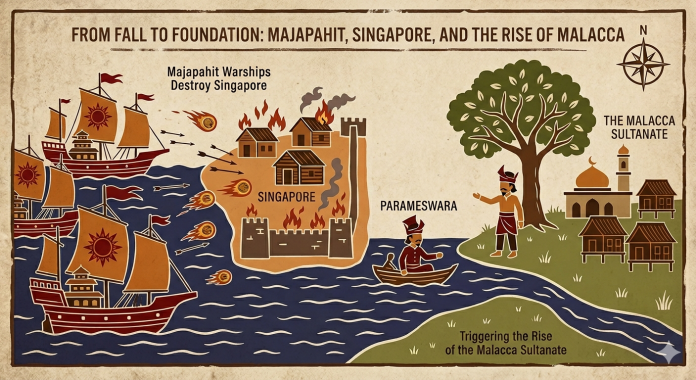

RADAR TULUNGAGUNG – The fall of Singapore in the late 14th century became a defining moment in Southeast Asian history. When Majapahit warships destroyed Singapore, the powerful Javanese empire believed it had eliminated the last stronghold of its long-time rival, Srivijaya. Instead, this victory triggered a chain of events that gave rise to a new regional power: the Malacca Sultanate.
At the height of its maritime dominance, Majapahit launched a large-scale naval campaign against Singapore in 1389. The island had long served as a refuge for Srivijayan elites after their decline in Sumatra. Despite surviving earlier invasions, Singapore could not withstand this final assault. The keyword Majapahit Warships Destroy Singapore reflects not only a decisive military victory but also a turning point that reshaped political and economic dynamics across the region.
The Birth of the Malacca Sultanate
After the destruction of Singapore, its ruler Parameswara fled south to avoid capture. Rather than surrender, he established a new settlement in a strategic location along the Strait of Malacca. This decision would prove highly significant.
Parameswara later adopted Islam, strengthening ties with Muslim traders who dominated regional commerce. This move allowed him to integrate into vast international trade networks connecting India, the Middle East, and beyond. He eventually founded the Malacca Sultanate, which quickly developed into a major maritime power.
Malacca’s success was built on its control of one of the busiest trade routes in the world. Ships traveling between India and China passed through the strait, and Malacca positioned itself as a key hub. By offering protection and facilitating trade, the new kingdom rapidly gained wealth and influence.
The Spread of Islam Through Trade Networks
The rise of Malacca coincided with the growing influence of Islam across the Indonesian archipelago. Unlike earlier religions such as Hinduism and Buddhism, Islam spread more easily through trade networks. It did not rely on fixed religious structures, making it adaptable to different cultural settings.
Muslim traders had been present in the region for centuries, but widespread conversion began around the 13th century. Coastal communities, especially in Sumatra, were among the first to adopt the new faith. Over time, local rulers followed, seeing both spiritual and economic advantages.
The adoption of Islam also introduced new systems of writing, law, and administration. These changes strengthened connections with other Muslim regions, further integrating Southeast Asia into global trade networks.
China’s Strategic Support and Zheng He’s Voyages
Malacca’s rapid rise was reinforced by its alliance with China during the Ming Dynasty. Seeking stability in maritime trade routes, China supported Malacca as a strategic partner against larger regional powers, including Majapahit and the Thai kingdoms.
This alliance became visible through the voyages of Admiral Zheng He. Beginning in 1405, Zheng He led massive treasure fleets across Asia, including repeated visits to Malacca. These expeditions were designed to demonstrate Chinese power and build diplomatic relationships.
The fleets were enormous, carrying thousands of sailors, soldiers, and officials. Their presence alone sent a clear message of protection and influence. For Malacca, this support ensured security and strengthened its position as a dominant trading center.
The Gradual Decline of Majapahit
While Malacca was rising, Majapahit began to weaken from within. Internal conflicts over royal succession and political intrigue reduced the empire’s ability to maintain control over its vast territories.
As trade routes shifted and new alliances formed, Majapahit’s influence over maritime trade declined. Many of its former vassals in Sumatra converted to Islam and aligned themselves with emerging Muslim kingdoms or with China.
By the early 16th century, a coalition of Muslim kingdoms captured key Majapahit ports along the northern coast of Java. In 1527, Majapahit effectively lost its dominance, marking the end of its era as a leading regional power.
A Lasting Legacy in Indonesian History
Despite its decline, Majapahit’s legacy endured. Members of the royal family fled to Bali, where they preserved Hindu-Buddhist traditions, art, and literature. These cultural elements continue to shape the island’s identity today.
Majapahit also remained influential in historical memory. Its image as a unified and powerful state later inspired Indonesian nationalism during the struggle for independence. The idea of unity across the archipelago can be traced back to this period.
The story behind Majapahit Warships Destroy Singapore highlights how a single military campaign can lead to unexpected consequences. Rather than securing long-term dominance, Majapahit’s victory helped create a new rival that would transform Southeast Asia for centuries.