
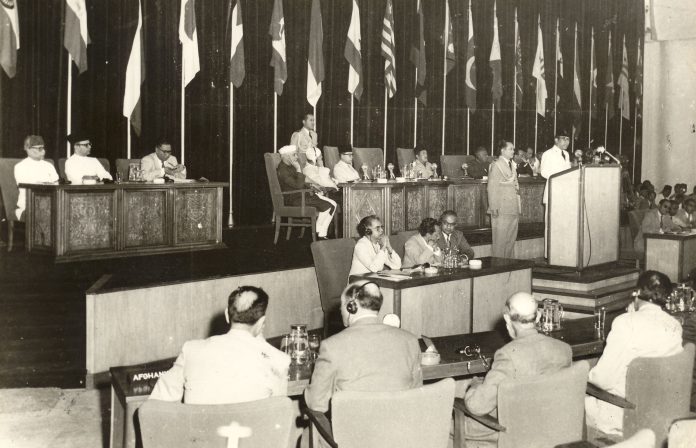

RADAR TULUNGAGUNG – Bandung Conference 1955 remains one of the most defining moments in modern history, when newly independent Indonesia emerged as the voice of the Global South. Held in April 1955 in Bandung, the gathering brought together leaders from Asia and Africa to challenge colonialism, racism, and Cold War domination.
At the center of this historic event was Sukarno, Indonesia’s first president, who had led the country to independence just six years earlier. Alongside figures like Jawaharlal Nehru and Gamal Abdel Nasser, Sukarno positioned Indonesia as a leader of anti-colonial resistance.
The Roots of Colonial Exploitation
To understand the significance of the Bandung Conference 1955, one must look back at Indonesia’s long history under colonial rule. Beginning in the 17th century, the Dutch established dominance through the Dutch East India Company, a powerful corporation that controlled trade, waged wars, and exploited local resources.
Indonesia’s vast wealth in spices such as nutmeg and cloves attracted European powers. Over time, the Dutch expanded their control beyond trade into governance, enforcing systems of forced labor and slavery. By the 19th century, Indonesia had become one of the most profitable colonies in the world, while its people faced poverty, heavy taxation, and limited rights.
Resistance was constant. One of the most notable uprisings was the Java War led by Prince Diponegoro, which resulted in massive casualties and highlighted growing anti-colonial sentiment.
War, Occupation, and Independence
The situation worsened during World War II when Japan occupied Indonesia. Initially welcomed as liberators, Japanese forces soon imposed harsh rule, leading to famine and forced labor. Millions of Indonesians suffered, and hundreds of thousands were coerced into labor projects.
Following Japan’s surrender in 1945, Indonesia declared independence. However, the Dutch attempted to regain control, triggering a brutal conflict known as the Indonesian National Revolution. Villages were destroyed, and over 100,000 Indonesians lost their lives.
Despite this, Indonesian forces, under Sukarno’s leadership, resisted fiercely. By 1949, international pressure forced the Dutch to recognize Indonesia’s independence, though not without demanding billions in compensation, effectively making Indonesia pay for its own freedom.
Bandung Conference 1955: A Turning Point
Against this backdrop, the Bandung Conference 1955 became a symbol of unity among formerly colonized nations. Leaders from 29 countries gathered to promote cooperation, oppose imperialism, and assert independence from both Western and Soviet influence.
The conference laid the foundation for the Non-Aligned Movement and inspired anti-colonial struggles worldwide. It energized movements in Africa and Asia, influenced civil rights activism in the United States, and even shaped revolutionary ideas in Latin America.
Sukarno’s message was clear: the Global South would no longer be dictated to by global superpowers.
Cold War Tensions and Political Turmoil
However, Indonesia’s rise as a leader in the anti-colonial world also drew suspicion from Western nations. During the Cold War, Sukarno’s political stance raised concerns, particularly as Indonesia leaned toward leftist ideologies.
In 1965, a violent political upheaval led to the rise of Suharto. The transition was marked by mass killings, with estimates ranging from 500,000 to over one million deaths. The event, often linked to foreign intervention, reshaped Indonesia’s political landscape for decades.
Suharto ruled Indonesia for over 30 years before stepping down in 1998 amid economic crisis and widespread protests, paving the way for democratic reforms.
Indonesia Today: A Lasting Legacy
Today, Indonesia stands as the world’s fourth most populous nation and a key member of the G20. Its journey, from colonization and revolution to dictatorship and democracy, reflects resilience and transformation.
The legacy of the Bandung Conference 1955 continues to resonate. It marked Indonesia’s emergence as a global voice for justice, equality, and independence. Despite the scars of its past, the nation remains a symbol of resistance and unity for developing countries worldwide.