
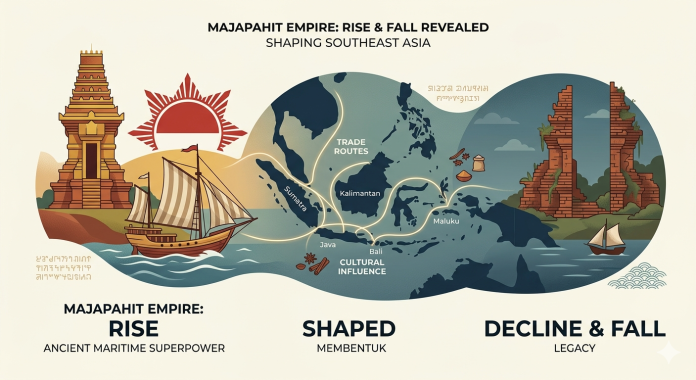

RADAR TULUNGAGUNG – The story of the Majapahit Empire is once again drawing global attention, as historians revisit how this ancient maritime power helped shape modern Indonesia. Long before the rise of Islam in the archipelago, the Majapahit Empire stood as one of the most dominant forces in Southeast Asia, controlling vast trade networks and influencing regional politics.
The Majapahit Empire emerged in the late 13th century on the island of Java, a region that has long served as the cultural and political heart of Indonesia. Its rise marked a turning point in regional history, proving that a vast and diverse archipelago could be unified under a single सत्ता. This legacy still echoes in today’s Republic of Indonesia.
At its peak, the Majapahit Empire was not just a political entity but a thalassocracy, an empire built on maritime dominance. It controlled key trade routes, including the strategic Malacca Strait, and facilitated the global spice trade that connected Asia, the Middle East, and even Europe.
The Strategic Roots of Power in Java
Java’s geography played a crucial role in the rise of Majapahit. Fertile volcanic soil made it one of the most agriculturally productive regions in the world, while its location placed it at the center of international trade routes.
The island was populated by Austronesian seafarers, known for their advanced navigation skills. These early inhabitants laid the foundation for powerful kingdoms that would later dominate maritime Southeast Asia.
Cultural influences from India and China also shaped Java’s political and religious systems. Hinduism and Buddhism became dominant, leading rulers to adopt the concept of divine kingship. Monumental structures such as Borobudur and Prambanan still stand today as evidence of this era.
The Rise of Majapahit Through Strategy and Conflict
The founding of Majapahit is closely tied to political intrigue and international conflict. Its founder, Raden Wijaya, cleverly used a Mongol invasion force sent by Kublai Khan to defeat a rival ruler before turning against the invaders themselves.
This strategic brilliance allowed Raden Wijaya to establish Majapahit in 1293. From there, the empire expanded rapidly, especially under the leadership of Gajah Mada, one of Indonesia’s most celebrated historical figures.
Gajah Mada is best known for his “Palapa Oath,” in which he vowed to unite the entire Nusantara under Majapahit rule. True to his word, he led military campaigns that brought vast territories under the empire’s influence, including Bali and parts of Sumatra and Borneo.
Golden Age Under Hayam Wuruk
The empire reached its peak during the reign of Hayam Wuruk. During this period, Majapahit became one of the largest and wealthiest empires in the world.
Its capital, Trowulan, evolved into a cosmopolitan hub where traders from China, India, Persia, and beyond gathered. The empire maintained a powerful navy and a professional army, enabling it to secure trade routes and maintain political stability.
Culturally, Majapahit thrived. Hinduism and Buddhism coexisted peacefully, blending with local beliefs to create a unique spiritual landscape. This spirit of tolerance remains a defining feature of Indonesian identity today.
Decline and the Rise of New Powers
Despite its strength, Majapahit eventually declined. The spread of Islam through trade networks began to reshape the region’s religious and political landscape. Unlike previous religions, Islam challenged the divine authority of Majapahit rulers.
Following the death of Hayam Wuruk in 1389, internal conflicts weakened the empire. Meanwhile, new Islamic states such as the Malacca Sultanate rose to prominence, shifting trade dominance away from Majapahit.
By the early 16th century, the emergence of the Demak Sultanate marked the final blow. In 1527, Majapahit collapsed, ending centuries of dominance.
Lasting Legacy in Modern Indonesia
Although the empire fell, its influence remains deeply embedded in Indonesia’s national identity. The concept of unity across diverse cultures—reflected in the national motto “Bhinneka Tunggal Ika”, can be traced back to Majapahit’s governance.
Historians often view Majapahit as a precursor to modern Indonesia, both in territorial vision and cultural integration. Its legacy continues to inspire a nation built on diversity, resilience, and shared history.