
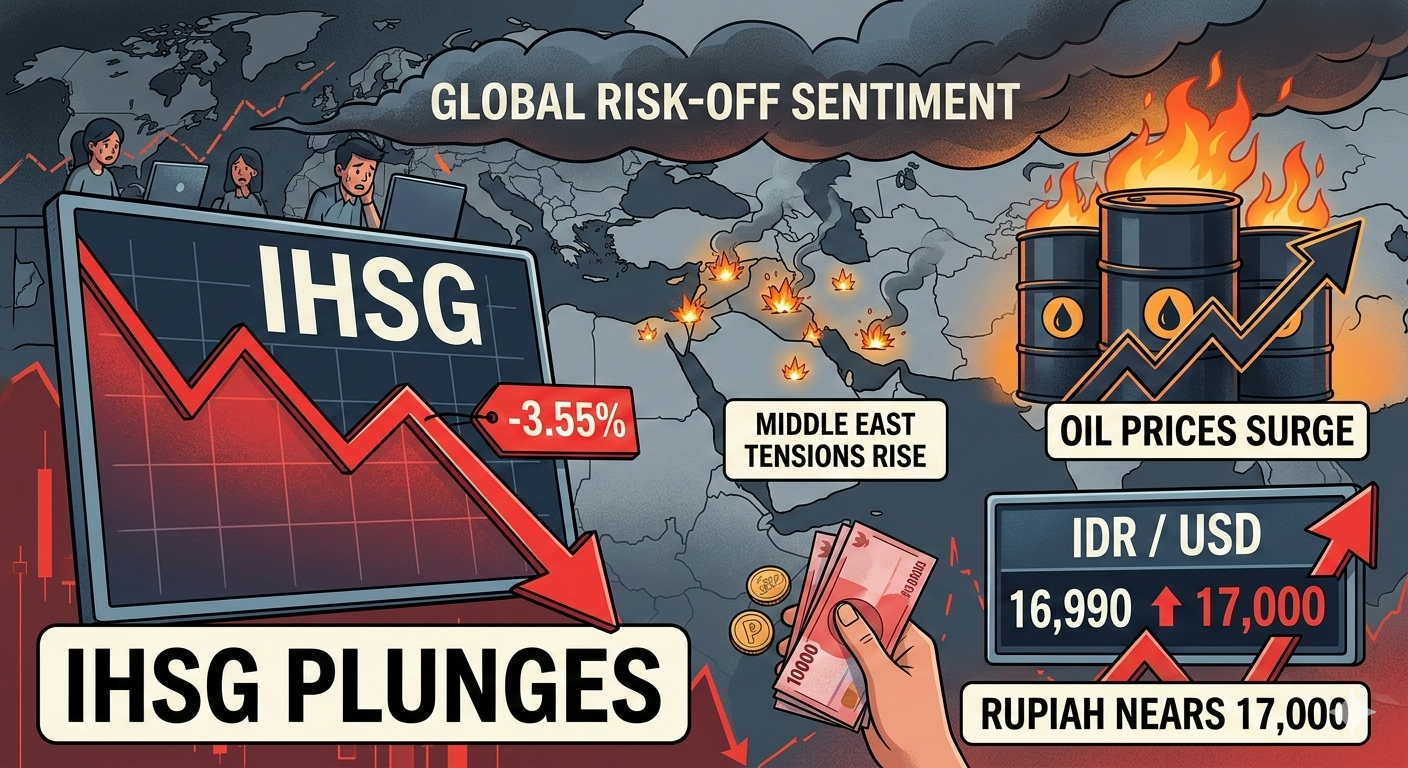

RADAR TULUNGAGUNG – The IHSG (Indonesia Composite Index) opened the week with heavy selling pressure as global and domestic concerns weighed on investor sentiment. During early trading on Monday, the IHSG plunged 3.55 percent and hovered around 7,313.29 points, reflecting strong risk-off sentiment in financial markets.
At the opening of the first trading session, the IHSG briefly fell deeper, even touching a correction of around 5 percent before recovering slightly. The index had dropped to a low of 7,162.25, while the highest level recorded in the morning session reached 7,350.33.
Market analysts say the sharp decline in the IHSG comes from a combination of global geopolitical risks and domestic concerns that continue to pressure Indonesia’s stock market.
Global Oil Prices Surge Amid Middle East Conflict
One of the strongest external pressures affecting the IHSG comes from the sudden surge in global oil prices. Energy markets reacted sharply as geopolitical tensions escalated in the Middle East, particularly with the ongoing conflict involving Iran.
Oil prices in futures trading jumped about 30 percent in a single day, approaching USD120 per barrel. The spike occurred as the conflict entered its second week and oil shipments through the strategic Strait of Hormuz became effectively blocked.
Several Middle Eastern oil producers, including Kuwait, Iran, and the United Arab Emirates, have also reduced crude oil production. Reports indicate their storage capacity is nearly full, forcing producers to limit output.
The rapid increase in oil prices has raised concerns about global inflation. Higher energy costs could push up living expenses and potentially lead to tighter monetary policies worldwide.
For investors, this creates uncertainty in global markets, including emerging markets such as Indonesia. As risk rises, investors typically reduce exposure to volatile assets such as stocks.
Risk-Off Sentiment Hits Emerging Markets
The escalation of geopolitical tensions has pushed global investors into a defensive mode. In uncertain situations, financial markets often shift into what analysts call risk-off sentiment, where investors move funds into safer assets.
Emerging markets usually experience the biggest impact during such shifts. Countries like Indonesia depend heavily on foreign capital inflows into their stock markets.
When global investors begin withdrawing funds, the impact quickly appears in stock indices like the IHSG.
The current market volatility shows that international investors are increasingly cautious, especially amid fears that geopolitical conflict could disrupt global trade and economic growth.
Concerns Over Indonesia’s MSCI Status
Beyond global factors, domestic sentiment also contributes to the pressure on the IHSG. Investors are closely watching developments related to Indonesia’s position in global stock indices.
Attention has recently turned toward the possibility of changes in Indonesia’s classification within the MSCI global index, compiled by Morgan Stanley Capital International.
Indonesia’s weight in the MSCI Emerging Markets Index has gradually declined and now approaches around 1 percent. The shrinking weight reflects the relatively smaller role of Indonesia’s stock market within global investment portfolios that track the index.
Some market participants have begun discussing the possibility, though still uncertain, of Indonesia being downgraded from emerging market status to frontier market.
Even the discussion of such a scenario can influence market sentiment. Many global investment funds, particularly passive funds and exchange-traded funds (ETFs), automatically adjust their portfolios according to MSCI index composition.
If Indonesia’s classification were to change, it could trigger a significant outflow of foreign capital from the domestic stock market.
Strong US Dollar Pressures Rupiah
Another external factor affecting Indonesia’s financial markets is the strengthening of the US dollar. The US Dollar Index surged to 99.46 at the end of last week as investors rushed to buy the American currency.
A stronger dollar often leads global investors to move funds away from emerging market assets, including Indonesian stocks and bonds.
The shift also affects the rupiah. During Monday’s trading session, the Indonesian currency weakened to around Rp16,970 per US dollar, representing a depreciation of 0.41 percent.
The rupiah is now approaching the psychological level of Rp17,000 per dollar, a threshold closely monitored by financial market participants.
Global Economic Data Also in Focus
Investors are also awaiting several important economic indicators that could influence market direction. On March 11, 2026, the United States will release its inflation data for February.
Previously, US inflation rose 0.2 percent in January, slightly below economists’ expectations. Market consensus predicts February inflation will remain around 0.2 percent, suggesting modest price pressures before the escalation of the Iran conflict.
Meanwhile, China is also scheduled to release its February inflation data. Analysts expect annual inflation to reach 0.8 percent, partly driven by the Lunar New Year effect.
For Indonesia, China’s economic stability is crucial. As one of Indonesia’s largest trading partners, China’s economic performance strongly influences commodity demand and export prospects.
Almost All Sectors Decline
The broad market decline shows how widespread the selling pressure is across sectors. Financial stocks fell 2.02 percent, while primary consumer goods dropped 3.66 percent.
Other sectors recorded even deeper corrections. Industrial stocks declined 5.29 percent, while the basic materials sector plunged 6.31 percent.
Infrastructure shares fell 5.72 percent, and the property sector weakened 4.25 percent. Even the energy sector, which often benefits from rising oil prices, declined 4.38 percent.
Meanwhile, the technology sector dropped 1.35 percent, transportation fell 4.81 percent, and healthcare slipped 2.27 percent.
With multiple global and domestic risks unfolding simultaneously, market participants expect volatility in the IHSG to remain high in the coming days.