
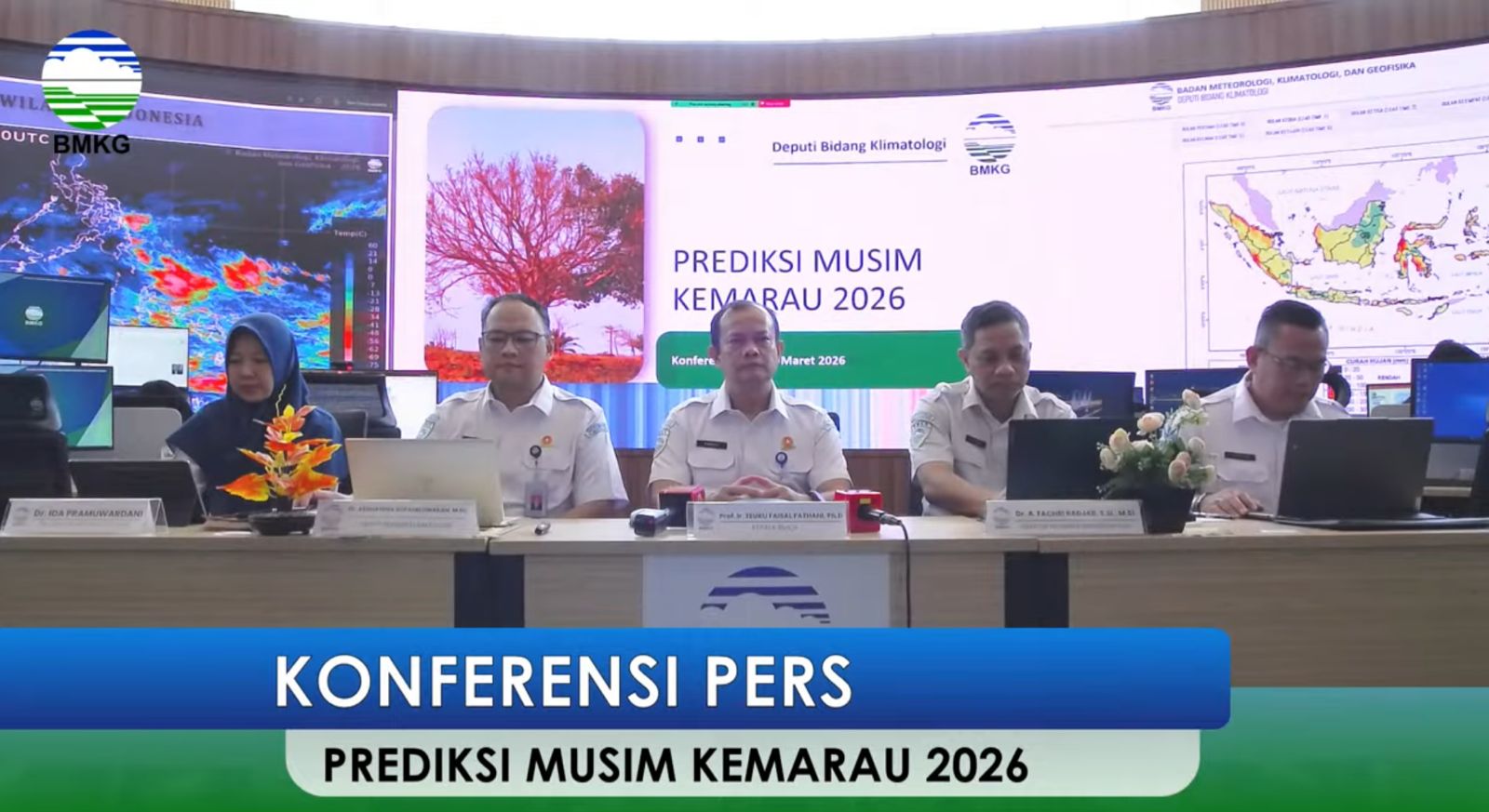

RADAR TULUNGAGUNG – BMKG officially released the Indonesia 2026 drought forecast, warning that this year’s dry season will arrive earlier and bring significantly drier conditions across much of the country.
The Indonesia 2026 drought forecast shows that 64.5 percent of seasonal zones are expected to experience below-normal rainfall. This means most regions will face a longer and harsher dry period compared to the climatological average.
Under the 2026 drought forecast, major agricultural areas, water resource systems, and forest zones are projected to face increased pressure, prompting authorities to call for early mitigation and climate risk management measures.
The head of Badan Meteorologi, Klimatologi, dan Geofisika (BMKG) delivered the announcement during a national climate briefing on March 4. She stressed that early preparation can reduce economic losses and limit environmental damage.
BMKG’s climatology division said the 2026 dry season will begin earlier in many regions. Because the onset will advance, several provinces may experience a longer dry spell.
The agency clarified that officials use the term “below-normal rainfall” in formal classifications. On the forecast map, brown areas mark regions expected to receive less rain than usual.
Regions facing below-normal rainfall include parts of Aceh, South Sumatra, and Lampung, along with nearly all of Java. Bali, West Nusa Tenggara, East Nusa Tenggara, West Kalimantan, Central Kalimantan, South Kalimantan, parts of East Kalimantan, sections of Sulawesi, Maluku, North Maluku, and parts of Papua may also turn drier than average.
Lower rainfall will directly affect agriculture, one of Indonesia’s most climate-sensitive sectors. BMKG advises farmers to adjust planting schedules immediately, especially in rain-fed areas.
The agency encourages farmers to choose drought-resistant crops, prioritize low-water commodities, and adopt shorter planting cycles. These steps can help reduce crop failure during prolonged dry spells.
Irrigated farmland may withstand the impact better. However, regional governments must maintain irrigation networks and manage water reserves carefully. Indonesia operates more than 220 dams that support farming and hydropower generation.
Authorities are urging local administrations to revitalize reservoirs, remove sediment buildup, and repair irrigation channels from primary to tertiary levels. Strong water management will prove crucial throughout the dry season.
The drought outlook also raises concerns about forest and land fires. Historically, below-normal rainfall often leads to higher wildfire activity.
Officials have already detected early hotspots in Riau and West Kalimantan. In response, authorities launched weather modification operations in vulnerable peatland areas to boost soil moisture before peak dryness sets in.
BMKG continues to monitor fire risks through daily, monthly, and six-month outlooks. The agency shares these updates with central and regional governments, especially in fire-prone provinces such as Riau, Jambi, South Sumatra, West Kalimantan, Central Kalimantan, and South Kalimantan.
Despite the approaching dry season, BMKG reminds the public that the current transitional period, known locally as pancaroba, can still trigger extreme weather.
Short but intense downpours may occur during this phase. Storms can bring lightning, strong winds, hail, and even localized tornadoes due to unstable atmospheric conditions.
Because seasonal cycles differ across regions, the transition period varies in length. BMKG therefore urges communities to follow official weather advisories closely.
BMKG emphasizes that the value of the Indonesia 2026 Drought Forecast depends on how quickly stakeholders act. The agency designed the outlook to guide planning in agriculture, water management, and forestry.
National ministries, local governments, and disaster mitigation agencies must translate climate data into concrete policies and field action. Without swift implementation, forecasts alone will not prevent losses.
As Indonesia moves toward an earlier and potentially harsher dry season, the coming months will test the country’s ability to manage drought risks, protect food security, and prevent destructive forest fires.