
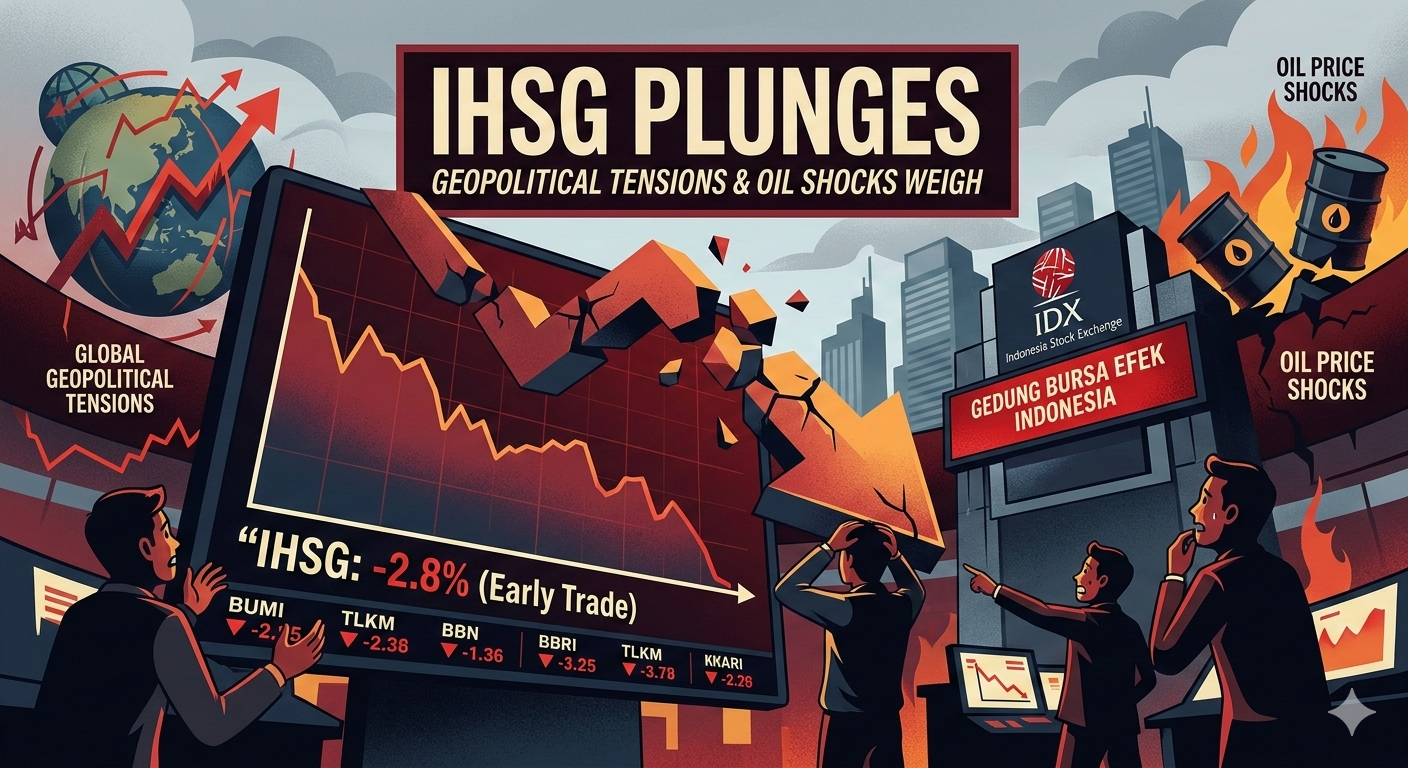

RADAR TULUNGAGUNG – The IHSG plunges sharply in early Wednesday trading, extending its recent losing streak as global geopolitical tensions and oil price shocks weigh heavily on the Indonesia stock market. At 10:02 a.m. Western Indonesia Time, the Jakarta Composite Index (IHSG) had fallen 187.91 points, or 2.4 percent, to 7,746.21. At its deepest correction within the first trading hour, the index slid 3.35 percent to 7,676.95, breaking below the psychological 7,700 level.
The IHSG plunges just minutes after the market opened, reflecting persistent selling pressure that began earlier this week. A day earlier, the index closed down 0.96 percent, following a steep 2.65 percent drop two days prior. Market participants reacted quickly, with sell-offs dominating across major sectors.
Data from the Indonesia Stock Exchange show that 563 stocks declined, while only 117 advanced and 278 remained unchanged. Trading value reached Rp5.23 trillion, involving 9.45 billion shares in nearly 598,000 transactions. The breadth of the decline indicates broad-based weakness rather than isolated sectoral corrections.
Several heavily traded stocks led the decline. Shares of PT Bumi Resources, PT GoTo Gojek Tokopedia, and Bank Mandiri ranked among the most actively traded counters in early transactions. All three weakened, adding pressure on the benchmark index.
Gold mining issuers also moved lower in tandem, becoming major drags on the IHSG’s performance. The sell-off reflects cautious investor sentiment amid rising global uncertainty.
Financial sector stocks fell 2.37 percent, while primary consumer goods dropped 2.7 percent. Non-primary consumer stocks suffered deeper losses at 4.82 percent. Meanwhile, industrial stocks corrected 3.82 percent. Overall, four main sectors recorded declines in the 2 to 4 percent range.
The energy sector slipped 3.1 percent despite surging global oil prices. Basic materials stocks tumbled 6.68 percent, making them the worst-performing segment of the session. Infrastructure fell 3.99 percent, and property declined 2.8 percent.
Technology shares lost 2.54 percent, transportation stocks plunged 5.04 percent, and healthcare eased 1.51 percent. The synchronized downturn across sectors underscores widespread risk aversion among investors.
External pressures continue to dominate market sentiment. Escalating military tensions involving the United States, Israel, and Iran have intensified fears of disruptions in global energy supply.
Concerns center on the Strait of Hormuz, a critical energy transit route in the Persian Gulf that carries around 20 percent of global oil and 25 percent of global gas shipments. Iranian military officials have warned of potential closure of the strategic waterway, even threatening to target vessels passing through the area.
As a result, Brent crude prices jumped 5.4 percent, while West Texas Intermediate (WTI) surged 4.7 percent on Tuesday. Over the past three trading days, oil prices have rallied approximately 15 percent. While higher oil prices may benefit energy producers, they also heighten inflation risks and global economic uncertainty.
Currency markets also reflected the pressure. The rupiah weakened toward the 17,000 mark against the US dollar. In spot trading, the currency moved within a range of Rp16,890 to Rp16,930, with transactions recorded at around Rp16,900 per dollar.
The rupiah also depreciated against other major currencies. It slipped 0.23 percent against the Singapore dollar, 0.37 percent versus the Japanese yen, and 0.16 percent against the euro. The weakening currency adds another layer of concern for investors monitoring capital flows and import costs.
Amid global headwinds, the government hopes domestic stimulus will provide a cushion. Ahead of Idul Fitri 1447 Hijri, authorities have rolled out measures aimed at maintaining purchasing power and supporting first-quarter 2026 economic growth.
The government has allocated Rp55 trillion for the disbursement of holiday allowances (THR) to state civil servants and private sector workers. Coordinating Minister for Economic Affairs Airlangga Hartarto confirmed that the THR will be paid in full, covering base salary and various allowances.
In addition, the Ministry of Manpower has required companies to pay full THR without installments. The government also facilitated holiday bonuses (BHR) for more than 850,000 online motorcycle taxi drivers, with total funds reaching around Rp220 billion.
Market observers believe these measures could provide short-term support for domestic consumption. However, for now, global risks and energy market volatility continue to overshadow local optimism, keeping investors on edge as the IHSG struggles to stabilize.