
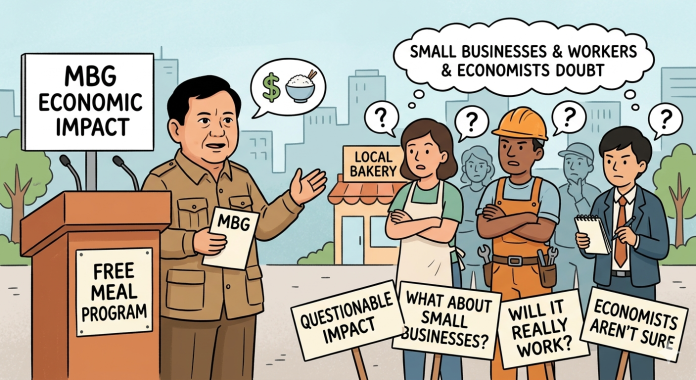

RADAR TULUNGAGUNG – One year after the launch of Indonesia’s MBG program, officially promoted as a solution for improving child nutrition and boosting the economy, new criticism has emerged over its real economic impact. While the government highlights millions of meals distributed and hundreds of thousands of jobs created, critics argue that the program may benefit political insiders more than ordinary Indonesians.
The MBG program, widely known as Prabowo Subianto’s flagship Free Nutritious Meal initiative, has become one of the most discussed national policies in recent months. According to data from the National Nutrition Agency (BGN) as of December 19, 2025, the program reportedly absorbed more than 754,000 workers through nearly 18,000 Nutrition Fulfillment Service Units (SPPG) across 38 provinces.
The government also claimed that over 43,000 suppliers had participated in supporting the MBG ecosystem. Supporters of the program often point to stories from volunteers who finally received income after long periods of unemployment.
However, critics and local residents have begun questioning whether the MBG economic impact truly benefits communities equally.
Limited Local Hiring Raises Questions
In Cirebon, West Java, a neighborhood leader revealed that only one person from around 200 households in his area managed to secure work as an MBG volunteer. Many residents reportedly hoped the nearby SPPG kitchen would open more employment opportunities for locals.
Ironically, BGN’s own technical guidelines state that at least 30 percent of volunteers should come from surrounding communities.
Concerns over labor conditions also emerged in Bandung, where workers at one SPPG kitchen reportedly demanded transparency regarding wage schemes after overtime pay disappeared. Critics argue that many MBG workers remain vulnerable because they only receive daily wages without written employment contracts.
Economist Bima Yudhistira described the situation as evidence that MBG creates informal-sector jobs rather than stable employment opportunities. According to him, the government’s claim of generating 1.5 million new jobs may not accurately reflect the reality faced by workers on the ground.
Small Businesses Feel the Pressure
The MBG economic impact has also triggered complaints from traditional market traders and small food businesses.
In Solo, Central Java, spice sellers claimed their revenues dropped by up to 50 percent because many school canteen operators stopped selling food after MBG meals became available. Vegetable vendors also reported difficulties obtaining fresh produce because suppliers prioritized bulk purchases from MBG kitchens.
Hermawati Setiorini, chairwoman of the Indonesian MSME Industry Association, explained that the massive scale of MBG kitchens often pushed suppliers to buy directly from middlemen instead of sourcing from small local businesses.
As a result, micro-business participation in MBG supply chains reportedly remains below 10 percent. Even small businesses that succeeded in becoming suppliers allegedly needed personal connections with kitchen operators to secure contracts.
Allegations of Political Patronage
The controversy surrounding the MBG program intensified after Indonesia Corruption Watch (ICW) released findings about foundations managing MBG kitchens.
According to ICW, several foundations allegedly obtained projects because of connections to political parties, military figures, police institutions, and volunteer groups linked to the 2024 presidential election campaign.
The organization concluded that MBG implementation was heavily influenced by patronage practices and conflicts of interest. Critics argued that the program had transformed into a political consolidation tool instead of a purely social welfare initiative.
Some analysts claimed that individuals and groups closest to political power appeared to receive the largest economic benefits from the project. They argued that affiliations with campaign networks, security institutions, and political organizations played a significant role in determining access to MBG-related opportunities.
Rising Food Prices and Market Disruption
Economists also warned that MBG could unintentionally damage traditional market systems.
When large-scale suppliers prioritize MBG kitchens, smaller traders often struggle to secure food stock. Reduced availability in traditional markets can eventually drive prices higher, putting pressure on consumers whose purchasing power remains limited.
Bima Yudhistira argued that the government failed to calculate the hidden economic losses suffered by small vendors, warteg owners, and catering businesses. He estimated that more than one million school canteen and catering workers may have lost income because MBG replaced their customer base.
Critics believe the policy risks creating dependency on centralized food distribution while weakening local economic ecosystems that previously supported thousands of small entrepreneurs.
Meanwhile, BGN Deputy Head Nani SD rejected the findings discussed in the BBC News Indonesia investigation. She dismissed the report as misleading and questioned the credibility of sources because the identities of volunteers and SPPG kitchens were not publicly disclosed.
Despite the criticism, public debate over the MBG economic impact continues to grow as Indonesians evaluate whether the ambitious program truly delivers equal economic benefits nationwide.