
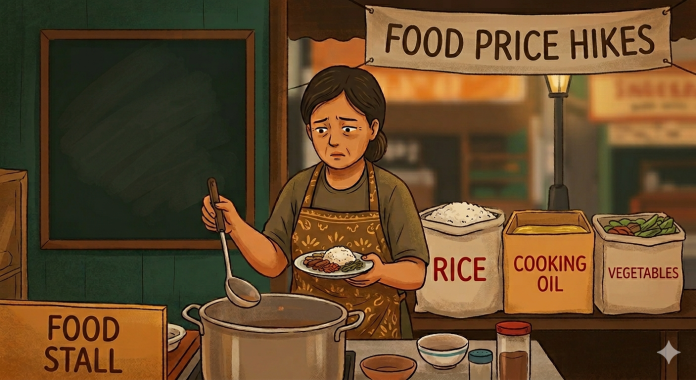

RADAR TULUNGAGUNG – Rising food prices in Surabaya are putting growing pressure on small restaurant owners, with many forced to reduce meal portions while keeping prices unchanged to avoid losing customers. Local food vendors say soaring costs of rice, cooking oil, vegetables, and other staples are threatening the sustainability of their businesses.
Small eateries across Surabaya, particularly those serving students and low-income residents, are struggling to absorb the continued increase in food prices. Vendors say they have little choice but to cut portion sizes instead of raising menu prices, fearing customers would stop buying meals altogether.
One of the affected business owners is Ana, who operates a small food stall in the Dukuh Kupang area of Surabaya. Speaking to Kompas TV, Ana said the surge in staple food prices has directly affected her daily operations and forced her to adjust the quantity of food served to customers.
Small Food Businesses Hit by Rising Food Prices
Ana explained that although the prices of ingredients such as rice, cooking oil, and vegetables have increased significantly, many food stall operators cannot pass the burden onto consumers. The majority of their customers are students and lower-income residents who are highly sensitive to price increases.
“As food vendors, we cannot increase food prices easily,” Ana said. “So we reduce the portions instead, while maintaining the same quality.”
According to Ana, staple ingredients including cooking oil, rice, and fresh vegetables have become noticeably more expensive in recent weeks. However, she noted that soybean-based products such as tofu and tempeh have not yet experienced severe price spikes at her supplier level.
Ana purchases tofu and tempeh in bulk for various dishes sold at her eatery. The ingredients are processed into several traditional Indonesian menu items, including botok, bali-style dishes, and kotokan. She said maintaining menu quality remains her top priority despite shrinking profit margins.
The impact of rising food prices is not limited to restaurant owners. Market activity in Surabaya has also slowed as household consumers reduce spending on non-essential items due to higher daily expenses.
Vendors Struggle to Balance Costs and Customer Demand
Ana revealed that her daily tempeh purchases currently cost between Rp90,000 and Rp100,000 ($5.50-$6.10), while a large container of tofu can reach Rp200,000 to Rp250,000 ($12-$15). The increasing operational burden has forced many small vendors to rethink purchasing strategies and food preparation volumes.
Food vendors interviewed in Surabaya said they face a difficult balancing act. Raising menu prices could drive customers away, but maintaining current prices while ingredient costs continue rising threatens long-term profitability.
The situation reflects broader concerns about food inflation in Indonesia, where fluctuations in staple commodity prices frequently affect small businesses and household spending power. Cooking oil, rice, onions, chilies, and vegetables remain among the most closely monitored commodities due to their importance in daily consumption.
Economic observers have warned that prolonged instability in staple food prices could weaken purchasing power further and place additional pressure on micro and small enterprises, which form a major part of Indonesia’s informal economy.
Calls for Government Action to Stabilize Food Prices
Food stall owners in Surabaya are now calling on the government to take immediate measures to stabilize food prices and ensure affordable access to essential ingredients. Vendors argue that stable commodity prices are crucial for keeping small culinary businesses operating smoothly.
Ana said many local business owners hope authorities can control price volatility before it causes wider economic disruption among small-scale food entrepreneurs.
“We hope food ingredient prices can return to stable levels soon so businesses like ours can continue running normally,” she said.
Local vendors also stressed that stable prices would help preserve both the quality and quantity of meals served to customers, especially in areas heavily dependent on affordable street food and small family-run eateries.
The issue highlights the vulnerability of Indonesia’s small food businesses to fluctuations in staple commodity prices. For many vendors in Surabaya, maintaining customer loyalty while coping with rising operational costs has become an increasingly difficult challenge as inflationary pressures continue to affect daily trade activity.