
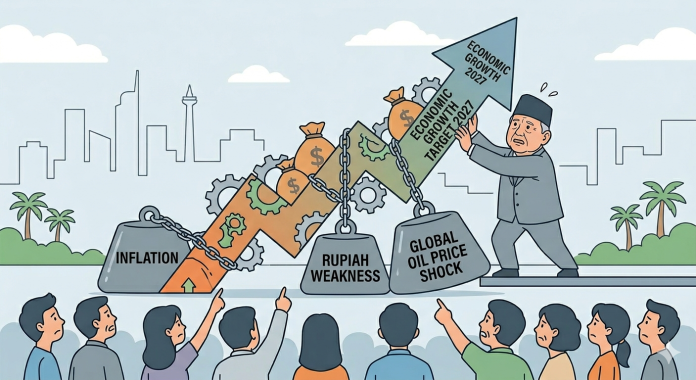

RADAR TULUNGAGUNG – Indonesian President Prabowo Subianto unveiled the macroeconomic framework for the 2027 state budget at parliament on Thursday, projecting economic growth of 5.8% to 6.5%. However, economists immediately questioned whether the ambitious target could withstand mounting global pressures, including surging oil prices, inflation risks, and a weakening rupiah.
The debate emerged during a televised discussion featuring capital market analyst Feri Latuhihin and Sugiat Santoso, a lawmaker from Prabowo’s Gerindra Party. While the government defended its “people-centered economy” strategy, analysts warned that Indonesia could struggle to maintain even 4.5% growth if global conditions worsen.
Latuhihin argued that financial markets remain unconvinced by the government’s optimistic economic growth target. He pointed to the Jakarta Composite Index continuing its decline and the rupiah briefly touching Rp17,800 per US dollar earlier in the day.
Economists Warn High Oil Prices Could Derail Growth
Latuhihin said the biggest threat to Indonesia’s economic growth target comes from global oil prices and geopolitical instability in the Middle East. According to him, crude oil prices in futures markets have climbed above US$100 per barrel and could reach US$140 after transportation and insurance costs.
He warned that no country remains immune when energy prices surge at that scale, including the United States despite its status as a net oil exporter.
“If oil prices stay above US$100 for the next two years, achieving 4.5% growth would already be considered good,” he said during the discussion.
The economist also predicted Indonesia could face double-digit inflation starting in May as producers begin passing higher energy costs to consumers. He noted that April inflation had not yet fully reflected the impact because many businesses were still using older inventory stocks.
Latuhihin linked the inflation threat to weakening household purchasing power, citing rising online lending debt and declining public savings over the last five years. Since household consumption remains Indonesia’s largest economic driver, he warned that prolonged inflation could significantly suppress domestic demand.
He also highlighted concerns over potential mass layoffs after Industry Minister Agus Gumiwang reportedly warned that a “wave of layoffs” may be approaching. According to Latuhihin, worsening unemployment could reduce tax revenues and place further strain on the government’s fiscal position.
Government Defends ‘People’s Economy’ Strategy
Sugiat Santoso rejected the criticism, arguing that Prabowo’s economic vision cannot be measured solely through liberal capitalist or market-based frameworks.
He said the administration’s approach centers on Article 33 of Indonesia’s Constitution, which emphasizes state control over natural resources for public welfare. According to Sugiat, the government aims to strengthen economic sovereignty rather than rely excessively on stock market performance or currency movements.
“The priority is ensuring the people remain protected economically regardless of global market conditions,” he said.
Sugiat claimed several of Prabowo’s flagship programs already reflect that strategy, including the recovery of 5.8 million hectares of land previously controlled by oligarchic interests and the expansion of rural economic initiatives.
He also defended programs such as MBG and the Merah Putih Village Cooperatives initiative, saying they could generate millions of new jobs instead of triggering unemployment.
The lawmaker acknowledged, however, that bureaucratic inefficiency remains a major obstacle. He argued that many government policies fail at the implementation stage due to slow licensing processes and administrative bottlenecks.
Rupiah Stability and Fiscal Risks Remain Key Concerns
The weakening rupiah became another central issue in the debate. Prabowo’s government targets an exchange rate between Rp16,800 and Rp17,500 per US dollar, but Latuhihin questioned whether the goal remains achievable.
He said rising global interest rates have accelerated capital outflows from emerging markets like Indonesia, while Bank Indonesia has limited remaining tools to defend the currency. The central bank recently raised interest rates, but the move failed to significantly strengthen the rupiah.
Latuhihin also warned that a possible El Niño-driven food crisis later this year could increase Indonesia’s import demand and further pressure the currency.
Beyond currency risks, he cautioned about Indonesia’s fiscal outlook after ratings agencies reportedly revised the country’s outlook from stable to negative. While Indonesia’s debt-to-GDP ratio remains relatively low at around 40%, he noted that debt servicing costs are approaching critical thresholds measured by international credit agencies.
Sugiat responded by insisting Indonesia’s long-term resilience depends on food security, energy security, downstream industrialization, and domestic production capacity. He argued that if those strategic programs succeed, Indonesia would be better insulated from global economic shocks.
Despite their sharp differences, both speakers agreed that geopolitical tensions and global economic uncertainty will play a major role in shaping Indonesia’s economic trajectory over the next two years.