
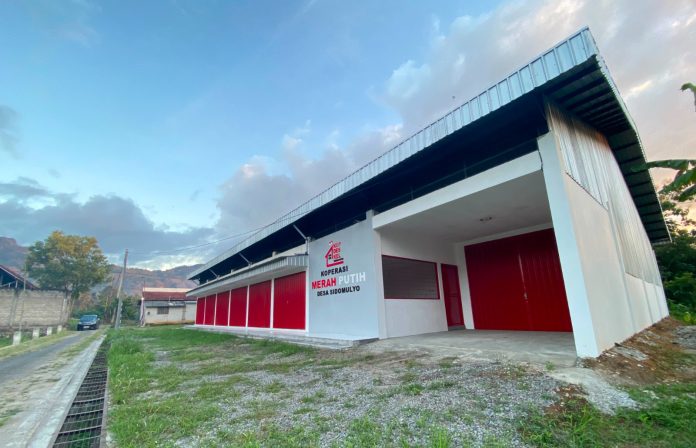

TULUNGAGUNG – The construction of Merah Putih Village Cooperatives (KDKMP) in Tulungagung Regency, East Java, is progressing slower than expected, with land availability emerging as the primary obstacle for hundreds of planned projects.
The Merah Putih Village Cooperatives program aims to strengthen local economies by establishing cooperative centers in villages and urban wards across Indonesia. However, many communities in Tulungagung have not started construction because they do not have suitable land assets that meet government requirements.
According to Lieutenant Colonel Hanny Galih Satrio, commander of the Tulungagung Military District Command (Kodim 0807), only 140 of the regency’s 257 villages and 14 urban wards have entered the first phase of the program. Of those locations, 37 villages have completed construction.
“One of the major challenges is that some villages do not own land, while others have land assets that are too small for the project,” Hanny said on Thursday.
As a result, authorities launched the first phase of development in villages that already have adequate land. Nevertheless, many communities still cannot move forward because they have not resolved their land issues.
The challenge extends beyond villages. Tulungagung’s 14 urban wards face similar difficulties because most of them do not have land assets that satisfy the minimum requirements for cooperative construction.
To accelerate the project, the military, local government, and village administrations are working together to identify alternative locations.
Officials are also exploring the use of land managed by the state-owned forestry company Perhutani. This option is especially important in mountainous areas where available land remains scarce.
“Discussions regarding permits for Perhutani-managed land are still ongoing,” Hanny explained.
Meanwhile, Acting Regent Ahmad Baharudin acknowledged that land ownership remains one of the biggest hurdles for the program. In some cases, urban wards own land assets, but those properties lie outside their administrative boundaries, which complicates development plans.
“For example, Tamanan Urban Ward owns land assets in Boyolangu District rather than within its own territory,” Baharudin said.
Another issue involves 41 proposed construction sites. Local authorities currently classify those areas as Protected Agricultural Land (LSD). Officials are reviewing possible adjustments to the land status. They want to determine whether the sites can support cooperative development.
The Tulungagung administration has not yet made a final decision regarding those locations. However, officials continue to seek solutions that will allow the stalled projects to move forward.
Only 37 Merah Putih Village Cooperatives have been completed so far. The program’s success in Tulungagung will depend on how quickly authorities resolve land-related constraints and secure suitable sites.
The local government hopes the initiative will boost community-based economic growth. It also expects the program to expand business opportunities across the regency.