
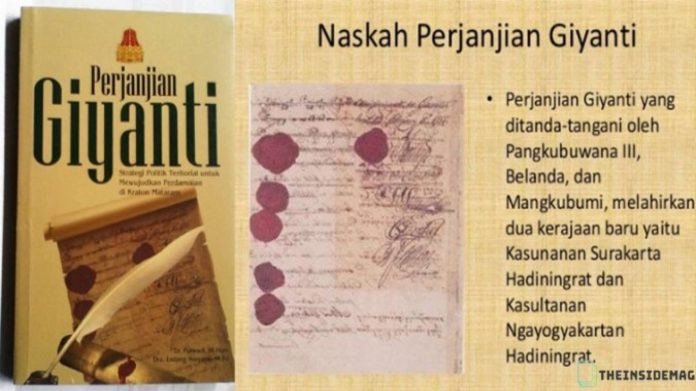

RADAR TULUNGAGUNG – The Giyanti Agreement of 1755 marked one of the most decisive turning points in Javanese history, ending years of civil war within the Mataram kingdom and formally dividing the powerful realm into the rival courts of Yogyakarta and Surakarta. The treaty reshaped the political and cultural landscape of Java for generations.
The Civil War That Shattered Mataram
The collapse of the Mataram kingdom began after the death of Pakubuwono II in December 1749. Before his death, the ruler entrusted the kingdom to the VOC during a period of political chaos, rebellion, and worsening health. However, Dutch officials interpreted the act not as temporary protection, but as a transfer of sovereignty.
Soon after, the VOC installed the teenage crown prince as Pakubuwono III in Surakarta. The decision triggered fierce resistance from Prince Mangkubumi, the younger brother of Pakubuwono II, who believed he held stronger legitimacy and broader support among Javanese elites.
Mangkubumi proclaimed himself the rightful ruler of Mataram and adopted the title Susuhunan Pakubuwono. By the end of 1749, Java effectively had two competing kings claiming authority over the same kingdom.
The conflict escalated into a prolonged civil war involving the VOC, Surakarta forces, and Mangkubumi’s supporters. Battles devastated villages across Java, while shifting alliances among Javanese nobles deepened instability. One of the most dramatic clashes occurred in Jenar, where Mangkubumi’s troops defeated VOC and Surakarta forces, killing several officers, including Major De Clerk.
By 1752, the rebellion fractured further when Raden Mas Said, later known as Mangkunegoro I, split from Mangkubumi after growing tensions over leadership, ambition, and military strategy. The former allies became bitter rivals, forcing Mangkubumi to reconsider his political approach.
Diplomacy, the VOC, and the Giyanti Agreement
The endless war drained both the Javanese factions and the VOC financially and militarily. In 1754, Dutch official Nicolaas Hartingh replaced Governor Von Hohendorff and introduced a more pragmatic diplomatic strategy.
Rather than continuing costly warfare to defend Pakubuwono III, the VOC opened negotiations with Mangkubumi. The prince also realized defeating Mangkunegoro while simultaneously fighting Surakarta and the Dutch had become nearly impossible.
A key intermediary in the negotiations was Syekh Ibrahim, an Ottoman-linked merchant trusted by both sides. Through him, Mangkubumi expressed willingness to accept a peaceful division of Mataram in exchange for royal recognition and territorial authority.
Negotiations intensified throughout 1754. Mangkubumi agreed to abandon the title Susuhunan Pakubuwono and instead accepted the title Sultan Hamengkubuwono, creating a distinct royal identity separate from Surakarta.
On February 13, 1755, the historic Giyanti Agreement was signed in Desa Gianti, now Jantiharjo in Central Java. The treaty formally divided the Mataram kingdom into two courts: the Yogyakarta Sultanate under Sultan Hamengkubuwono I and the Surakarta Sunanate under Pakubuwono III.
The agreement granted both kingdoms large territories across central and eastern Java. However, the borders remained highly complex, with overlapping claims that later triggered local disputes and instability.
Historical records show the treaty also required the VOC to pay annual compensation of 20,000 riyals linked to control of Java’s northern coastal regions. Despite Dutch involvement, historians argue the division largely reflected internal struggles among Javanese elites rather than a purely colonial strategy.
Birth of Yogyakarta and the Legacy of Division
Following the agreement, Sultan Hamengkubuwono I established a new capital in Yogyakarta, while Surakarta remained the seat of Pakubuwono III. The split also influenced Javanese culture, with both courts developing distinct traditions in batik, dance, gamelan, architecture, and royal ceremonies.
Although oral traditions often portray Yogyakarta as the guardian of “Old Mataram” culture and Surakarta as the creator of newer court traditions, historians note the cultural separation evolved gradually over decades rather than immediately after 1755.
The political rivalry also did not end with the Giyanti Agreement. Pakubuwono III later sought alliances with Mangkunegoro to counterbalance the growing influence of Sultan Hamengkubuwono I. Additional territorial divisions followed in 1757 and 1813, further fragmenting the old Mataram realm.
Despite becoming Dutch protectorates under the VOC and later colonial administrations, both royal houses survived into the modern era. During the Indonesian Revolution in 1945, the rulers of Yogyakarta and Surakarta declared support for the newly formed Republic of Indonesia.
Today, Yogyakarta retains its special autonomous status within Indonesia, while the legacy of the Giyanti Agreement continues to shape Javanese identity, politics, and royal tradition nearly three centuries later.