
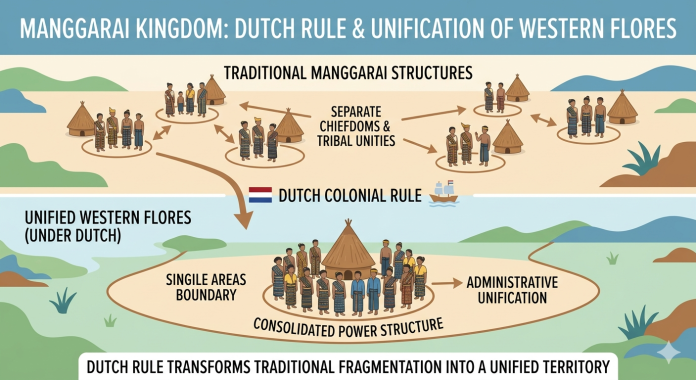

RADAR TULUNGAGUNG – The history of the Manggarai Kingdom reflects a major political transformation in western Flores, where Dutch colonial authorities consolidated dozens of traditional domains into a single administrative kingdom during the early 20th century. The move reshaped local governance and laid the foundation for modern Manggarai identity across western Flores.
Before Dutch intervention, the Manggarai region consisted of several influential traditional polities, including Todo, Cibal, and Bajo. For centuries, the area also experienced political influence from the Sultanate of Bima and, at times, the Sultanate of Gowa, creating a complex web of local and regional power relationships.
The establishment of the Manggarai Kingdom marked a turning point, as colonial authorities sought to create a unified administrative entity that stretched from the eastern boundary near Wae Mokel to the western areas facing the Sape Strait.
How Dutch Colonial Rule Unified Manggarai
Dutch colonial forces entered Manggarai in 1907 and formally consolidated their control over the region in 1908. Initially, colonial administrators planned to establish a civil center in Todo, the seat of one of the region’s most influential traditional rulers. However, geographic considerations prompted the administration to relocate its center to Ruteng.
Colonial authorities viewed the various traditional domains as components of a single territorial unit. This administrative approach eventually led to the formation of the Manggarai Kingdom, bringing together numerous local jurisdictions under one political framework. According to historical accounts, the kingdom was formally organized by the Dutch in the late 1920s and consisted of 38 kedaluan, or customary administrative districts.
One of the first rulers associated with the new kingdom was Raja Bagung of Pongkor. At the same time, Dutch authorities sponsored the education of Alexander Baruk, the son of Todo ruler Kraeng Tamur, in Manado. After returning from his studies in the early 1930s, Alexander Baruk assumed a leading role within the kingdom’s administration. Historical records indicate that Bagung and Baruk exercised authority simultaneously for a period, with distinct ceremonial and executive functions.
From Bima’s Influence to the Rise of Local Kingdoms
Long before Dutch rule, western Flores was closely linked to the Sultanate of Bima on Sumbawa. Following the decline of Gowa’s influence after the 1667 Treaty of Bungaya and the Makassar War of 1666–1669, Bima strengthened its position in Manggarai and became the dominant regional authority recognized by the VOC.
Historical sources describe a governance system built around kedaluan and gelarang, overseen by representatives of the Sultan of Bima known as naib. Major customary domains included Todo, Cibal, and Bajo, while smaller districts paid tribute through a layered political structure.
A notable episode occurred in 1727 when a Manggarai territory centered on Reo became part of a marriage arrangement involving a Makassarese princess, Daeng Tamima. Subsequent conflicts involving Bima, local rulers, and Makassarese interests reshaped political control in the region. By the mid-18th century, Bima had successfully reasserted its authority over Manggarai.
Lasting Legacy of the Manggarai Kingdom
The creation of the Manggarai Kingdom had lasting consequences for the region’s political and cultural identity. By integrating numerous customary territories into a single administrative entity, Dutch authorities accelerated the emergence of a broader Manggarai identity that transcended older divisions among Todo, Cibal, Bajo, and other local domains.
Following the deaths of Raja Bagung in 1947 and Alexander Baruk in 1949, leadership passed to Kraeng Constantinus Ngambut, also known as Kraeng Langkas, who remained a prominent ruler until the late 1950s. The transition coincided with Indonesia’s post-independence administrative restructuring, which gradually replaced traditional kingdoms with modern governmental institutions.
Today, the history of the Manggarai Kingdom remains an important part of western Flores’ cultural heritage, illustrating how indigenous leadership, regional sultanates, and colonial governance combined to shape one of eastern Indonesia’s most distinctive historical regions.