

RADAR TULUNGAGUNG – The assassination of Jayanegara, the second king of the Majapahit Empire, remains one of the most controversial events in Indonesian history. Rising to power in 1309 after the death of his father, Raden Wijaya, Jayanegara inherited a kingdom that was still fragile and in the process of consolidation. His leadership, however, quickly drew criticism as political instability and internal conflicts began to dominate his reign.
From the very beginning, Jayanegara’s rule was marked by suspicion and harsh decisions. Several prominent figures who had once been loyal to the Majapahit court were accused of betrayal and eliminated. These actions triggered a series of rebellions, exposing deep fractures within the kingdom and weakening trust between the central authority and regional elites.
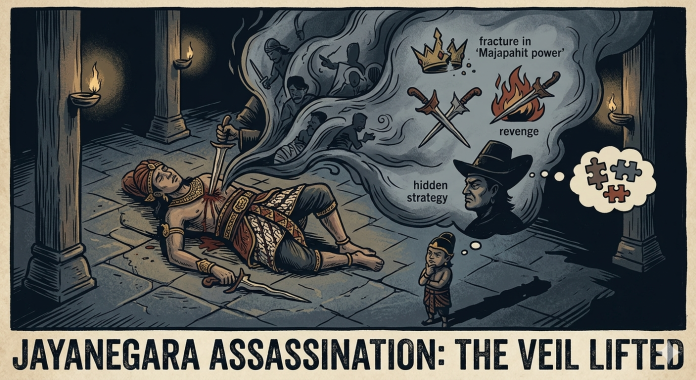
The Jayanegara assassination in 1328 ultimately became the turning point of his troubled reign. Killed by his own royal physician in what many believe was an act of revenge, his death not only shocked the palace but also opened the door to a rapid political transition. The incident continues to spark debate among historians, raising questions about whether it was purely personal vengeance or part of a larger political conspiracy.
A Reign Marked by Fear and Rebellion
Jayanegara ascended the throne at a young age, lacking the experience needed to stabilize a newly established kingdom. Instead of consolidating power through diplomacy, he ruled with suspicion and harsh measures. Several prominent figures who had once supported his father fell victim to his purges.
Names like Rangga Lawe, Lembu Sora, and Nambi became symbols of resistance. Rangga Lawe, a noble from Tuban, led one of the earliest rebellions after being denied a key political position. Although the uprising was suppressed, it revealed growing tensions between the central authority and regional elites.
The situation worsened in 1319 when a court official named Rakuti successfully seized the capital. Facing imminent danger, Jayanegara fled the palace. It was during this critical moment that a young figure named Gajah Mada emerged. As a member of the Bhayangkara guard, he orchestrated a strategic rescue, securing the king’s escape and restoring order.
This event marked the beginning of Gajah Mada’s rise in political influence.
Controversies Surrounding the King’s Personal Life
Beyond political instability, Jayanegara’s personal behavior further damaged his reputation. Historical narratives and local traditions describe actions that were widely considered immoral and inappropriate for a ruler.
One of the most controversial decisions was his prohibition against his half-sisters, Diah Gitarja and Diah Wiyat, from marrying. In royal tradition, marriage alliances were crucial for strengthening political ties. His refusal sparked speculation that he harbored improper intentions toward them.
Additionally, rumors circulated within the palace about his treatment of women from lower social classes. While not all accounts are verifiable, these stories contributed to widespread unrest and dissatisfaction among both nobles and commoners.
The Revenge That Changed History
The most dramatic turning point came from an unexpected figure: a royal physician named Ratanca, also known as Tanca. A trusted healer from Kudadu, he had long served the royal family. However, his loyalty turned into resentment after his wife was allegedly mistreated while serving in the palace.
With no legal means to challenge the king, Ratanca harbored his anger in silence. The opportunity for revenge came in 1328 when Jayanegara fell seriously ill. As the royal physician, Ratanca was granted direct access to treat him.
According to historical accounts, Ratanca requested a private session for the treatment. Once inside the chamber, he drew a concealed surgical instrument and stabbed the king multiple times. Jayanegara, weakened by illness, was unable to resist.
Guards rushed in moments later, finding the king lifeless and Ratanca standing calmly beside him. He was immediately executed, bringing a swift end to both lives.
Power Transition and Political Speculation
Following Jayanegara’s death, the palace quickly moved to stabilize the situation. Gayatri Rajapatni took control and appointed her daughter, Tribhuwana Tunggadewi, as the new ruler.
The speed of this transition has raised questions among historians. Some believe it was a well-prepared political move rather than a spontaneous decision. There are also theories suggesting that Gajah Mada may have played a behind-the-scenes role in orchestrating events.
Jayanegara’s leadership, often described as paranoid and ineffective, was seen as an obstacle to Majapahit’s expansion. In contrast, Gajah Mada envisioned a powerful and unified empire, a vision he would later pursue during Tribhuwana’s reign.
A Legacy of Controversy
Officially, Jayanegara’s death was recorded as an act of betrayal by a royal physician. However, alternative interpretations paint it as an act of resistance against a ruler who had overstepped his authority.
To this day, the assassination remains a subject of debate. Was it purely personal revenge, or part of a larger political strategy?
What is clear is that Jayanegara’s reign left a lasting impact on the trajectory of the Majapahit Empire, paving the way for a new era under stronger and more visionary leadership.