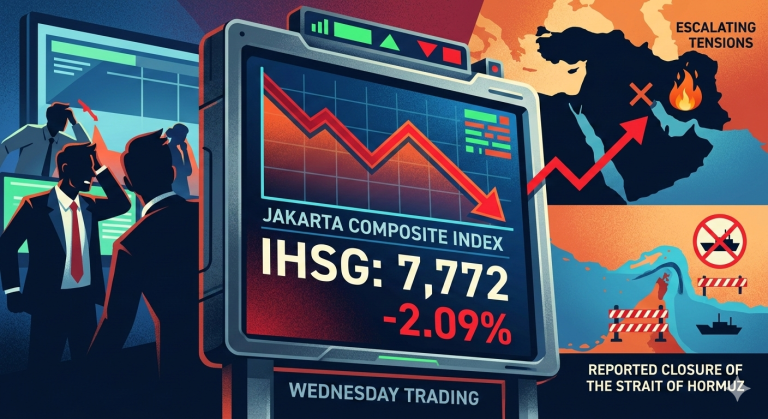
RADAR TULUNGAGUNG – IHSG weakens sharply in Wednesday’s trading session, sliding more than 2 percent within the first hour as investors react to escalating tensions in the Middle East and the reported closure of the Strait of Hormuz. The Jakarta Composite Index fell 2.09 percent to 7,772 after initially opening near the 7,800 level.
The IHSG weakens despite starting the session relatively stable. At the opening bell, the benchmark index still hovered around the 7,800 range. However, selling pressure intensified quickly, dragging the index down toward the psychological 7,700 zone.
Market participants closely monitoring the Indonesia Stock Exchange saw the IHSG weakens in tandem with rising global uncertainty. Concerns over geopolitical instability and potential disruptions in global energy supply have prompted investors to shift toward safer assets.
Sectoral data show broad-based weakness across the board. Within the first hour of trading, all 11 sectors on the exchange moved into negative territory, confirming widespread risk-off sentiment.
The financial sector fell 1.62 percent, contributing significantly to the index’s decline due to its heavy weighting. Primary consumer stocks slipped 1.69 percent, while non-primary consumer shares recorded a deeper correction of 2.83 percent. Industrial stocks edged down 1.41 percent.
The energy sector declined 1.3 percent, even as global oil prices remained volatile. Meanwhile, basic materials suffered one of the steepest drops, tumbling 4.95 percent. Infrastructure stocks fell 2.64 percent, and property shares slid 1.91 percent.
Technology stocks weakened 1.62 percent. Transportation and logistics stocks lost 2.87 percent, reflecting concerns over rising fuel costs and supply chain disruptions. Healthcare proved relatively resilient but still corrected 0.62 percent.
The synchronized downturn across sectors signals strong selling momentum rather than isolated profit-taking. Analysts note that external factors currently overshadow domestic fundamentals.
The main trigger behind the sell-off stems from growing geopolitical tensions in the Middle East. Market players are increasingly worried about the potential economic impact of a prolonged conflict involving major global powers in the region.
Particular concern surrounds the Strait of Hormuz, a vital global shipping lane through which a significant portion of the world’s oil supply passes. Reports of restricted access or possible closure have heightened fears of supply disruptions and rising energy prices.
For emerging markets like Indonesia, higher oil prices can widen the trade deficit, increase inflationary pressures, and weaken the currency. As a result, investors often reduce exposure to risk assets, including equities.
The reaction on the Indonesia Stock Exchange mirrors movements seen in other regional markets, where volatility has also increased amid global uncertainty.
The pressure was not limited to equities. The rupiah also depreciated alongside the stock market decline. The local currency broke through the psychological level of 16,900 against the US dollar, trading at 16,901 per dollar, down 0.30 percent.
The weakening rupiah reflects capital outflows and stronger demand for the greenback as a safe-haven currency. Currency traders are closely monitoring further developments in global geopolitics that may influence exchange rate stability.
Against other major currencies, the rupiah also showed broad weakness. It depreciated 0.32 percent against the Singapore dollar, declined 0.43 percent versus the Japanese yen, and fell 0.19 percent against the euro.
The parallel decline in equities and the rupiah indicates that foreign investors may be trimming positions in Indonesian assets amid heightened uncertainty.
Market analysts expect volatility to persist in the near term, especially if geopolitical tensions escalate further or energy supply disruptions materialize. The psychological 7,700 level now serves as a key support area for the IHSG.
If selling pressure continues, technical correction risks could deepen. Conversely, any signs of diplomatic de-escalation may help restore investor confidence and trigger a rebound.
For now, traders are advised to remain cautious and closely track global developments. With all sectors already in the red within the first hour of trading, the market’s direction will largely depend on external sentiment rather than domestic corporate performance.
As geopolitical risks remain elevated, investors are bracing for continued fluctuations in both the IHSG and the rupiah in the coming sessions.