
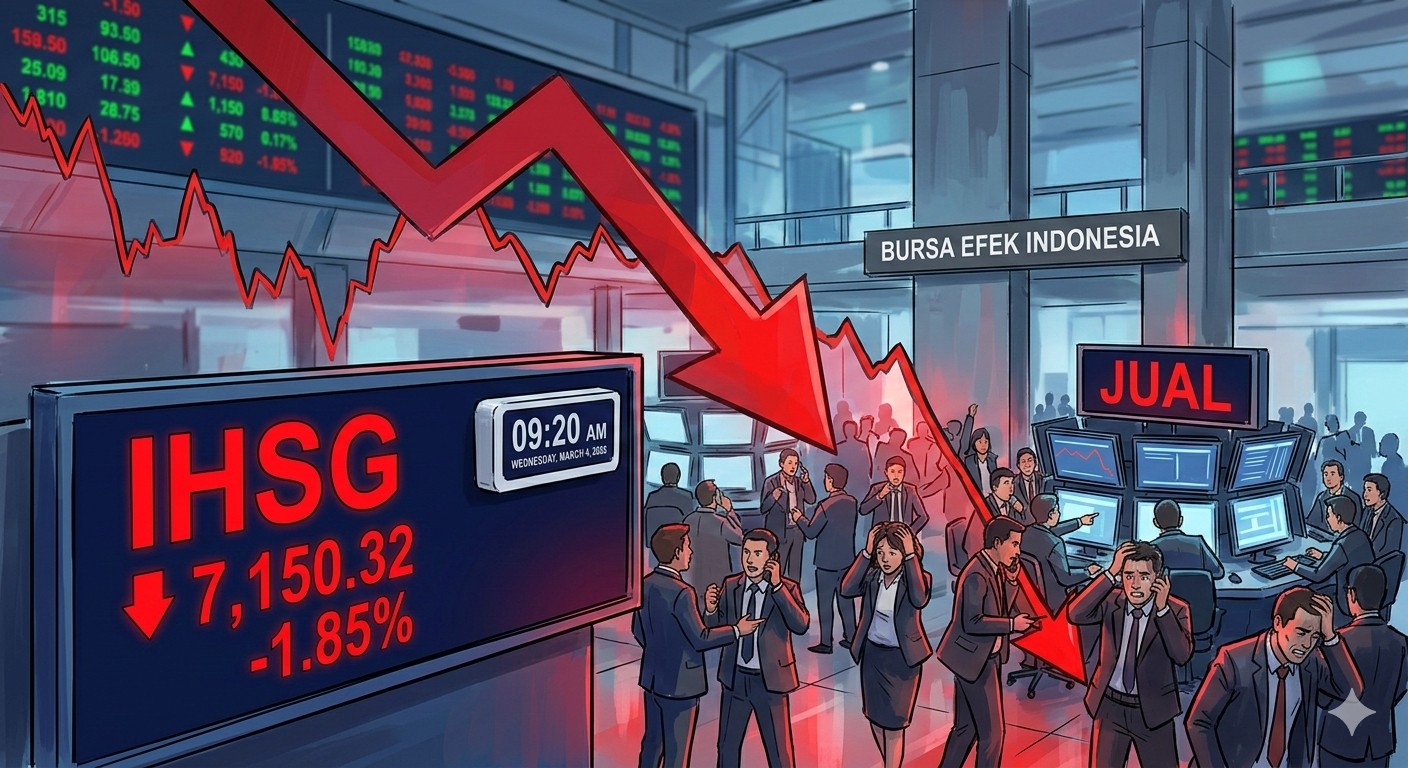

RADAR TULUNGAGUNG – The IHSG opens in red on Wednesday, March 4, 2026, as the Indonesia Stock Exchange recorded heavy selling pressure in early trading. Within the first 20 minutes of the session, the Jakarta Composite Index slipped sharply, reflecting cautious investor sentiment.
At 09:20 Western Indonesia Time, the IHSG opens in red and drops to 7,754. Earlier at the opening bell, the benchmark index had already weakened to 7,896. As trading progressed, the decline deepened, pushing the index to an intraday low of 7,736.
Market data show that the IHSG opens in red amid mounting pressure from a weakening rupiah and broad-based stock sell-offs. The local currency’s depreciation toward the psychological level of 17,000 per US dollar has further dampened investor confidence, triggering capital outflows from domestic equities.
According to official data from the Indonesia Stock Exchange, total trading value reached Rp4.86 trillion in early transactions. Investors traded 9.19 billion shares across the market, reflecting active but predominantly negative trading activity.
The market breadth clearly showed dominance of declining stocks. A total of 520 shares moved lower, while only 113 stocks posted gains. Meanwhile, 85 stocks remained unchanged. The imbalance highlights the intensity of the sell-off during the morning session.
Analysts observe that such broad weakness indicates not merely sectoral correction, but rather overall risk aversion among market participants. Investors appear to be repositioning portfolios amid external and domestic uncertainties.
One of the key factors weighing on the stock market is the rupiah’s continued depreciation. The local currency is approaching the 17,000 per US dollar mark, a psychological threshold closely monitored by traders.
Currency weakness often signals capital outflows and rising import costs. For equity investors, a depreciating rupiah raises concerns over inflationary pressures, higher production costs, and potential margin compression for listed companies.
The correlation between the currency market and the equity market became evident as the IHSG’s decline accelerated alongside the rupiah’s weakening trend. Foreign investors, who play a significant role in daily transactions, are particularly sensitive to exchange rate volatility.
The morning session reflected widespread selling across various sectors. Although detailed sectoral breakdowns were not fully disclosed in the early update, the dominance of declining stocks suggests pressure was not limited to a single industry.
Market participants also pointed to weakness in several large-cap and second-liner stocks as contributors to the index’s fall. Heavyweight shares tend to amplify index movements due to their substantial market capitalization.
Furthermore, sentiment around certain underperforming stocks added to the negative tone. Investors reacted swiftly to unfavorable developments, preferring to secure liquidity rather than hold risk assets during uncertain conditions.
The decline from the opening level of 7,896 to the intraday low of 7,736 underscores the intensity of the correction. Technically, the drop toward the mid-7,700 range puts the IHSG near a short-term support zone. If selling pressure persists, market watchers warn that further correction cannot be ruled out.
Market observers say the combination of rupiah depreciation and global uncertainty has created a fragile investment climate. Although domestic economic fundamentals remain relatively stable, short-term volatility continues to dominate trading patterns.
Investors are now closely watching whether the rupiah can stabilize below the 17,000 level. A successful defense of that threshold could help ease pressure on equities. Conversely, a break above it may intensify concerns over capital flight.
Despite the negative start, some analysts believe selective buying opportunities could emerge if valuations become more attractive. However, they emphasize that caution remains essential given ongoing currency fluctuations and external risks.
For now, the IHSG’s movement in the coming sessions will depend largely on currency stability and broader investor sentiment. With more than 520 stocks already in decline during early trading, market participants are bracing for continued volatility throughout the day.