
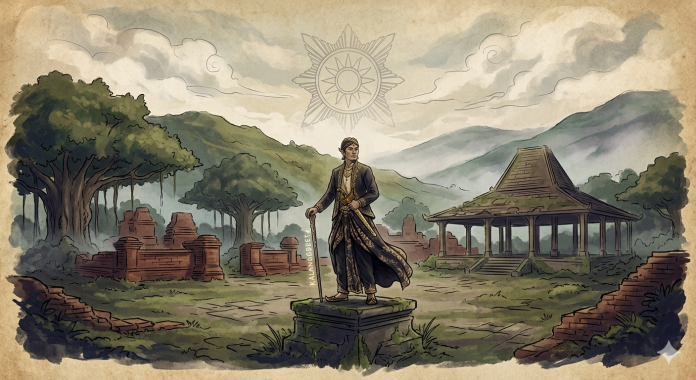

RADAR TULUNGAGUNG – Kalangbret Village in Kauman District has long attracted attention because of its legendary past. Many residents believe the village name originated from the tragic death of Adipati Kalang, a figure tied to stories from the Majapahit era. However, historical findings and local interviews reveal that the true origin of Kalangbret may be far older and more complex than the popular folklore circulating in the community.
Kalangbret itself is known as one of the oldest historical villages in Tulungagung. Local historians and village elders even mention that the area once served as the capital of Tulungagung before the administrative center moved elsewhere. That historical status makes the village closely connected to ancient political and cultural developments in the southern region of East Java.
The legend surrounding Kalangbret begins with a story linked to King Prabu Brawijaya of Majapahit. According to oral tradition, one of Brawijaya’s descendants became involved in a complicated conflict connected to a woman named Kembang Sore. The conflict eventually dragged several important figures into a deadly dispute that later shaped local folklore.
The Story of Adipati Kalang and Kembang Sore
Residents explained that Adipati Kalang once fell in love with Kembang Sore. However, their relationship reportedly triggered tension and violence among royal figures connected to the Majapahit Kingdom. The story became increasingly dramatic after the death of a nobleman known as Lembu Peteng.
Local accounts say Prabu Brawijaya later ordered Patih Gajah Mada to investigate the incident. During the search, Gajah Mada encountered Kalang and uncovered deeper conflicts involving the murder of royal figures.
The legend claims that Adipati Kalang eventually faced punishment after the truth behind the conflict emerged. According to the story, his body was cut repeatedly or “disembret-sembret.” Many villagers believe the phrase later evolved into the name “Kalangbret.”
The tragic tale remains deeply rooted in community memory. Several residents continue to pass the story from generation to generation, making it an inseparable part of Kalangbret’s cultural identity.
Journey to Gunung Bolo
To understand the connection between Adipati Kalang and Kembang Sore, researchers and local storytellers visited Gunung Bolo in Bulurejo. The area is believed to hold the grave of Kembang Sore and serves as an important spiritual site for local residents.
Stories from Gunung Bolo describe Kembang Sore as a respected figure who later chose a spiritual path after fleeing conflict. Oral narratives mention that she established a hermitage and lived as a religious ascetic.
The mountain area still preserves many mystical stories connected to Majapahit history. Elderly residents continue to recount tales about sacred heirlooms, keris battles, and spiritual powers that allegedly shaped the region’s early history.
Although many details remain difficult to verify historically, the stories continue attracting curiosity from visitors interested in Tulungagung’s ancient legends.
Historical Facts Challenge the Popular Myth
Despite the popularity of the Adipati Kalang legend, interviews with village elders reveal another perspective. Some senior residents argued that Kalangbret’s name did not originate from the death of Adipati Kalang at all.
Historical references indicate the name “Kalangbret” already existed long before the legendary conflict became part of local folklore. The term reportedly appeared in ancient records connected to Babat Tulungagung and the Giyanti Agreement of 1755.
Researchers also found references to Kalangbret in inscriptions related to Kadipaten Ngrowo, an early governmental region that once had its capital in Kalangbret. This evidence strengthens the argument that the village name predates the legend of Adipati Kalang.
Local elders explained that Kalangbret was once considered an important administrative center before the capital later moved and evolved into modern Tulungagung. That historical role gives the village a much broader significance beyond the mythological stories attached to it.
Between Myth and Historical Identity
Today, Kalangbret stands as a village where mythology and history blend together. The stories of Majapahit, Gajah Mada, Kembang Sore, and Adipati Kalang continue shaping the identity of local residents.
For some people, the legend represents cultural heritage that should remain preserved. Others believe historical evidence must become the main reference in understanding the village’s origins.
Even so, both perspectives contribute to the richness of Tulungagung’s historical landscape. The combination of folklore, oral tradition, and historical manuscripts keeps Kalangbret relevant as one of the most intriguing historical villages in East Java.
The village not only stores stories about ancient conflicts and royal figures but also reflects how collective memory can survive across generations despite changing times.