
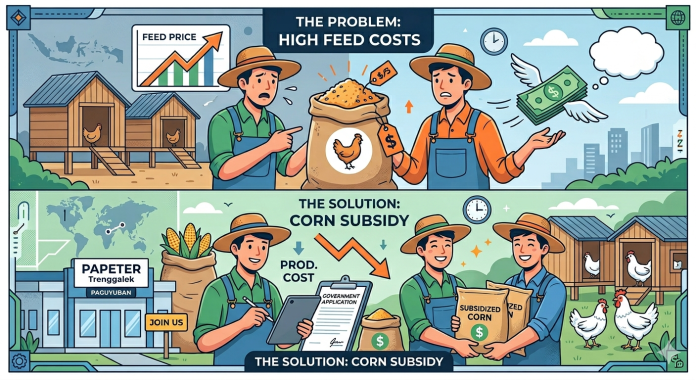

TRENGGALEK – The corn feed subsidy program is emerging as a crucial support measure for poultry farmers in Trenggalek as soaring feed costs continue to pressure the local egg production industry. Rising feed prices, driven partly by fluctuations in the U.S. dollar exchange rate, have forced farmers to look for ways to keep their businesses profitable.
Officials from the Trenggalek Livestock and Fisheries Agency say government-backed corn subsidies can help reduce production expenses. The program targets poultry farmers, including egg producers, whose operations rely heavily on corn-based feed.
Yoyon Hariyanto, Head of Breeding, Feed, and Livestock Production at the agency, said corn accounts for around 50 percent of poultry feed composition. As a result, increases in corn prices directly affect production costs.
“The subsidy helps farmers because corn makes up about half of the feed. When prices rise, farmers can apply for assistance,” Yoyon said.
The government introduced the subsidy program in 2024. Since then, it has become one of the key measures to support livestock producers facing volatile feed prices.
Data from the agency show that authorities distributed 812.4 tons of dried corn to 56 farmers across Trenggalek between 2024 and 2025. This year, officials have already delivered 65 tons during the first phase of distribution.
Yoyon said the application process remains similar to previous years. Farmers typically request subsidies when corn prices exceed Rp 6,000 per kilogram. Demand often increases further when prices approach Rp 9,000 per kilogram.
Under the program, farmers can purchase subsidized corn at approximately Rp 5,500 per kilogram. The National Food Agency provides corn at Rp 5,000 per kilogram, while farmer associations add a small operational fee before distribution. Farmers collect the subsidized corn from state logistics agency warehouses.
Authorities can distribute subsidies in up to four phases each year. However, the volume depends on market conditions and actual demand from farmers.
The agency also encourages poultry farmers who have not yet joined the Trenggalek Egg Farmers Association (Papeter) to become members. Membership allows easier access to government support programs, including feed subsidies.
Meanwhile, local egg farmer Defi Sugiarto from Ngulankulon Village in Pogalan District said feed prices continue to rise while egg prices remain unstable. That imbalance has created serious challenges for producers.
Defi said reducing feed quality is not an option because it could affect egg production. He also dismissed the idea of mixing cheaper ingredients into feed.
“If we reduce feed quality, the chickens may stop laying eggs,” he said.
He added that producing homemade feed requires additional time and labor. Therefore, he prefers maintaining high-quality feed to keep his flock healthy and sustain egg production.
“For us, healthy chickens are the priority. Good feed produces good eggs. As for prices, we have to follow the market,” Defi said.
As feed costs remain high, many farmers see the corn feed subsidy as an important buffer that helps protect poultry businesses and maintain local egg supplies.