
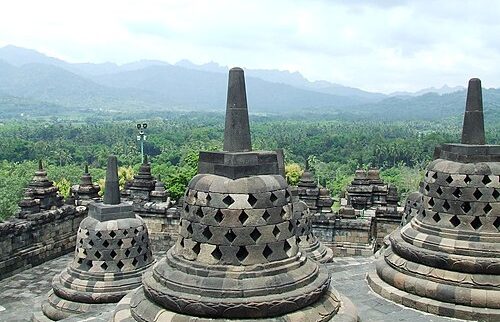

RADAR TULUNGAGUNG – The history of Borobudur Temple continues to fascinate global travelers and historians after the ancient Buddhist monument, once buried under volcanic ash and jungle growth for centuries, emerged as one of the world’s greatest archaeological rediscoveries. The massive temple complex in Central Java now stands as Indonesia’s most iconic cultural landmark and a UNESCO-recognized heritage treasure.
Built between the eighth and ninth centuries during the rule of the Syailendra Dynasty, Borobudur Temple remains the largest Buddhist temple in the world and one of the most important examples of Buddhist architecture in Asia. Historians believe the monument was constructed during the height of Mahayana Buddhism in Java, centuries before Cambodia’s Angkor Wat rose to prominence.
The monument’s layered terraces, giant central stupa, and thousands of relief panels have made Borobudur Temple a symbol of Indonesia’s ancient engineering brilliance and artistic sophistication.
The Origins and Architectural Greatness of Borobudur Temple
Located in Magelang, Borobudur Temple was built using approximately 55,000 cubic meters of andesite stone. Builders assembled the structure without cement, relying instead on an advanced interlocking system that allowed the stones to fit together like massive puzzle pieces.
Architects also designed a sophisticated drainage system to protect the monument from heavy tropical rainfall. More than 100 carved water spouts shaped like Makara, mythical creatures associated with water in Hindu tradition, were installed around the temple complex.
Borobudur consists of six square terraces topped by three circular platforms and a massive central stupa. The walls contain 2,672 relief panels and 504 Buddha statues, making it the world’s largest collection of Buddhist relief art.
The reliefs portray teachings from Buddhist philosophy, stories of Siddhartha Gautama, and scenes from ancient Javanese daily life. Archaeologists have studied the carvings to understand transportation systems, fashion, architecture, weapons, agriculture, and maritime culture in eighth-century Java.
One of the most famous depictions is the “Borobudur Ship,” a traditional outrigger vessel that highlights the maritime capabilities of ancient Nusantara civilizations.
Historians say the temple’s structure represents Buddhist cosmology through three spiritual levels: Kamadhatu, the realm of desire; Rupadhatu, the transitional world free from earthly desires but still tied to form; and Arupadhatu, the highest spiritual realm symbolizing liberation from worldly attachment.
How Borobudur Temple Disappeared for Centuries
Despite its grandeur, Borobudur Temple gradually fell into abandonment around the 14th century as Hindu-Buddhist kingdoms in Java declined and Islamic influence spread across the region.
Several historians also link the temple’s disappearance to volcanic eruptions and the relocation of the Medang Kingdom’s political center to East Java. Over time, layers of volcanic ash, soil, trees, and dense vegetation buried the monument, causing locals to view it merely as a large hill.
The temple remained hidden until the early 19th century when Thomas Stamford Raffles, then governor of Java under British administration, heard reports about a mysterious ancient structure deep inside a forest near Magelang.
In 1814, Raffles assigned Dutch engineer H.C. Cornelius to investigate the site. Cornelius and roughly 200 workers spent two months cutting trees, removing bushes, and clearing soil that covered the temple.
Their efforts revealed the massive Buddhist monument to the world once again. Although Raffles documented the discovery only briefly in his writings, historians credit him with drawing international attention to Borobudur Temple.
Looting, Restoration, and Modern Threats
Borobudur’s rediscovery unfortunately triggered widespread looting and vandalism. Local residents reportedly removed stones from the monument for construction materials, while collectors stole Buddha heads and sculptures for private collections and overseas museums.
In 1896, Chulalongkorn received permission from the Dutch colonial government to take several Borobudur artifacts to Thailand. Some of those pieces remain displayed in museums in Bangkok today.
Concerns over severe structural damage eventually pushed the Dutch East Indies administration to begin restoration work in 1907 under engineer Theodor van Erp. A second major restoration project followed between 1973 and 1983 with support from UNESCO and the Indonesian government.
The project strengthened the temple foundation and cleaned more than 1,400 relief panels.
However, Borobudur continued facing threats even after restoration. On January 21, 1985, bombs exploded across several levels of the temple complex, damaging stupas and structures. Authorities arrested two suspects, but investigators never fully uncovered the alleged mastermind behind the attack.
Despite repeated acts of vandalism and environmental damage, Borobudur Temple remains one of the world’s most visited Buddhist pilgrimage sites. Every year, Buddhists from across Indonesia and abroad gather at the monument to celebrate Vesak, commemorating the birth, enlightenment, and death of Buddha.
Today, Borobudur stands not only as a spiritual destination but also as a reminder of Indonesia’s rich civilizational history and the enduring effort required to preserve ancient cultural heritage for future generations.