
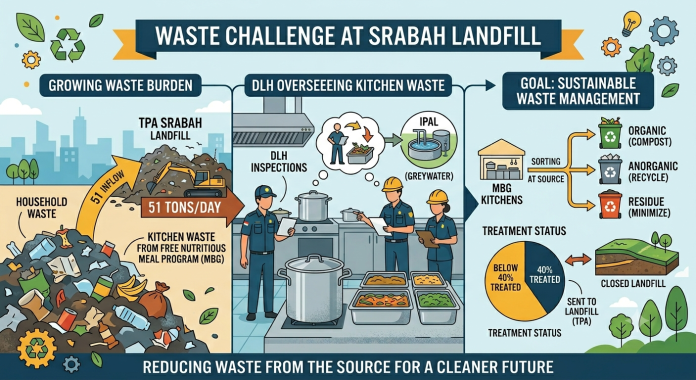

TRENGGALEK – MBG kitchen waste is adding pressure to Trenggalek’s main landfill as local authorities struggle to improve waste processing rates that remain below 40 percent.
The Srabah Landfill, the regency’s primary waste disposal site, already handles large volumes of household waste every day. Now, waste generated by kitchens serving Indonesia’s Free Nutritious Meal (MBG) program has emerged as another source of concern.
In response, the Trenggalek Environmental Agency (DLH) has intensified monitoring of waste management practices at Nutrition Fulfillment Service Units (SPPG), which operate the MBG kitchens.
Officials want to ensure that waste from large-scale cooking activities does not end up entirely at the landfill.
Acting DLH Head Cusi Kurniawati said her team has started inspections at several MBG kitchen locations. During the visits, officers also provide guidance on proper waste management.
“We have collected samples from several SPPG locations and will continue inspections at all MBG kitchens in Trenggalek. We are checking wastewater treatment systems and educating operators on managing waste directly from the source,” Cusi said.
According to the agency, kitchen waste could significantly increase pressure on the landfill if operators fail to process it properly.
Most organic waste generated by food preparation can still undergo treatment before disposal. Therefore, officials believe better waste management at the source can reduce the burden on landfill facilities.
DLH and the Regional Coordination Agency (Bakorwil) have already inspected two SPPG locations as pilot projects.
Meanwhile, authorities plan to expand inspections to additional MBG kitchens next week.
Cusi stressed that kitchen operators must do more than manage liquid waste through wastewater treatment plants. They must also sort and process solid waste before disposal.
“We have asked operators not to send all waste directly to the landfill. They must process organic waste, separate recyclable materials, isolate residual waste, and ensure liquid waste enters the treatment system,” she said.
Environmental officials view source-based waste management as a critical step in reducing landfill dependency.
Data from DLH shows that Trenggalek currently processes less than 40 percent of its waste. As a result, most waste still ends up at the Srabah Landfill.
Every day, waste collection services transport around 51 tons of garbage to the site.
Consequently, local authorities face growing challenges in maintaining sustainable waste management practices.
“If we fail to control waste at the source, including waste from MBG kitchens, the burden on the landfill will continue to increase. That is why upstream management remains essential,” Cusi explained.
Furthermore, the agency hopes MBG kitchens can become models for responsible waste management.
Officials believe the program should contribute to better environmental practices rather than create new environmental problems.
“Waste management is a shared responsibility. We want a more organized system so the landfill does not reach capacity too quickly,” said Cusi, who also serves as Assistant II to the Trenggalek Regional Secretary.
The growing volume of MBG kitchen waste highlights the importance of stronger waste reduction efforts as Trenggalek seeks to improve environmental sustainability and extend the lifespan of its landfill.