
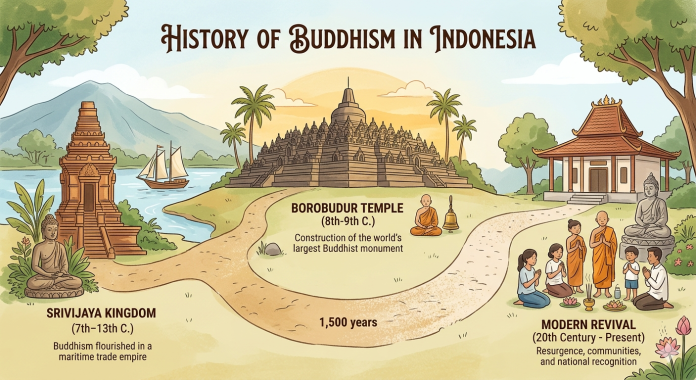

RADAR TULUNGAGUNG – The history of Buddhism in Indonesia stretches back more than 1,500 years, making it one of the oldest organized religions in the archipelago. From the rise of the Srivijaya Kingdom to the construction of Borobudur and the modern revival of Buddhist communities, the faith has played a significant role in shaping Indonesia’s cultural and religious landscape.
Historical records and archaeological findings suggest that Buddhism reached the Indonesian archipelago through maritime trade networks connecting India, Southeast Asia, and China. Buddhist monks and merchants are believed to have introduced the religion between the 2nd and 5th centuries CE, long before the emergence of major Buddhist kingdoms in the region.
Evidence from inscriptions, temples, and foreign travel accounts indicates that Buddhist teachings gradually spread across Sumatra and Java, where they later flourished alongside Hindu traditions.
The Rise of Buddhist Kingdoms in Nusantara
One of the most influential centers of Buddhism in Southeast Asia was the Srivijaya Kingdom, which emerged in Sumatra around the 7th century and remained a major regional power for several centuries.
Historical inscriptions show that Srivijaya officially embraced Buddhism and became a renowned center of Buddhist learning. The kingdom attracted scholars and monks from across Asia, helping establish the archipelago as an important destination for religious education.
Accounts from the Chinese Buddhist monk Yijing, who visited the region in the 7th century, described Srivijaya as a thriving center of Buddhist study. His writings reported the presence of large monastic communities and extensive religious scholarship, demonstrating the kingdom’s importance in the Buddhist world.
Some historical records also suggest that scholars connected to Srivijaya maintained intellectual ties with Nalanda University, one of the most prestigious centers of Buddhist learning in ancient India.
Borobudur and the Golden Age of Buddhism in Java
Buddhism expanded significantly in Central Java during the rule of the Sailendra Dynasty between the 8th and 9th centuries.
The dynasty left behind some of Indonesia’s most iconic cultural monuments, including Borobudur Temple, Mendut Temple, and Pawon Temple.
Borobudur, recognized as a UNESCO World Heritage Site, remains the largest Buddhist temple in the world. Built during the 8th and 9th centuries, the monument reflects the influence of Mahayana Buddhism and demonstrates the sophistication of religious, artistic, and architectural achievements in ancient Java.
Following the decline of Sailendra rule, Buddhism continued to coexist with Hindu traditions. Rather than competing, the two belief systems increasingly interacted and influenced one another, creating a distinctive cultural and religious environment across Java.
Syncretism, Decline, and Modern Revival
The blending of Hindu and Buddhist traditions reached its peak during the era of the Majapahit Empire, which ruled much of the archipelago from the late 13th to the 15th century.
Historical texts from the period describe concepts such as “Siwa-Buddha,” reflecting the close relationship between Hindu and Buddhist philosophies. Religious tolerance and coexistence became hallmarks of the kingdom, with both traditions enjoying official recognition.
After the decline of Majapahit in the late 15th century, the spread of Islam across many parts of the archipelago gradually reduced the influence of Buddhism. During the Dutch colonial era, Buddhist communities remained relatively small and were concentrated mainly among ethnic Chinese populations.
A significant revival began in the 20th century. The visit of Sri Lankan monk Narada Maha Thera in 1934 helped renew interest in Buddhist teachings. Following Indonesian independence, Buddhist organizations expanded, and national figures such as Ashin Jinarakkhita played a key role in rebuilding Buddhist institutions.
In 1956, Vesak celebrations returned to Borobudur for the first time in centuries, marking a major milestone in the religion’s modern revival. During the New Order period, Buddhist organizations continued to grow, while various traditions—including Theravada, Mahayana, Buddhayana, and others, expanded throughout the country.
Today, Buddhism remains one of Indonesia’s officially recognized religions. Although Buddhists represent a minority of the population, the faith continues to contribute to the nation’s cultural diversity and spiritual heritage.
The long history of Buddhism in Indonesia, from ancient trade routes and powerful kingdoms to modern religious communities, demonstrates the enduring influence of a tradition that helped shape the civilization of Nusantara for more than a millennium.