
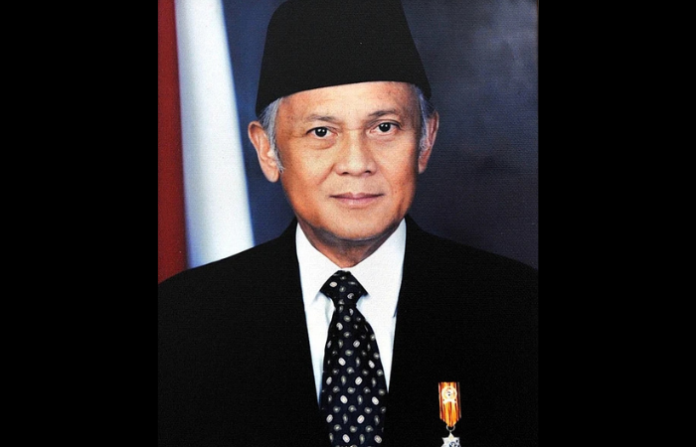

RADAR TULUNGAGUNG – The legacy of B.J. Habibie continues to shape modern Indonesia decades after he transformed the country’s aviation industry, stabilized a collapsing economy during the Asian financial crisis, and introduced sweeping democratic reforms following the fall of President Soeharto in 1998. Though his presidency lasted only 17 months, many historians regard his administration as a pivotal turning point in Indonesia’s transition toward democracy.
Known internationally as an aerospace engineer and technological visionary, Baharuddin Jusuf Habibie combined scientific expertise with political leadership during one of the most turbulent periods in Indonesian history. His contributions extended far beyond aircraft development, influencing economic recovery, press freedom, human rights, and regional governance.
Habibie’s reputation as both a technocrat and statesman has strengthened over time, with many analysts now viewing his brief presidency as one of the most consequential transitional administrations in Southeast Asia.
From Aerospace Visionary to National Innovator
Born on June 25, 1936, in Parepare, South Sulawesi, Habibie developed a strong interest in science and engineering from an early age. After pursuing higher education in Germany, he built a successful engineering career before returning to Indonesia at the request of President Soeharto.
Habibie became the driving force behind Indonesia’s ambition to master advanced technology. During the 1980s, he led the development of the national aerospace industry through Industri Pesawat Terbang Nusantara (IPTN), later known as PT Dirgantara Indonesia.
One of the company’s most notable achievements was the CN-235 aircraft, developed jointly with Spain’s CASA. The aircraft entered service with both military and civilian operators, helping establish Indonesia’s credibility in aerospace manufacturing.
The industry reached another milestone on August 10, 1995, when the N-250 “Gatotkaca” conducted its maiden flight. The aircraft was designed and engineered primarily by Indonesian experts and symbolized the country’s growing technological capabilities.
Experts have often described Habibie’s aerospace vision as a strategic effort to improve connectivity across the vast Indonesian archipelago while strengthening national sovereignty and economic development.
Economic Recovery and Democratic Reform
Habibie assumed the presidency on May 21, 1998, following the resignation of President Soeharto amid widespread protests, political unrest, and a severe economic crisis triggered by the 1997 Asian financial collapse.
Indonesia faced soaring inflation, social instability, and fears of national disintegration. Within days of taking office, Habibie formed the Reform Development Cabinet and launched measures aimed at restoring investor confidence and stabilizing the economy.
During his administration, the Indonesian rupiah strengthened significantly from crisis levels that had exceeded Rp10,000 per US dollar and at times approached Rp15,000. Economic confidence gradually returned as the government introduced reforms and strengthened financial governance.
One of Habibie’s most significant economic initiatives was granting greater independence to Bank Indonesia through legislation enacted in 1999. The move helped establish a more credible framework for monetary policy and financial stability.
At the same time, Habibie implemented many demands of the Reformasi movement. His government released political prisoners, expanded freedom of expression, and removed restrictions on the press.
He argued that a free press was essential for ensuring citizens had access to accurate information, enabling informed decision-making in a democratic society.
Human Rights, Regional Autonomy, and a Lasting Impact
Habibie’s administration also introduced important human rights measures. Following the violence that accompanied the 1998 unrest, his government supported efforts to address discrimination and protect vulnerable groups.
Among the most notable initiatives was the establishment of the National Commission on Violence Against Women (Komnas Perempuan). His administration also eliminated several regulations that discriminated against ethnic Chinese Indonesians, including the requirement for the controversial SKBRI citizenship certificate.
In the legislative arena, Habibie’s government produced dozens of laws and regulations that laid the groundwork for democratic governance. These included political party reforms, anti-monopoly legislation, and the landmark Regional Autonomy Law.
The autonomy framework helped reduce tensions in several regions by decentralizing authority and giving local governments greater control over development and administration.
One of Habibie’s most controversial decisions involved East Timor. His government allowed a United Nations-backed referendum in 1999, resulting in the territory voting for independence. East Timor later became the sovereign nation of Timor-Leste.
Although the decision generated political opposition and contributed to the rejection of his accountability speech by the People’s Consultative Assembly (MPR), many observers later viewed the move as consistent with democratic and human-rights principles.
After leaving office, Habibie remained active in public life, advising successive Indonesian presidents. He died on September 11, 2019, leaving behind a legacy that continues to influence Indonesia’s technological ambitions, democratic institutions, and national development. For many Indonesians, Habibie remains a rare example of a scientist who successfully guided a nation through a moment of historic transformation.