
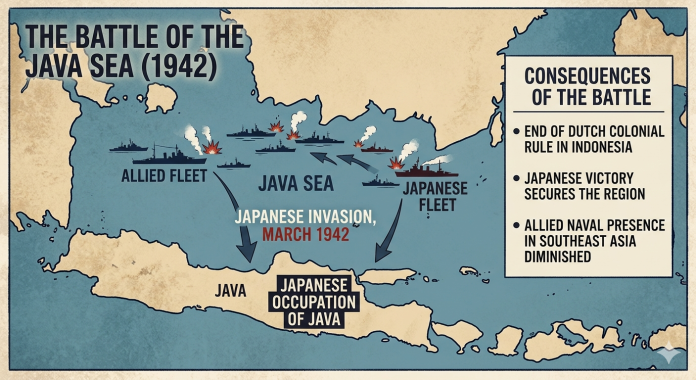

RADAR TULUNGAGUNG – The Battle of the Java Sea in February 1942 became one of the most decisive naval engagements in the Pacific theater of World War II, paving the way for Japan’s rapid conquest of Java and ultimately ending more than three centuries of Dutch colonial rule in Indonesia. The battle marked a turning point in Southeast Asian history as Allied forces failed to stop Japan’s advance toward the Dutch East Indies.
Although Indonesians were not direct participants in the global conflict, several regions across the archipelago became major battlegrounds during World War II. The Battle of the Java Sea, fought on February 27, 1942, stands out as one of the most significant military confrontations ever to occur in Indonesian waters.
Japan’s victory enabled its forces to launch a full-scale invasion of Java just days later, leading to the surrender of Dutch colonial authorities and the beginning of Japanese occupation across the archipelago.
Why Japan Targeted Java
After attacking Pearl Harbor on December 7, 1941, Japan rapidly expanded across Southeast Asia and the Pacific. Military leaders viewed the Dutch East Indies as a critical source of oil, rubber, tin, and other strategic materials.
Japanese forces first captured key locations outside Java. They seized Tarakan, Balikpapan, Manado, Kendari, Makassar, Ambon, and large parts of Sumatra. These victories isolated Java from Allied support and weakened regional defenses.
To stop the Japanese advance, Allied nations formed the American-British-Dutch-Australian Command, or ABDA Command. The multinational force established its headquarters in West Java and planned to block Japan’s movement toward Australia.
However, ABDA faced major challenges from the beginning. Poor coordination, limited resources, and inadequate preparation weakened the Allied defense effort. Japan maintained the initiative and continued advancing toward Java.
Battle of the Java Sea Ends in Disaster for Allied Forces
The decisive naval confrontation occurred on February 27, 1942, in the Java Sea northwest of Surabaya. Allied naval forces under Dutch Rear Admiral Karel Doorman attempted to intercept a Japanese invasion convoy approaching Java.
The Allied fleet consisted of cruisers and destroyers from the Netherlands, the United States, the United Kingdom, and Australia. Opposing them was a Japanese fleet commanded by Takeo Takagi.
Historians generally regard the Battle of the Java Sea as one of the largest surface naval engagements of World War II. During the lengthy engagement, Japanese naval forces benefited from superior coordination, effective long-range torpedoes, and greater operational readiness.
A series of setbacks weakened the Allied fleet. The British destroyer HMS Electra was sunk, Dutch destroyer HNLMS Kortenaer was destroyed by a torpedo, and cruiser HMS Exeter suffered severe damage. Late in the battle, Japanese torpedoes struck the Dutch cruisers HNLMS De Ruyter and HNLMS Java.
Admiral Doorman went down with De Ruyter, becoming one of the battle’s most notable casualties. Approximately 2,300 Allied sailors were killed during the engagement and related actions, while the Allies lost multiple cruisers and destroyers. Japanese losses were comparatively light.
Japanese Invasion Leads to the Fall of the Dutch East Indies
The naval defeat left Java exposed. On March 1, 1942, roughly 40,000 Japanese troops landed at multiple locations, including Banten Bay in western Java, Eretan Wetan in West Java, and Kragan in Central Java.
Japanese forces advanced quickly toward key administrative and military centers. Troops under Lieutenant General Hitoshi Imamura captured strategic positions and pushed toward Bandung, where Allied command structures were concentrated.
Fierce resistance occurred in several areas, including around Leuwiliang near Bogor, where Australian-led units temporarily slowed the Japanese advance. Despite these efforts, Japanese troops continued moving rapidly across the island.
On March 8, 1942, Dutch Commander-in-Chief Hein ter Poorten formally surrendered to Japanese forces at Kalijati Airfield in Subang, West Java. The surrender ended organized Dutch military resistance in the colony.
The agreement marked the collapse of the Dutch East Indies administration and the beginning of Japanese rule in Indonesia, which lasted until Japan’s surrender in August 1945.
The Battle of the Java Sea remains one of the most consequential military engagements in Indonesian history. Beyond its military significance, the battle directly contributed to the fall of Dutch colonial authority and reshaped the political landscape that would eventually lead to Indonesia’s declaration of independence in 1945.