
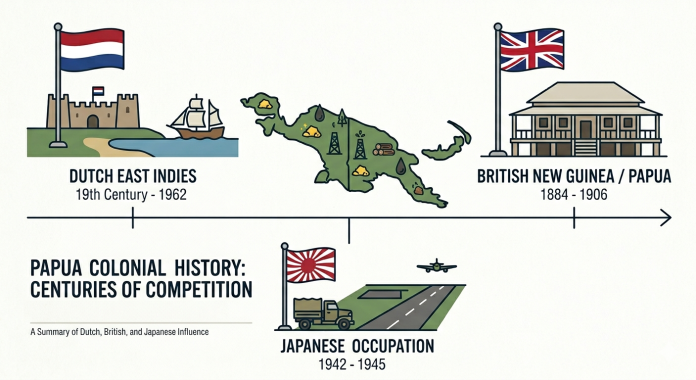

RADAR TULUNGAGUNG – Papua colonial history reveals a centuries-long struggle over one of the world’s most resource-rich regions. Long before modern debates about Papua emerged, foreign empires, colonial administrations, and wartime occupiers competed for influence over the territory, drawn by its strategic location and abundant natural wealth.
Known today for its vast mineral reserves, biodiversity, and globally renowned tourism destinations such as Raja Ampat, Papua has experienced a complex history shaped by external intervention and local resistance. Historical records show that the region became a target for traders, explorers, and colonial powers seeking access to resources and strategic maritime routes.
The story of Papua extends far beyond its natural beauty. It encompasses shifting political alliances, colonial ambitions, wartime occupations, and persistent efforts by local communities to defend their homeland against foreign domination.
Historical Ties Between Papua and the Tidore Sultanate
One of the earliest political connections linking Papua to the wider Indonesian archipelago involved the Tidore Sultanate in present-day North Maluku. Historical traditions preserved in local narratives describe longstanding relationships between Papuan communities and Tidore, including trade, political cooperation, and maritime alliances.
Several historians note that portions of Papua were influenced by regional kingdoms and trading networks long before the arrival of European colonial powers. While some historical claims regarding direct control remain debated among scholars, Tidore exercised varying degrees of influence over parts of Papua, particularly coastal areas connected to regional trade routes.
European explorers eventually arrived in the region during the Age of Exploration. Spanish and Portuguese navigators reached New Guinea, while later Dutch, British, and German interests expanded into the area. The name “New Guinea” emerged from European observations that the Indigenous population’s physical appearance resembled that of people living in the Guinea region of Africa.
Papua’s rich natural resources and strategic location quickly attracted growing international attention, transforming the territory into a focal point of colonial competition.
Dutch Expansion and the Division of New Guinea
During the nineteenth century, colonial rivalry intensified. Britain and the Netherlands both sought to establish influence in New Guinea, while Germany expanded its presence in the northeastern section of the island.
The Dutch formally strengthened their claims over western New Guinea beginning in the 1820s, although effective control remained limited for decades due to disease, logistical challenges, and resistance from local communities. Malaria outbreaks repeatedly undermined early colonial settlements and military outposts.
A series of agreements among European powers eventually divided New Guinea into separate colonial territories. The western half became Dutch New Guinea, while Britain controlled southeastern areas centered around Port Moresby. Germany administered the northeastern region.
By the early twentieth century, the Dutch expanded administrative centers in locations such as Manokwari, Fakfak, and Merauke. Colonial authorities promoted economic development projects involving agriculture, forestry, fisheries, and resource extraction. However, these initiatives primarily served colonial interests, with limited benefits reaching much of the Indigenous population.
Japanese Occupation and Papuan Resistance During World War II
The outbreak of World War II dramatically altered Papua’s political landscape. Following Japan’s rapid military advances across Southeast Asia, Japanese forces launched operations against Dutch positions in New Guinea in early 1942.
After securing control over key areas, Japan developed military infrastructure including airfields, roads, and coastal facilities. Strategic locations such as Sarmi became important bases supporting Japanese operations in the Pacific theater.
As occurred elsewhere in occupied territories, many Papuans were subjected to forced labor. The occupation generated widespread hardship, leading to growing resistance among local communities.
One of the most significant episodes occurred in Biak, where Papuan resistance movements emerged against Japanese forces. Allied offensives later intensified across the region. During the 1944 Biak campaign, Allied troops, supported by local intelligence and assistance from Papuan communities, launched major operations that weakened Japanese defenses.
Additional battles followed in areas including Numfor, Hollandia, and Sarmi. By late 1944, Allied forces had largely dismantled Japanese control across Papua. Thousands of Japanese troops were killed, captured, or forced to retreat as the Pacific War shifted in favor of the Allies.
The end of Japanese rule did not immediately resolve Papua’s political future. Instead, new disputes emerged regarding sovereignty and control of the territory, setting the stage for major geopolitical developments in the years that followed.
Papua colonial history remains a crucial part of understanding modern Indonesia and the broader history of colonialism in Southeast Asia. The region’s experiences under successive foreign powers highlight both the strategic value of Papua and the resilience of its people throughout centuries of external intervention.