
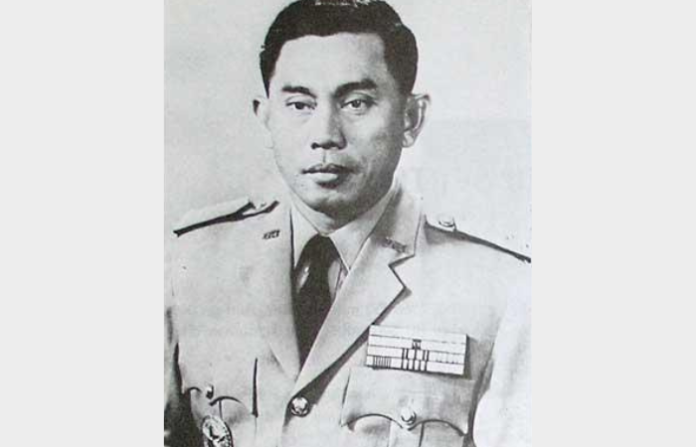

RADAR TULUNGAGUNG – Ahmad Yani’s journey from a student facing discrimination under Dutch colonial rule to becoming one of Indonesia’s most influential military leaders remains one of the country’s most significant historical stories. His rise through the ranks of the Indonesian military ultimately placed him at the center of the political tensions that shaped modern Indonesia.
In the late 1930s, Ahmad Yani pursued his education at the Algemene Middelbare School (AMS) in Bandung, one of the most prestigious secondary schools during the Dutch colonial era. Like many indigenous Indonesians of his generation, he encountered unequal treatment from sections of the colonial society, where educational opportunities often favored Europeans.
However, Ahmad Yani’s interests extended beyond academic study. Drawn to military service from a young age, he chose a different path and left AMS before completing his studies. He later enrolled in a Dutch military education program in Kalijati, West Java, where he began receiving formal military training.
From Colonial Military Training to Indonesia’s Independence Struggle
Ahmad Yani’s military education was interrupted when Japan occupied the Dutch East Indies in 1942. During the Japanese occupation, he joined PETA (Pembela Tanah Air), a military force established by Japan that trained indigenous Indonesians in military tactics and organization.
Following Indonesia’s proclamation of independence on August 17, 1945, Ahmad Yani joined the newly formed Indonesian military, which later evolved into the national armed forces. His leadership skills quickly became evident during the Indonesian National Revolution, particularly in Central Java.
One of his most notable achievements came during the struggle to defend Magelang against Dutch military operations. His successful efforts to secure the area earned him recognition among fellow officers and strengthened his reputation as a capable field commander.
As Indonesia faced internal security challenges in the 1950s, Ahmad Yani played important roles in military operations against the Darul Islam rebellion and regional uprisings, including the PRRI movement in Sumatra. These campaigns significantly elevated his standing within the armed forces.
His military successes eventually led to his appointment as Chief of Staff of the Indonesian Army in 1962, succeeding General Abdul Haris Nasution in the position’s highest operational role within the Army.
Ahmad Yani’s Growing Influence During the Sukarno Era
As Army Chief, Ahmad Yani became one of the most influential figures in President Sukarno’s government. His position brought him into frequent contact with the president, and he often attended high-level discussions concerning national security and political affairs.
During the early 1960s, Indonesia experienced increasing political competition among nationalist, religious, and communist groups. Sukarno promoted the concept of Nasakom, an acronym for Nasionalisme, Agama, and Komunisme—as a framework for maintaining national unity.
Despite supporting Sukarno’s leadership, Ahmad Yani remained firmly opposed to expanding communist influence within the military. Alongside other senior Army officers, he rejected proposals supported by PKI leaders to create a so-called “Fifth Force,” which would have armed workers and peasants outside the regular military structure.
This disagreement marked a growing divide between the Army leadership and PKI figures, contributing to the tense political atmosphere that dominated Indonesia in the years leading up to 1965.
The Crisis of 1965 and Ahmad Yani’s Legacy
Political tensions reached a critical point in 1965 as accusations and counteraccusations circulated between military leaders and PKI figures. Rumors concerning the existence of a “Council of Generals” allegedly plotting against President Sukarno became a major topic of public discussion.
The situation culminated in the events of September 30 and October 1, 1965, when a group of military personnel launched an operation that targeted several senior Army officers. Ahmad Yani was among the officers killed during the incident, which later became known as the G30S movement.
His death transformed him into one of Indonesia’s most prominent national military figures. The government later recognized Ahmad Yani as a National Hero for his contributions to the country’s independence, security, and military development.
Today, Ahmad Yani remains an important figure in Indonesian history, remembered for his role in defending the young republic, leading the Army during a turbulent political era, and standing at the center of one of the nation’s most consequential historical turning points.