
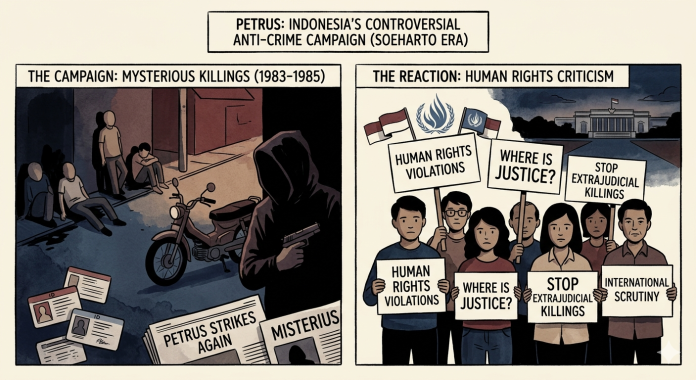

RADAR TULUNGAGUNG – The Petrus killings became one of Indonesia’s most controversial anti-crime operations during the New Order era after hundreds of alleged criminals died in mysterious shootings between 1983 and 1985. The campaign reduced crime rates in several cities, but it also triggered accusations of extrajudicial executions and serious human rights abuses under President Soeharto’s government.
Indonesia experienced rapid economic growth and urban expansion during the late 1970s and early 1980s. Thousands of people moved from rural regions to major cities such as Jakarta, Yogyakarta, and Semarang in search of jobs and better living conditions. Many newcomers struggled to find work, and violent crime soon increased in urban areas.
The government responded with a tougher security strategy. Soon afterward, residents across Java began discovering bodies of suspected gang members and street criminals in public spaces. Most victims showed gunshot wounds and signs of violence, creating fear throughout Indonesian society.
Origins of the Petrus Killings During the New Order Era
The Petrus killings emerged during the consolidation of power under President Soeharto after the political turmoil of 1965 and 1966. Following the Supersemar decree on March 11, 1966, Soeharto strengthened the New Order government and prioritized political stability and national security.
By the early 1980s, violent crime had become a major public issue in Indonesia’s largest cities. During an ABRI leadership meeting in March 1982, Soeharto ordered security forces to take stronger action against criminal groups. Officials later held meetings in Jakarta and launched “Operation Celurit,” which later evolved into the Petrus crackdown.
Reports from Yogyakarta identified one of the earliest victims as Wahyono, a local gang leader who died shortly after authorities warned criminals to surrender. His death shocked criminal networks and marked the start of a broader wave of mysterious shootings across Central Java, East Java, and Jakarta.
Witnesses frequently found bodies near roads, markets, and empty fields. Many victims carried three gunshot wounds and marks around their necks that suggested strangulation. In several cases, perpetrators reportedly left Rp10,000 to Rp20,000 near the bodies to help cover burial expenses.
Rising Death Toll and Survivor Testimonies
Data cited in historical records showed the scale of the operation. In 1983 alone, at least 503 deaths were reportedly linked to the Petrus killings. The figure later declined to 107 in 1984 and 74 in 1985, suggesting that the campaign significantly reduced violent crime rates in several cities.
One of the most widely discussed survivor testimonies came from Bati Mulyono, a Central Java gang leader who claimed he became a Petrus target in 1983. According to his account, unidentified gunmen opened fire on his vehicle in Semarang, forcing him into hiding.
Bati later described witnessing a horrifying execution while traveling in a pickup truck in Central Java. He claimed several sacks loaded onto the vehicle contained living people who were later shot by armed men on the roadside. His testimony became one of the most chilling narratives associated with the operation and highlighted the climate of fear surrounding the anti-crime campaign.
Historians and rights groups have since debated the credibility and extent of such accounts, but survivor stories helped reinforce allegations that the killings involved systematic extrajudicial actions.
Human Rights Criticism and Soeharto’s Response
The Petrus killings quickly sparked domestic and international criticism. Senior Indonesian statesman Adam Malik publicly argued that even criminals should face legal trials instead of summary executions. He warned that bypassing the rule of law could damage Indonesia’s legal system.
However, not all officials opposed the operation. Amir Machmud, then chairman of the MPR/DPR, reportedly supported the shootings as a necessary measure to protect public security during a period of rising crime.
International pressure intensified after Amnesty International questioned the Indonesian government over alleged human rights violations. Indonesian authorities largely dismissed the criticism at the time, arguing that public order and national stability were the greater priority.
Years later, Soeharto indirectly acknowledged the operation in his 1989 autobiography. He defended the use of “firm measures” against criminals, arguing that violent crime had exceeded humanitarian limits and required decisive action.
The Petrus killings officially ended in 1985, but the controversy surrounding the operation has never fully disappeared. Human rights advocates continue to classify the shootings as one of Indonesia’s major unresolved human rights abuses, while historians remain divided over whether the campaign represented a brutal necessity or a grave violation of the rule of law.