
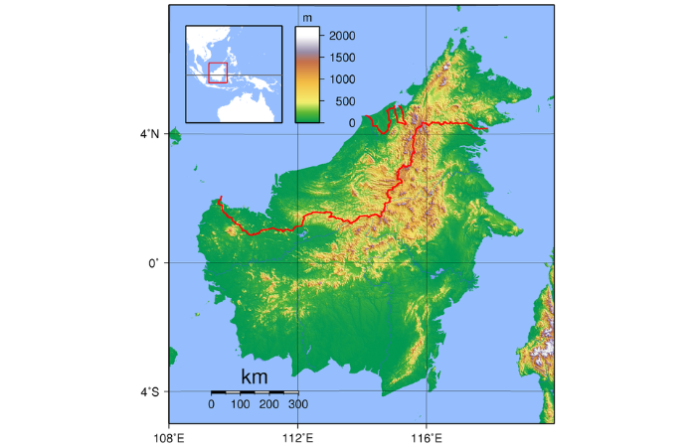

RADAR TULUNGAGUNG – Borneo, the world’s third-largest island, remains one of the only islands on Earth politically divided among three countries: Indonesia, Malaysia, and Brunei Darussalam. The island’s unusual borders emerged after centuries of regional kingdoms, European colonialism, and postwar independence movements in Southeast Asia.
Indonesia today controls most of the island through the Kalimantan region, while Malaysia governs the northern territories of Sabah and Sarawak. Brunei Darussalam, despite its small territory, survives as an independent monarchy on the island’s northern coast.
The modern political map of Borneo was shaped by the rivalry between the British and Dutch empires, the decline of the Brunei Sultanate, and the formation of modern Southeast Asian states during the 20th century.
The Origins of Borneo and the Rise of Brunei
Borneo ranks as the third-largest island in the world after Greenland and New Guinea. Indonesians commonly call the island “Kalimantan,” while most international maps and historical records use the name “Borneo.”
Historians link the word “Borneo” to Brunei, one of the island’s oldest political powers. Portuguese traders who arrived in Southeast Asia during the 16th century likely altered the pronunciation of “Brunei” into “Borneo” while recording regional trade routes and maps.
Long before European colonialism began, the Brunei Sultanate controlled large parts of northern Borneo and developed into a major trading power. Merchants from China, the Middle East, and other Southeast Asian kingdoms traded through Brunei’s ports between the 15th and 17th centuries.
At the same time, other regional powers also competed for influence across the island. The Majapahit Empire from Java expanded its authority into several coastal areas of Borneo during the 14th century and strengthened trade connections across the archipelago.
European Colonialism Divided the Island
The political division of Borneo began during the colonial era as European powers competed for trade and territory across Southeast Asia.
The Dutch gradually expanded their control over southern Borneo through the Dutch East Indies, while the British strengthened their influence in northern regions including Sarawak, Sabah, and Brunei.
Sarawak itself became a British protectorate under the rule of the Brooke dynasty, often called the “White Rajahs,” beginning in the 19th century. During this period, Brunei lost much of its historic territory and was eventually reduced to the small state recognized today.
By the early 20th century, most of Borneo had effectively been divided between two colonial powers: Britain in the north and the Netherlands in the south.
During World War II, Japan occupied the entire island from 1941 until 1945 after defeating British and Dutch colonial forces. However, following Japan’s surrender, British and Dutch authorities temporarily returned to reclaim their former territories.
Independence Reshaped Modern Borneo
Indonesia declared independence in 1945, although Dutch recognition came later after several years of diplomatic conflict and armed struggle. Former Dutch-controlled territories in southern Borneo eventually became part of the Republic of Indonesia.
Meanwhile, Britain reorganized its Southeast Asian territories after World War II. The Federation of Malaya gained independence in 1957 before later forming Malaysia in 1963 together with Sabah and Sarawak in northern Borneo.
Brunei considered joining the federation but ultimately chose not to become part of Malaysia. Political differences, economic considerations, and Brunei’s desire to maintain its monarchy contributed to the decision.
Instead, Brunei remained under British protection for two more decades before officially gaining full independence on January 1, 1984.
Today, Indonesia controls approximately 73 percent of Borneo, Malaysia about 26 percent, and Brunei less than one percent. Despite its small size, Brunei successfully maintained its sovereignty while neighboring territories joined larger political unions.
The history of Borneo reflects centuries of trade, colonial rivalry, and independence movements that transformed one island into territory shared by three modern nations.