
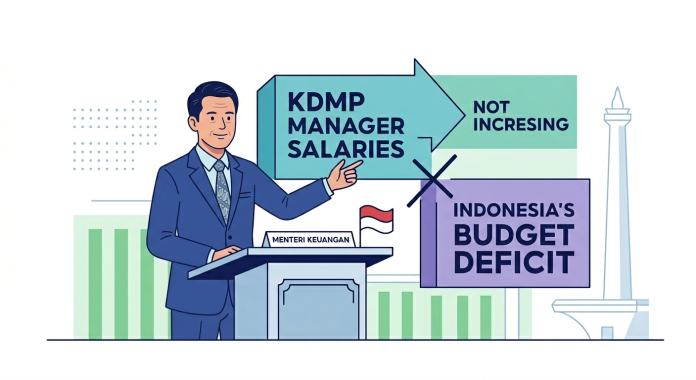

RADAR TULUNGAGUNG – The Indonesian government confirmed that salaries for managers of the Merah Putih Village Cooperatives program (KDMP) will not increase the state budget deficit. The statement aims to calm public concerns over the financial impact of the nationwide village cooperative initiative.
Finance Minister Purbaya Yudhi Sadewa explained that the government will pay managers of the Merah Putih Village Cooperatives in stages over the next two years. He stressed that the state will use existing allocations instead of adding new spending to the State Budget (APBN).
Public attention toward the Merah Putih Village Cooperatives program has continued to rise in recent months. The government promotes the initiative as a major strategy to strengthen village economies, create jobs, and improve food distribution systems across Indonesia.
Government Uses Existing Budget Allocation
Purbaya said the government already prepared funding for manager salaries through the village cooperative budget post. Officials found that part of the allocation remained unused, allowing the government to redirect the funds for managerial payments.
He emphasized that the state does not need to create a new budget allocation for the program.
“The budget already exists. Some cooperative funds remain unused, so we can utilize them first,” he said.
The explanation became important after several groups questioned the fiscal impact of paying thousands of managers across the country. Some analysts worried the ambitious cooperative program could widen Indonesia’s budget deficit.
However, the government insisted that the financing mechanism would not burden state finances.
Himbara Financing Still Has Large Capacity
The government also highlighted support from Himpunan Bank Milik Negara (Himbara), the association of Indonesia’s state-owned banks.
Earlier, the government secured a Rp40 trillion financing ceiling from Himbara to support Merah Putih Village Cooperatives operations and village business development programs.
Purbaya explained that the program has not absorbed the entire financing facility. Because the funding usage remains below the maximum ceiling, the government still has room to optimize the available financing for operational needs, including management support.
He added that repayment cycles and financing flows could continue supporting cooperative activities without creating new fiscal pressure.
“The Rp40 trillion facility has not been fully used, so financing capacity remains available,” he stated.
Through this mechanism, the government hopes to maintain fiscal discipline while keeping the village cooperative program running smoothly.
Merah Putih Village Cooperatives Become Key Rural Economic Program
The Merah Putih Village Cooperatives initiative has become one of the government’s flagship economic programs for rural development.
Through the program, the administration wants villages to build stronger cooperatives that can manage agricultural products, logistics, food distribution, and other local business sectors.
Officials believe professional managers will help cooperatives operate more effectively and transparently. For that reason, the government plans to implement structured salary schemes for managers across Indonesia.
Supporters of the program argue that Merah Putih Village Cooperatives can strengthen village economies and reduce dependence on middlemen in agricultural supply chains.
The initiative could also create new jobs in rural areas and encourage faster local economic growth.
Public Monitoring Likely to Continue
Even though the government has provided clarification, public scrutiny over the financing structure will likely continue.
Several observers have urged the government to maintain transparency and accountability throughout the implementation process. They warned that large-scale programs involving state funds and banking support require strong supervision.
Critics also questioned how authorities would monitor financing flows and cooperative performance in thousands of participating villages.
Despite those concerns, the government remains confident that the program can operate without disrupting Indonesia’s fiscal stability.
Purbaya repeated that the administration had carefully calculated the financing structure and would not expand the state budget deficit to support manager salaries.
The government now hopes the public will view the Merah Putih Village Cooperatives program as a long-term strategy to strengthen rural economies while maintaining responsible fiscal management.
As implementation continues, many observers will focus on funding absorption, cooperative performance, and accountability in villages participating in the program.