
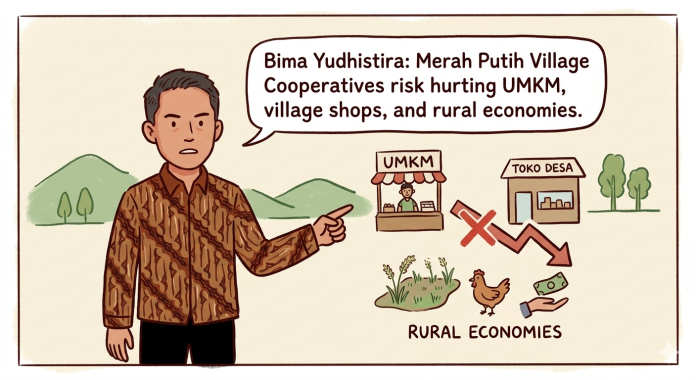

RADAR TULUNGAGUNG – Economic analyst Bima Yudhistira sharply criticized the government’s Merah Putih Village Cooperatives program, arguing that the policy design is fundamentally flawed and risks damaging village economies across Indonesia.
During a public discussion, Bima Yudhistira said Merah Putih Village Cooperatives had “failed from the very beginning” because the concept ignores the true principles of a cooperative system. He warned that the program could create direct competition with small businesses while burdening villages with long-term financial obligations.
The criticism surrounding Merah Putih Village Cooperatives has intensified as the government accelerates the formation of cooperatives in thousands of villages nationwide. According to Bima Yudhistira, the policy resembles a state-controlled retail project instead of a community-driven cooperative movement.
Bima Yudhistira Questions Cooperative Concept
Bima explained that successful cooperatives in countries such as Singapore and the United Kingdom grew organically through public participation, not through government intervention.
He pointed to Singapore’s NTUC supermarket network, which labor unions own and operate as a cooperative competing against major capitalist businesses. In his view, that model proves cooperatives can become a strong economic alternative when members manage them independently.
“What is happening now is not a cooperative in the real sense,” Bima said.
He criticized the recruitment process behind Merah Putih Village Cooperatives, which reportedly involves government officials and large-scale staffing arrangements. According to him, cooperatives should grow through voluntary membership instead of top-down instructions from the state.
Bima argued that the current structure makes the program look more like a state-run retail chain than a genuine cooperative institution.
Risk of Hurting UMKM and Village Shops
One of Bima Yudhistira’s biggest concerns involves the impact of Merah Putih Village Cooperatives on small traders and village-owned businesses.
He warned that traditional shops, UMKM players, and neighborhood stalls could lose customers because the cooperative network plans to distribute subsidized products such as cooking oil, fertilizer, and other necessities.
According to Bima, small businesses will struggle to compete if the cooperatives receive special pricing and supply access from state-linked distributors.
“This creates cannibalism in the village economy,” he explained.
Bima fears the situation could trigger social conflict among lower-income communities because traders would directly compete for the same shrinking market.
Instead of operating as retail competitors, he suggested cooperatives should focus on becoming aggregators for local products. Under this concept, cooperatives would help farmers and craftsmen connect with larger buyers and broader distribution networks.
Farmers Still Depend on Middlemen
Bima shared his observations from a recent visit to Cianjur, where vegetable farmers reportedly still rely heavily on middlemen despite being located near government-backed food supply programs.
He questioned why local produce was not directly purchased by community kitchens and food distribution programs. According to him, this shows that the real problem lies in distribution systems rather than the absence of village cooperatives.
“The middleman system should transform into a cooperative structure,” Bima said.
He emphasized that cooperatives should strengthen production and distribution chains instead of competing with small retailers at the grassroots level.
Village Funds Feared to Be at Risk
Bima Yudhistira also highlighted concerns over the financing scheme connected to Merah Putih Village Cooperatives.
He warned that loans from state-owned banks could eventually become a burden on village budgets. If cooperatives fail to generate sufficient revenue, repayment obligations may force villages to reduce spending on infrastructure and public services.
According to him, some areas have already experienced budget reallocations connected to the cooperative program.
Bima also criticized procurement decisions that he considered disconnected from actual village needs. He cited examples of expensive vehicle purchases even though many farming communities only require basic transport vehicles such as pickup trucks for agricultural logistics.
“This does not match real conditions in the field,” he said.
Cooperative System Still Relevant for Indonesia
Despite criticizing Merah Putih Village Cooperatives, Bima stressed that cooperatives remain highly relevant for Indonesia’s economy.
He mentioned the emergence of housing cooperatives among young Indonesians as proof that modern cooperative models can still address major social problems such as expensive housing and land speculation.
Bima also noted that several publishing businesses and creative enterprises currently operate successfully using cooperative systems.
According to him, cooperatives can become an effective counterbalance against overly liberal economic systems if they are built through genuine community participation.
Drawing from his experience while studying in the United Kingdom, Bima explained that cooperative membership abroad is voluntary and directly tied to consumer participation. Members can even receive annual profit-sharing benefits from the businesses they support.
Villages Begin Searching for New Solutions
As concerns continue growing, several village officials are reportedly exploring alternative ways to manage the cooperative program.
Bima said some local governments are considering merging Merah Putih Village Cooperatives facilities with existing village-owned enterprises to avoid future financial and legal problems.
He warned that village leaders fear being blamed if the project eventually fails and causes state financial losses.
For Bima Yudhistira, the solution is simple: village communities must receive full autonomy to manage cooperatives democratically and independently.
However, he remains pessimistic that Merah Putih Village Cooperatives can succeed if the current policy model continues unchanged while public purchasing power weakens across Indonesia.