
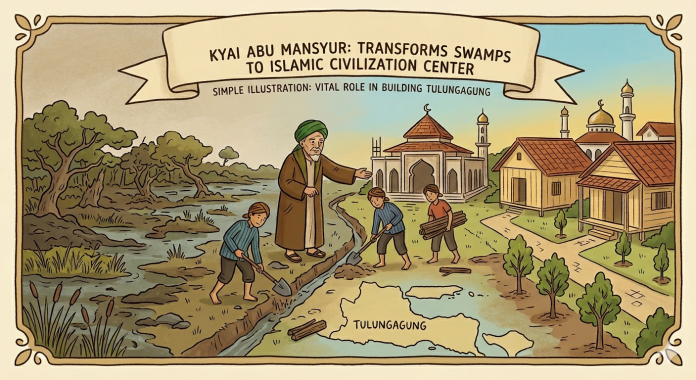

RADAR TULUNGAGUNG – Kyai Abu Mansyur remains one of the most influential figures in the history of Tulungagung. Historical narratives from Tawangsari describe him as a religious scholar from the Mataram royal family who transformed a swamp-filled region into the center of Tulungagung civilization.
The story of Kyai Abu Mansyur continues to attract attention because historians link him directly to the early development of Tawangsari. Residents know him by several names, including Raden Mas Qosim and Raden Mastolo. Historical records describe him as a central figure who spread Islam, organized settlements, and built waterways that shaped modern Tulungagung.
Many cultural observers also connect Kyai Abu Mansyur with the rise of Islamic influence in southern East Java. His legacy still survives through traditions, historical sites, and oral stories that local communities preserve today.
A Prince From the Mataram Kingdom
Historical manuscripts state that Kyai Abu Mansyur was the eighth son of Amangkurat IV, ruler of the Islamic Mataram Kingdom centered in Kartasura. His mother reportedly came from the Kudus nobility, making him part of two major Javanese bloodlines.
Although born as a prince, Kyai Abu Mansyur did not focus on royal power. Instead, he chose the path of Islamic preaching and spiritual education. Several manuscripts mention that he studied Islamic teachings in the Arabian Peninsula, including Mecca and other Middle Eastern regions, before eventually settling in Java.
His title “Abu Mansyur” is believed to indicate his status as a respected Sufi scholar. Historians also associate him with Tegalsari Islamic boarding school, one of the most influential pesantren centers in East Java during the Mataram era.
The Figure Behind Tulungagung’s Birth
The most fascinating part of Kyai Abu Mansyur’s history is his role in establishing Tulungagung. Long before the regency officially existed, Tawangsari had already become an important settlement area.
Ancient records describe the region as a vast swamp surrounded by water sources. Kyai Abu Mansyur reportedly led efforts to dry the wetlands and organize several small territories into one administrative center.
According to local oral history, he arranged river flows from the main springs toward Ngrowo and selected the area near today’s town square as the center of government. The pendopo, mosque, and prison were all strategically positioned under his guidance.
The origin of the name Tulungagung is also tied to the massive springs found in the area. In Javanese tradition, “Tulung” refers to a water source, while “Agung” means large or grand.
Mystical Process and Local Legends
The transformation of the swamp into habitable land is surrounded by mystical stories that still live among residents. Folklore mentions supernatural figures such as Jigang Joyo and Slontang Joyo helping seal the springs.
Several symbolic elements were also involved in the process, including white buffaloes, sacred banyan trees from Mataram, and heirlooms believed to possess spiritual power.
Cultural observers say these stories reflect the blend of spirituality, environmental engineering, and Javanese philosophy during the Mataram period. The process reportedly took years before the land became suitable for settlement.
Legacy Still Preserved Today
Many traces of Kyai Abu Mansyur’s influence remain visible in Tawangsari. Historical structures such as the mosque, gate complex, pendopo, and royal cemetery continue to stand as reminders of the region’s Islamic heritage.
The architecture strongly resembles old Mataram and Surakarta designs, reinforcing claims about his royal background. Residents also continue traditions such as ratib recitations, pilgrimage rituals, and pencak silat practices believed to originate from his teachings.
One unique feature is the symbolic placement of trees around the complex. Every plant carries philosophical meaning related to humility, sincerity, and remembrance of God.
Local historians believe Tawangsari was intentionally designed as a spiritual center where every structure reminded people about Islamic values and devotion.
The Mystery of His Burial Site
Despite his major influence, the location of Kyai Abu Mansyur’s actual grave remains a mystery. Some historical accounts claim he died while performing the hajj pilgrimage in Mecca and was buried there.
However, several sacred tombs inside the Tawangsari complex are still associated with his family and descendants. The secrecy surrounding the burial site has only increased public curiosity over the years.
For many residents, Kyai Abu Mansyur is more than a historical figure. He represents the spiritual foundation of Tulungagung and the symbol of how Islamic civilization once shaped the region from the heart of ancient Java.