
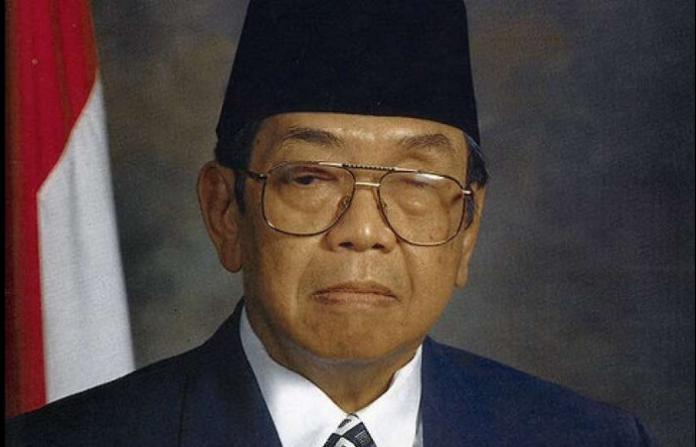

RADAR TULUNGAGUNG – Abdurrahman Wahid biography offers a compelling story of a leader who shaped Indonesia’s reform era with bold ideas, controversy, and an unwavering commitment to pluralism. Known widely as Gus Dur, Indonesia’s fourth president remains one of the most influential and debated figures in the nation’s modern history.
Born on September 7, 1940, in Jombang, East Java, Abdurrahman Wahid came from a prominent Islamic family. His father, KH Wahid Hasyim, was a key religious figure, while his grandfather, KH Hasyim Asy’ari, founded Nahdlatul Ulama (NU), the country’s largest Islamic organization. This strong background placed Gus Dur at the intersection of religion, education, and politics from an early age.
From childhood, Gus Dur showed an extraordinary passion for reading. He spent countless hours in libraries, devouring books on philosophy, history, and literature far beyond his age level. However, he was not a typical bookish child. He was active, mischievous, and loved playing football, reflecting a dynamic personality that would later define his leadership style.
Early Life and Education Journey
Gus Dur’s education journey was unconventional. He attended schools in Jakarta but often felt disconnected from his peers, leading him to skip classes and spend more time reading independently. Eventually, he continued his studies in Islamic boarding schools (pesantren), where his intellectual abilities stood out.
His academic journey took him abroad. He studied at Al-Azhar University in Cairo before moving to the University of Baghdad, where he earned a degree in Arabic literature in 1970. During his time overseas, Gus Dur also explored European culture, ideas, and philosophies, including Marxism, which broadened his worldview.
After returning to Indonesia, he became a teacher, writer, and public intellectual. His writings appeared in major publications, and he quickly gained recognition as a progressive thinker.
Rise in Nahdlatul Ulama and Politics
Gus Dur’s influence grew when he joined Nahdlatul Ulama. In 1984, he became its chairman and made a significant decision to withdraw NU from practical politics, redirecting its focus to social and religious work. This move strengthened NU’s role in Indonesian society.
Over time, Gus Dur emerged as a bridge between Islamic groups and other communities, promoting tolerance and dialogue. His reputation as a pluralist leader grew stronger, especially during the final years of the New Order regime.
Following the fall of Suharto in 1998, Indonesia entered a democratic transition. In the 1999 election, Gus Dur ran as a presidential candidate and was elected as Indonesia’s fourth president.
Presidency and Reform Policies
Gus Dur’s presidency marked a significant shift in Indonesia’s political landscape. Known for his progressive stance, he implemented several key reforms.
He lifted restrictions on Chinese cultural celebrations, officially recognizing Lunar New Year as a national holiday. He also acknowledged Confucianism as one of Indonesia’s official religions, promoting inclusivity.
In conflict regions like Aceh and Papua, Gus Dur chose dialogue over military approaches. He even allowed cultural symbols such as the Morning Star flag in Papua, signaling a softer and more humane policy direction.
Additionally, he reduced military influence in politics and abolished the Ministry of Information to promote press freedom. These policies reflected his commitment to democracy and human rights.
Controversies and Impeachment
Despite his achievements, Gus Dur’s presidency faced significant challenges. His leadership style, often seen as unpredictable, created tensions within the government. He frequently reshuffled ministers without consultation, leading to political instability.
One of the most controversial issues was his proposal to normalize relations with Israel. While he argued it would strengthen diplomacy and economic stability, the idea faced strong opposition from the public and political elites.
He was also accused in corruption scandals, including Buloggate and Bruneigate. Although these allegations were never proven in court, they weakened his political position.
The situation reached its peak on July 23, 2001, when Gus Dur issued a presidential decree to dissolve parliament. On the same day, the People’s Consultative Assembly (MPR) impeached him, ending his presidency after just 22 months in office.
Legacy of Gus Dur
After his removal, Gus Dur remained active in social and political life. He founded organizations promoting democracy, interfaith dialogue, and moderate Islam.
He passed away on December 30, 2009, at the age of 69. Despite a short and turbulent presidency, his legacy endures as a symbol of tolerance, pluralism, and courage in defending human rights.
The Abdurrahman Wahid biography ultimately reflects a leader who dared to challenge norms and envision a more inclusive Indonesia, leaving a lasting impact on the nation’s democratic journey.