
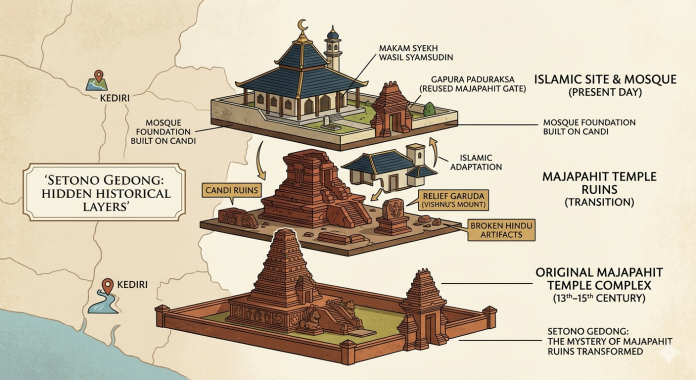

RADAR TULUNGAGUNG – Setono Gedong Temple mystery in Kediri, East Java, is drawing renewed attention after historical findings suggested the site may not originally be an Islamic complex, but rather a relic from the Majapahit era.
Located in the heart of Kediri, the site has long been known as a religious tourism destination centered around Islamic graves. However, new interpretations based on historical records and field observations point to a different origin, one rooted in the classical Hindu-Buddhist period of Java.
The Setono Gedong Temple mystery gained traction from notes by British historian Thomas Stamford Raffles in the early 19th century. During his tenure in Java, Raffles documented widespread temple destruction in Kediri, describing it as unusually massive compared to other regions.
Raffles’ Testimony on Massive Destruction
In his seminal work History of Java (1817), Raffles recorded that Kediri was once filled with classical artifacts, including temple ruins, statues, and inscriptions. However, by the time he visited, most of these relics had been destroyed.
He noted that the scale of destruction could only have been achieved through a large and organized mobilization of people and resources. This observation has become a key reference in understanding the Setono Gedong Temple mystery.
Raffles also described a sacred Muslim site called Astana Gedong, built using stones believed to originate from ancient temples. Local residents at the time reportedly acknowledged that the materials came from “ancient people” or pre-Islamic civilizations.
Traces of Majapahit Architecture
Recent on-site examinations reveal strong indications that Setono Gedong was once a temple. The structure’s base resembles a typical temple foundation, complete with stone joints, locks, and carvings.
Artifacts such as padmasana (lotus throne), Garuda carvings, and geometric decorations consistent with Majapahit architecture have been identified. These elements are commonly associated with Hindu-Buddhist worship, particularly linked to the deity Vishnu.
A significant discovery further strengthens this claim: a human relief sculpture depicting a meditating figure. Such imagery is not typically found in Islamic architecture, reinforcing the theory that the site predates Islamic influence.
Transformation Into a Religious Site
Over time, the site appears to have undergone functional and narrative transformation. The structure, once a temple, is believed to have been repurposed into a sacred Islamic complex.
Local myths also contributed to this shift. One popular story claims the site is a “Tiban Mosque,” a structure said to have been miraculously built overnight by a saint. However, historical records from Raffles’ era do not mention such narratives, suggesting they emerged later.
The presence of Islamic graves, including one attributed to Sheikh Al Wasil Syamsuddin, further solidified the site’s identity as a religious destination. Yet, historians argue that these claims rely heavily on secondary sources and oral traditions rather than primary evidence.
Historical Conflict and Cultural Shift
Some historians link the destruction of temples in Kediri to the military expansion of the Demak Sultanate in the 16th century. Historical accounts describe conflicts between Islamic forces and the Daha Kingdom, believed to be centered in present-day Kediri.
This period marked a major cultural and religious transition in Java, potentially explaining the widespread alteration of classical sites.
Preservation Concerns in Modern Era
Today, the Setono Gedong Temple mystery is not only about its past but also its future. The site is increasingly dominated by modern religious infrastructure, including mosques and burial facilities.
Observers note the absence of signage identifying the location as a historical temple site. Instead, the area is primarily promoted as a pilgrimage destination, with little emphasis on its pre-Islamic heritage.
This has raised concerns among historians and cultural preservationists. Comparisons have been made to other sites like Kimpulan Temple in Yogyakarta, where modern development was adjusted to preserve archaeological remains.
A Call for Balanced Historical Narrative
Experts argue that acknowledging the site’s full history is essential. The Setono Gedong Temple mystery represents a layered narrative of cultural transformation, not a contradiction.
By preserving both its classical and Islamic heritage, the site could become a symbol of Indonesia’s rich and diverse past. Transparency in historical interpretation, they say, is key to fostering respect and understanding across generations.